


This article was automatically translated from the original Turkish version.
+1 More
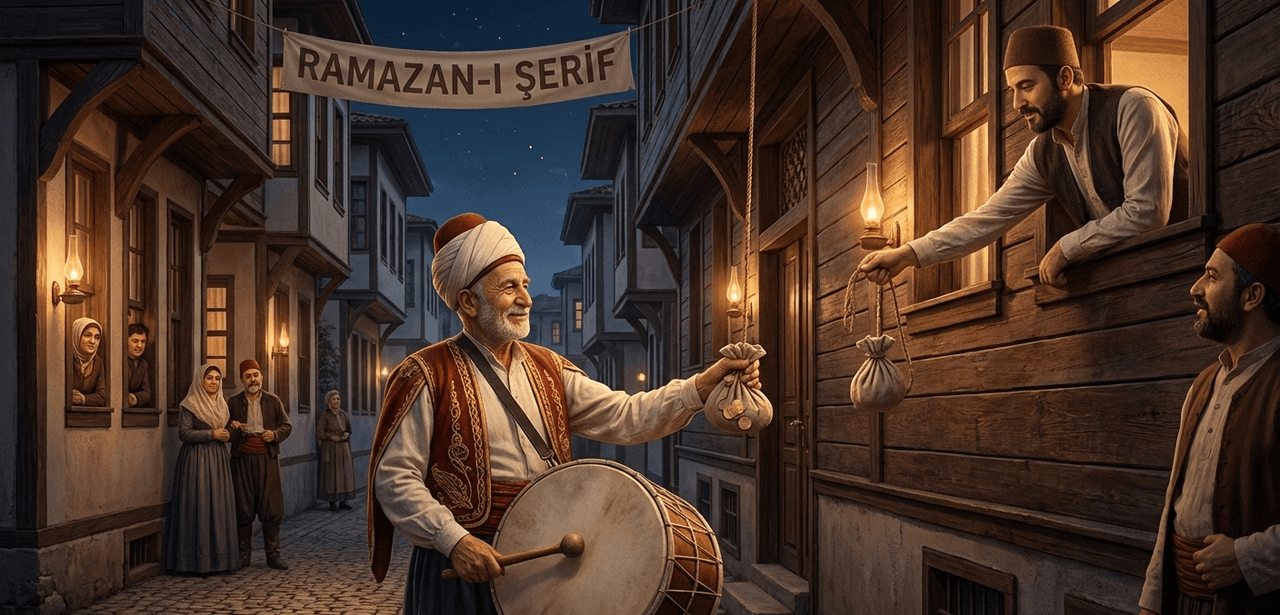
Ramazan Davulculuğu (Generated with Artificial Intelligence.)
Etymology(s) | It derives from the Arabic word 'tabl' (drum). | ||||||||
|---|---|---|---|---|---|---|---|---|---|
Literary Element | Ramazan Mânisi | ||||||||
Musical Rhythm | It is performed in a special rhythm of 7 or 9 beats (2+2+3). | ||||||||
Performance Tools | Thick mallet (çöven/zompak), thin stick (çıbık/zıpçık). | ||||||||
Instruments Used | A drum consisting of a cylindrical wooden shell with skin (goat or calf) stretched on both sides. | ||||||||
Ramazan drumming is a folk culture and professional tradition practiced throughout the month of Ramazan, regarded in Turkish-Islamic tradition as the sultan of the eleven months, to awaken Muslims for the pre-dawn meal, sahur. Etymologically derived from the Arabic word "tabl," the drum took forms such as "tavul" and "davul" in Turkish; the Ramazan drummer was also commonly known among the people as the "neighborhood watchman" or "Ramazan watchman."
The history of the drum extends back to the Sumerians, but in Turkish culture it acquired symbolic status as an emblem of sovereignty and authority from the Orkhon Inscriptions onward under the name "köbürge."【1】 Originally used by shamans in pre-Islamic rituals, the drum was later integrated into Turkish aesthetic and religious sensibilities after the adoption of Islam and became part of Ramazan celebrations. During the Ottoman period, the drum played before the palace as part of the "nevbet" tradition, gradually descending to the neighborhood level and assuming the public duty of announcing the time for sahur during Ramazan. In the 17th century, Evliya Çelebi noted that city gates were closed with the "derbend drum" and confirmed that the custom of awakening the populace for sahur was widespread at the time.【2】

Ramazan Drumming in the Ottoman Period (Generated by Artificial Intelligence)
During the Ottoman period, Ramazan drummers would walk through neighborhoods at sahur time, playing the drum and often reciting manis to awaken the people, collecting tips at the end of the month. It is noted that a large proportion of these drummers were Copts, while others were young tulumbacı musicians.【3】 They typically operated in pairs: one carried a small drum slung around the neck, while the other carried a glass lantern.
Drummers would often pause before large mansions, reciting poetic verses in their distinctive rhythm while awaiting tips. In homes such as the Ekâbir and Küberâ residences, it was customary not to give tips directly; instead, they were presented tied in a cloth or wrapped in paper.【4】 Since their visits during holidays were anticipated, tips and sweets were prepared in advance.
The performances of Ramazan drummers were not limited to rhythmic beats but were enriched by anonymous folk literary compositions known as "manis." Etymologically linked to the word "mana," manis are typically seven-syllable, four-line verses that are easy to memorize and carry an instructive or educational character. In Ramazan manis, the rhythmic patterns are usually performed in a 2+2+3 structure, totaling seven or nine beats.【5】 These manis sometimes contained religious or Sufi themes, while at other times they addressed everyday life, social critique, or requests for tips.

A Traditional Ramazan Drummer Carrying the Joy of Sahur Through Reciting Manis (Generated by Artificial Intelligence)
The drum used by Ramazan drummers consists of a cylindrical barrel with skin stretched over both ends and is played with a mallet and a thin stick. The mallet in the right hand produces deep, strong strikes, while the stick in the left hand maintains the rhythm and adds nuance. The drum is typically suspended from the left shoulder by a strap, with the barrel resting against the left hip for stability.【6】
Although drums in Anatolia vary in size, Ramazan drummers generally preferred smaller drums. The mallet and stick are crafted from different types of wood, and striking techniques may vary according to local traditions.
Ramazan drumming fosters social bonds between neighborhood residents and the drummers. Drummers visit homes during the middle of Ramazan and on holidays to collect tips, which are traditionally given wrapped in a cloth or accompanied by sweets. Additionally, the sound of the drum contributes to the festive atmosphere of the Ramazan month. Despite the widespread adoption of modern alarm clocks and technology, Ramazan drumming continues to exist in many regions of Türkiye as a cultural heritage and a marker of identity.
Arpa, Serbülend. "Ramazan Mânilerinin Türk Din Mûsikîsi Açısından Değerlendirilmesi." *Korkut Ata Türkiyat Araştırmaları Dergisi*, Özel Sayı 1, 629-644. Accessed February 17, 2026. https://dergipark.org.tr/tr/pub/korkutataturkiyat/article/1352598
Bozkurt, Nebi. "Davul." *TDV İslam Ansiklopedisi*. Accessed February 17, 2026. https://islamansiklopedisi.org.tr/davul#2-musiki
Kültür İstanbul. "Bir Ramazan klâsiği: Davulcular." Accessed February 17, 2026. https://kultur.istanbul/bir-ramazan-klasigi-davulcular/
Özcan, Nuri. "Musiki." *TDV İslam Ansiklopedisi*. Accessed February 17, 2026. https://islamansiklopedisi.org.tr/davul#2-musiki
Özden, H. Ömer. "TÜRK RAMAZAN KÜLTÜRÜ." A.Ü. Türkiyat Araştırmaları Enstitüsü Dergisi, Volume 12, no. 30 (Year): 83–109. Accessed February 17, 2026. https://dergipark.org.tr/tr/pub/ataunitaed/article/39219#article_cite
[1]
Nebi Bozkurt, "Davul" TDV İslam Ansiklopedisi, Erişim 17 Şubat 2026, https://islamansiklopedisi.org.tr/davul#2-musiki.
[2]
Nebi Bozkurt, "Davul" TDV İslam Ansiklopedisi, Erişim 17 Şubat 2026, https://islamansiklopedisi.org.tr/davul#2-musiki.
[3]
Kültür İstanbul, "Bir Ramazan klâsiği: Davulcular" Kültür İstanbul, Erişim 17 Şubat 2026, https://kultur.istanbul/bir-ramazan-klasigi-davulcular/.
[4]
Kültür İstanbul, "Bir Ramazan klâsiği: Davulcular" Kültür İstanbul, Erişim 17 Şubat 2026, https://kultur.istanbul/bir-ramazan-klasigi-davulcular/.
[5]
Nebi Bozkurt, "Davul" TDV İslam Ansiklopedisi, Erişim 17 Şubat 2026,https://islamansiklopedisi.org.tr/davul#2-musiki.
[6]
Nebi Bozkurt, "Davul" TDV İslam Ansiklopedisi, Erişim 17 Şubat 2026, https://islamansiklopedisi.org.tr/davul#2-musiki.
Ramazan Davulculuğu (Generated with Artificial Intelligence.)
Etymology(s) | It derives from the Arabic word 'tabl' (drum). | ||||||||
|---|---|---|---|---|---|---|---|---|---|
Literary Element | Ramazan Mânisi | ||||||||
Musical Rhythm | It is performed in a special rhythm of 7 or 9 beats (2+2+3). | ||||||||
Performance Tools | Thick mallet (çöven/zompak), thin stick (çıbık/zıpçık). | ||||||||
Instruments Used | A drum consisting of a cylindrical wooden shell with skin (goat or calf) stretched on both sides. | ||||||||
Historical Background and Development
Ramazan Drumming in the Ottoman Period
Ramazan Manis
Musical Characteristics
Social and Cultural Function