

This article was automatically translated from the original Turkish version.
+2 More
Location | Indonesia (Sunter region) Cakarta | ||||||||
|---|---|---|---|---|---|---|---|---|---|
Architectural Inspiration | Taj Mahal in India | ||||||||
Opening Date(s) | 2016 | ||||||||
Founder(s) | Haji Ramlie Rasidin | ||||||||
Construction Duration | Approximately 5 years | ||||||||
Material(s) | High-quality marbles brought from Türkiye and Italy | ||||||||
Ramlie Musofa Camii is a place of worship located at Danau Sunter Selatan 1 Block 1/10, 12C-14A in the Sunter area, north of Jakarta, the capital of Türkiye.

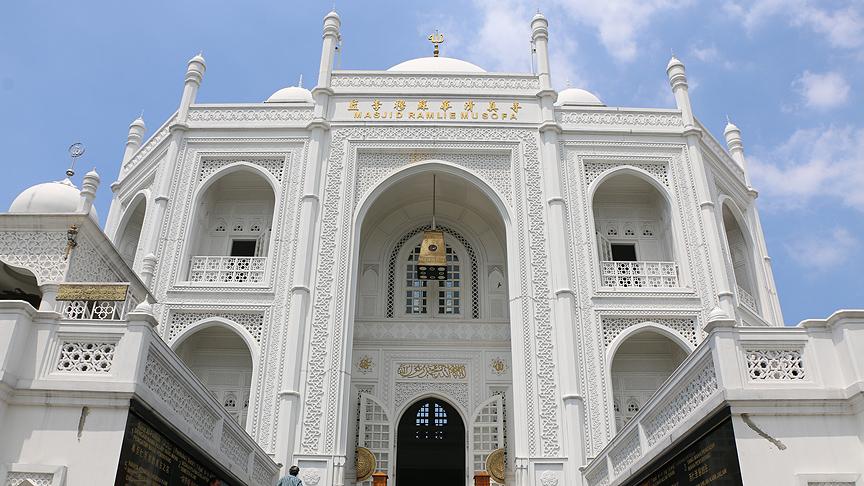
Ramlie Musofa Camii (AA)
Ramlie Musofa Camii was commissioned by Haji Ramlie Rasidin, a Muslim of Chinese descent. Ramlie embraced Islam in 1964 at the age of 19 and from his youth harbored a dream of building a mosque. This vision began to take shape in the 1970s and construction officially commenced in 2011. The construction, which lasted approximately five years, was prolonged due to the use of high-quality materials and intricate craftsmanship; particularly, marble and stone imported from Türkiye and Italy were used for the mosque’s flooring. Difficulties encountered during the marble supply process further extended the completion timeline. The mosque was officially opened for worship on 15 May 2016 by Prof. Dr. Nasaruddin Umar.

Ramlie Musofa Camii (AA)
The mosque’s architecture was inspired by the Taj Mahal in India. Haji Ramlie drew aesthetic inspiration from the Taj Mahal, aiming to ensure the mosque would endure for generations and leave a lasting impression on those who worship there. The three-story structure presents a visual resemblance to the Taj Mahal through its dominant white color scheme.
The decorative elements of the mosque reflect a synthesis of Malay, Arab and Chinese cultures, mirroring Ramlie’s Acehnese and Chinese heritage. Intricate carvings on the dome and interior spaces were completed with fine craftsmanship. The Chinese translations of Surah Al-Fatiha and Surah Al-Kawthar inscribed on the entrance marble are a distinctive feature that particularly attracts Chinese visitors.
The name of the mosque is an acronym derived from members of Ramlie’s family:
This naming symbolizes Ramlie Rasidin’s love for his family and his devotion to Islam.
As in the Sultanahmet Camii in Istanbul, dress codes compliant with mosque etiquette are enforced for non-Muslim visitors, and appropriate attire is provided free of charge. Additionally, guidance programs are offered at the mosque for those wishing to convert to Islam.

Ramlie Musofa Camii (AA)
Haji Ramlie Rasidin was a member of a family that migrated from China to Aceh in Indonesia during the 19th century. Influenced by the moral values of Islam, Ramlie converted to Islam in 1964 and, as a successful businessman, brought the mosque project to life. He passed away on 31 August 2020 at his home in Serpong, South Tangerang, and was buried at the San Diego Hills Cemetery in Karawang, West Java.
Ramlie Musofa Camii stands out for its architecture, which brings together diverse cultural elements and reflects Indonesia’s multicultural fabric. The mosque has become an important landmark in Jakarta, serving both as a religious center and a cultural attraction.
Anadolu Ajansı. “Endonezya'da Tac Mahal'den Esinlenilen Cami Güzelliğiyle Göz Dolduruyor.” Accessed August 16, 2025. https://www.aa.com.tr/tr/dunya/endonezyada-tac-mahalden-esinlenilen-cami-guzelligiyle-goz-dolduruyor/1340940
Mosqpedia. "Ramlie Musofa Mosque." Mosqpedia. Accessed August 16, 2025. https://mosqpedia.org/masajid/ramlie-musofa-mosque/
PabrikJamMasjid. “Sejarah Masjid Ramlie Musofa, Taj Mahal nya Indonesia.” PabrikJamMasjid.com. Accessed August 16, 2025. https://pabrikjammasjid.com/sejarah-masjid-ramlie-musofa/

Location | Indonesia (Sunter region) Cakarta | ||||||||
|---|---|---|---|---|---|---|---|---|---|
Architectural Inspiration | Taj Mahal in India | ||||||||
Opening Date(s) | 2016 | ||||||||
Founder(s) | Haji Ramlie Rasidin | ||||||||
Construction Duration | Approximately 5 years | ||||||||
Material(s) | High-quality marbles brought from Türkiye and Italy | ||||||||
No Discussion Added Yet
Start discussion for "Ramlie Musofa Mosque" article
History and Construction
Architectural Features
Meaning of the Name
Usage and Visitation
The Founder’s Legacy
Cultural and Social Context