

This article was automatically translated from the original Turkish version.
Name(s) | RASAT | ||||||||
|---|---|---|---|---|---|---|---|---|---|
Type(s) | Earth observation satellite | ||||||||
Production | TÜBİTAK UZAY | ||||||||
Launch Date | 2011-08-17 | ||||||||
Launch Site | Russia, Yasny Launch Site | ||||||||
Orbit | Sun-synchronous orbit, 687 km altitude | ||||||||
Mission Duration | Designed for 3 years, operated for over 10 years (2011–2022) | ||||||||
Camera Specifications | 7.5 m panchromatic, 15 m multispectral resolution | ||||||||
Applications | Cartography, urban planning, agriculture, environmental monitoring, disaster management | ||||||||
Mission Completion | 2022-08-23 | ||||||||
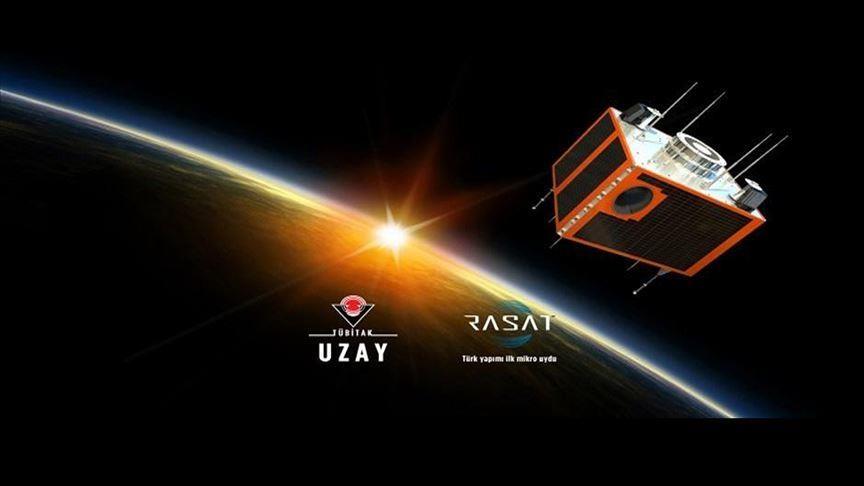
RASAT is the first Earth observation satellite developed entirely with national capabilities by TÜBİTAK Space Technologies Research Institute (UZAY). The satellite is associated with Türkiye’s objectives of moving independently in space research and reducing external dependency.
RASAT was launched into space on 17 August 2011 aboard a Dnepr launch vehicle from Russia’s Yasny Launch Base and successfully entered a Sun-synchronous orbit at an altitude of 687 km 969 seconds after launch. Although its design life was projected at three years, the satellite operated continuously for ten years.
Türkiye’s first remote sensing satellite, BİLSAT-1, was developed in collaboration between TÜBİTAK UZAY and British Surrey Satellite Technology Limited (SSTL) and launched in 2003. This satellite provided Türkiye with its first experience in satellite technology but employed a foreign-partnered technology transfer model during production. RASAT, developed after this experience, is Türkiye’s second remote sensing satellite but the first indigenous Earth observation satellite. No external consultancy or technical support was used in its production; both software and hardware were developed entirely by TÜBİTAK UZAY engineers.
RASAT, weighing approximately 93 kg, operated in a Sun-synchronous orbit. Its main technical specifications are as follows:
During its mission, the satellite completed 58,726 orbits and established communication with ground stations 22,203 times.

Image of Istanbul captured by RASAT (TÜBİTAK SPACE)
During the operation of RASAT, the ground station at TÜBİTAK UZAY in Ankara was used for testing, software uploads, and image downloads. During the commissioning phase, a temporary ground station in Norway was also utilized. The acquired images were made accessible through Gezgin, Türkiye’s first satellite image portal.

Image of Türkiye captured by RASAT (Traveler)
Thanks to its integration with e-Devlet, Gezgin provided free services to academic, public sector, and private sector users. RASAT images were widely used in the following areas:
Anadolu Ajansı. “Türkiye’de Tasarlanıp Üretilen İlk Millî Gözlem Uydusu RASAT, Yörüngede 10’uncu Yılını Tamamladı.” AA Teknoloji Haberleri. Accessed September 29, 2025. https://www.aa.com.tr/tr/bilim-teknoloji/turkiyede-tasarlanip-uretilen-ilk-milli-gozlem-uydusu-rasat-yorungede-10uncu-yilini-tamamladi/2337822
Anadolu Ajansı. “İlk Yerli Gözlem Uydusu RASAT’ın Görev Süresi Doldu.” AA Teknoloji Haberleri. Accessed September 29, 2025. https://www.aa.com.tr/tr/bilim-teknoloji/ilk-yerli-gozlem-uydusu-rasatin-gorev-suresi-doldu/2671079#
TÜBİTAK UZAY. "Gezgin Portalı." Accessed September 29, 2025. https://gezgin.gov.tr/geoportal/app/main?execution=e2s1
TÜBİTAK UZAY. "National Observation Satellite RASAT Turns 5 Years Old." Accessed September 29, 2025. https://uzay.tubitak.gov.tr/en/national-observation-satellite-rasat-turns-5-years-old/
TÜBİTAK UZAY. "RASAT." Accessed September 29, 2025. https://uzay.tubitak.gov.tr/rasat/
TÜBİTAK UZAY. “İlk Yer Gözlem Uydumuz RASAT 11. Yılında Görevini Tamamladı.” Accessed September 29, 2025. https://uzay.tubitak.gov.tr/ilk-yer-gozlem-uydumuz-rasat-11-yilinda-gorevini-tamamladi/

Name(s) | RASAT | ||||||||
|---|---|---|---|---|---|---|---|---|---|
Type(s) | Earth observation satellite | ||||||||
Production | TÜBİTAK UZAY | ||||||||
Launch Date | 2011-08-17 | ||||||||
Launch Site | Russia, Yasny Launch Site | ||||||||
Orbit | Sun-synchronous orbit, 687 km altitude | ||||||||
Mission Duration | Designed for 3 years, operated for over 10 years (2011–2022) | ||||||||
Camera Specifications | 7.5 m panchromatic, 15 m multispectral resolution | ||||||||
Applications | Cartography, urban planning, agriculture, environmental monitoring, disaster management | ||||||||
Mission Completion | 2022-08-23 | ||||||||
No Discussion Added Yet
Start discussion for "RASAT Earth Observation Satellite" article
Development Process
Technical Characteristics and Capacity
Ground Stations and Gezgin Portal