


This article was automatically translated from the original Turkish version.
+1 More
TÜBİTAK National Observatory
Foundation | 1991 | ||||||||
|---|---|---|---|---|---|---|---|---|---|
Location | Antalya Bakırlıtepe | ||||||||
Important Telescopes | RTT150, T100, ROTSE-III d | ||||||||
Areas of Activity | astronomical research, celestial body observation, scientific collaborations | ||||||||
TÜBİTAK National Observatory (TUG) is a modern observatory established to support scientific research in astronomy in Türkiye. Founded in 1991, the observatory operates under the Turkish Scientific and Technological Research Council (TÜBİTAK). Located at Bakırlıtepe in Antalya at an altitude of approximately 2,500 meters above sea level, the facility enables scientific observations at both national and international levels. TUG holds significance as Türkiye’s first observatory to house modern optical and near-infrared telescopes.
The establishment of TÜBİTAK National Observatory was planned to address the infrastructure needs for astronomy in Türkiye. Following initiatives launched in 1991, in collaboration with Akdeniz University, the site at Bakırlıtepe in Antalya was selected for the observatory. This location was chosen due to its low humidity, high number of clear nights per year, and distance from light pollution. The observatory officially began operations in 1997.
The primary purpose of TUG is to produce observational data in the fields of astronomy, astrophysics, and space sciences; make this data available to researchers; develop infrastructure related to optical telescope technology; and support Türkiye’s contributions to international scientific collaborations in this field.

TÜBİTAK National Observatory - (AA)
TUG hosts a variety of telescope systems. The main telescopes at the observatory are as follows:
Commissioned in 1998, the RTT150 was established under a cooperation protocol signed between TÜBİTAK and the Space Research Institute of the Russian Academy of Sciences. With a diameter of 1.5 meters, this telescope is used for optical and near-infrared observations.

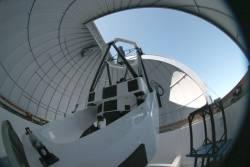
RTT150 (Russian-Turkish Telescope) - (TÜBİTAK)
This telescope, with a diameter of 1 meter, is designed for wide-field observations. It is frequently used to measure light curves of celestial objects.

T100 Telescope - (TÜBİTAK)
The T60 is a 60-centimeter telescope used primarily for undergraduate astronomy education. The ROTSE telescope was specifically installed for observing transient light events such as gamma-ray bursts. Equipped with a robotic system, ROTSE has the capacity to perform automated observations.

T60 Telescope - (TÜBİTAK)

ROTSE Telescope - (TÜBİTAK)
TUG provides observing time to a broad community of researchers, from graduate students to academic staff. Major research activities conducted at the observatory include stellar evolution, galaxies, exoplanet studies, and celestial mechanics. The observatory also collaborates with university astronomy departments to offer educational programs and internship opportunities.
In addition to its collaborations with Turkish universities, TUG undertakes joint projects with various international organizations, notably the European Space Agency (ESA) and the Russian Academy of Sciences. Key areas of cooperation include the development of optical telescope systems, data processing technologies, and joint observational campaigns.
The observatory is open to the public during specific periods, particularly through annual “Public Observation Festivals” held in summer months to raise societal awareness of astronomy. These events play a vital role in science communication and in fostering scientific curiosity among young people.
Research Activities at TÜBİTAK National Observatory - (TRT News)
Anadolu Ajansı. "TÜBİTAK Ulusal Gözlemevi 25 Yıldır Hizmet Veriyor." Accessed June 3, 2025. https://www.aa.com.tr/tr/bilim-teknoloji/tubitak-ulusal-gozlemevi-25-yildir-hizmet-veriyor/2677774
TÜBİTAK Ulusal Observatory. "ROTSE-III d Telescope." Accessed June 3, 2025. https://tug.tubitak.gov.tr/en/teleskoplar/rotse-iii-d-telescope
TÜBİTAK Ulusal Observatory. "RTT150 Teleskobu." Accessed June 3, 2025. https://tug.tubitak.gov.tr/tr/teleskoplar/rtt150
TÜBİTAK Ulusal Observatory. "T100 Teleskobu." Accessed June 3, 2025. https://tug.tubitak.gov.tr/tr/teleskoplar/t100

TÜBİTAK National Observatory
Foundation | 1991 | ||||||||
|---|---|---|---|---|---|---|---|---|---|
Location | Antalya Bakırlıtepe | ||||||||
Important Telescopes | RTT150, T100, ROTSE-III d | ||||||||
Areas of Activity | astronomical research, celestial body observation, scientific collaborations | ||||||||
No Discussion Added Yet
Start discussion for "TÜBİTAK National Observatory (TUG)" article
Establishment Process and Purpose
Telescopes and Technical Equipment
RTT150 (Russian-Turkish Telescope)
T100 Telescope
T60 and ROTSE Telescopes
Research and Educational Activities
National and International Collaborations
Access and Public Services