

This article was automatically translated from the original Turkish version.
+1 More
Razorbill (Alca torda)
Common Name | Razorbill | ||||||||
|---|---|---|---|---|---|---|---|---|---|
Scientific Name(s) | Alca torda | ||||||||
Family | Alcidae (Alk birds) | ||||||||
Order | Charadriiformes | ||||||||
Distribution(s) | North Atlantic – Eastern Canada Northern European coasts Iceland Greenland | ||||||||
Habitat | Rocky cliffs nearshore ocean areas open ocean islands | ||||||||
IUCN Status | Least Concern (LC) | ||||||||
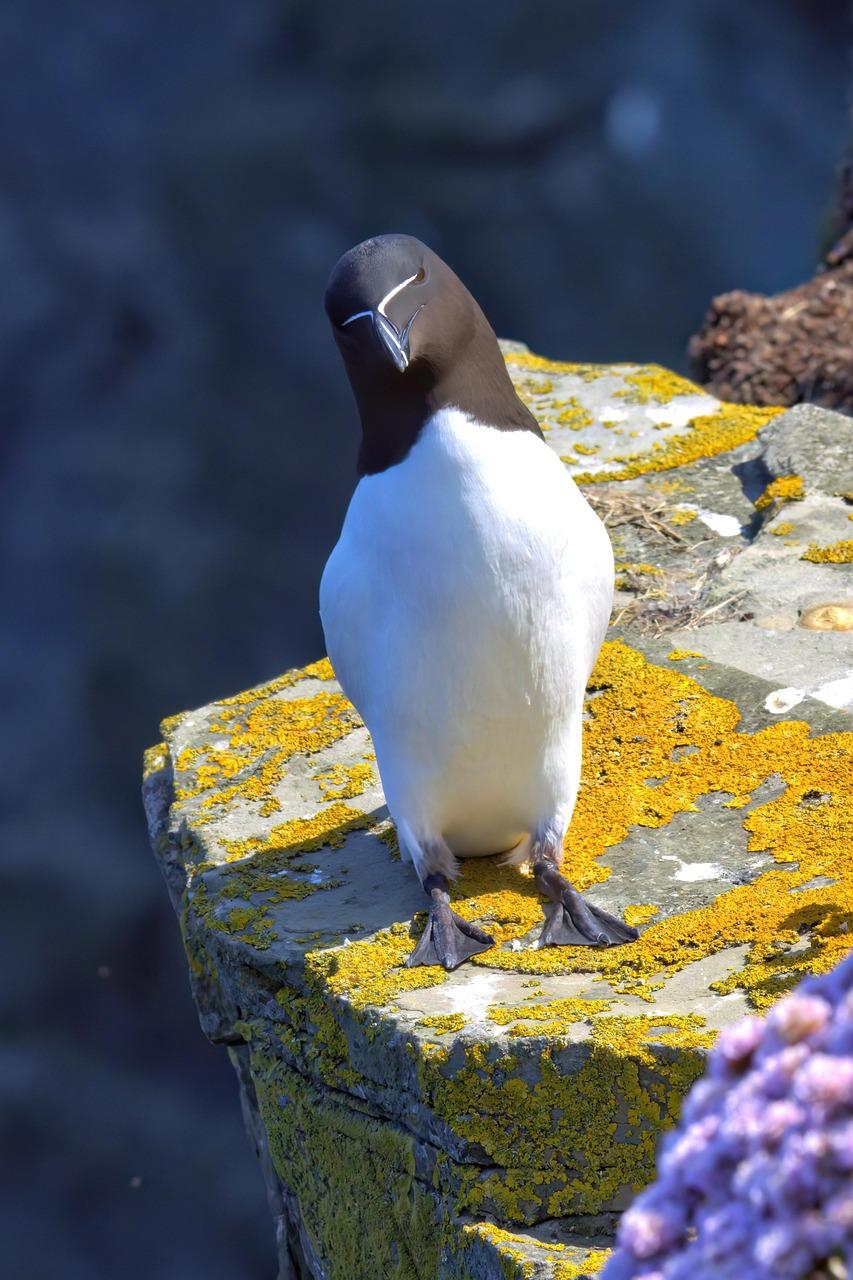
The razorbill is a seabird species native to the cold seas of the Northern Hemisphere, recognized by its black-and-white plumage and thick, blunt-tipped beak. The beak is black with a horizontal white stripe running through its center. The interior of the mouth is a bright yellow. Its body is black above and white below, creating a striking contrast. During the breeding season, the entire face becomes black, while in winter the throat and sides of the face turn white.
The average wingspan ranges from 60 to 69 cm. Females weigh between 505 and 730 grams, while males weigh between 530 and 720 grams. Their feathers are waterproof and their streamlined body structure makes them highly effective at swimming underwater to hunt. The tail is long and pointed and is typically held close to the body. The oldest recorded individual lived to be 41 years old; the average lifespan is approximately 13 years.

Razorbill (Pixabay)
The razorbill is found exclusively in the Atlantic Ocean. Its breeding range lies between 73° and 43° north latitude. Breeding sites include the Hudson Bay, western Greenland, the Gulf of Maine, Iceland, the British Isles, Norway, the Baltic Sea and the White Sea. Ninety percent of the European population resides on this continent, with particularly high densities in Iceland, Britain and the Scandinavian countries. In winter, it can migrate as far south as the western Mediterranean and the Azores. Its natural habitats include coastal oceanic zones, sea cliffs and offshore islands. Nests are typically built on rocky ledges, crevices in cliffs or sheltered fissures.
The razorbill is monogamous and strengthens pair bonds during the breeding season through mutual preening and other social behaviors. Between late April and early June, the female lays a single egg directly on bare rock. The incubation period lasts approximately 35 days, with both parents taking turns sitting on the egg. Chicks leave the nest 17 to 23 days after hatching, even though they cannot yet fly, plunging from the cliff edge into the sea. The male parent guides the chick underwater after it enters the ocean. It has been observed that females sometimes mate with other males before laying eggs and later return to their original partner. The number of fish brought to the nest ranges from one to six, though occasionally up to twenty have been recorded.
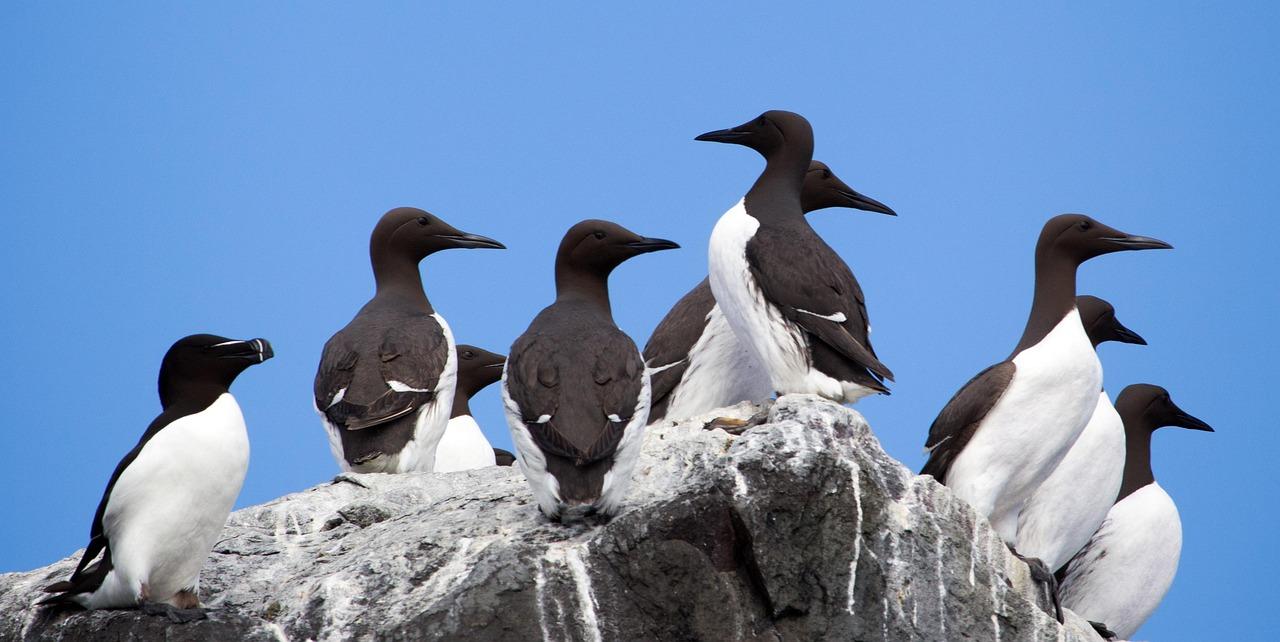
Razorbill (Pixabay)
Razorbills are piscivorous. Their diet primarily consists of capelin (Mallotus villosus), sand lance (Ammodytes), herring (Clupea harengus), young cod and some crustaceans. They typically catch prey at depths of 25 to 40 meters, though dives as deep as 120 meters have been recorded. During dives, they use their wings to "fly" underwater. To protect their catch from kleptoparasitic gulls, they swallow prey before surfacing. Razorbills often gather in large flocks to feed and spend a significant portion of the day foraging over open ocean.
The International Union for Conservation of Nature (IUCN) classifies the razorbill as Least Concern. Although its population declined in the St. Lawrence Gulf during the 1970s, it has since recovered following the 1980s. According to the European Red List of Birds, there has been a significant increase in its distribution across Europe in recent years. The global adult population is estimated to range between 838,000 and 1,660,000 individuals, with European populations accounting for 90 percent of this total.
The razorbill faces threats from climate change, rising sea surface temperatures, declining fish stocks, bycatch in fishing gear, oil spills, offshore energy installations and human disturbance. Additionally, eggs and chicks are preyed upon by native predators and invasive species.
As a carnivorous species, the razorbill plays a vital role in marine ecosystems by feeding on mid-water fish and small invertebrates. It also serves as a food source for predators such as gulls and foxes. In scientific research, it is frequently used as a model species, particularly in studies of mating behavior and underwater diving biomechanics.
All About Birds. "Razorbill Genel Bakış."Cornell Ornitoloji of Ornithology. Accessed June 24, 2025. https://www.allaboutbirds.org/guide/Razorbill/overview.
Animal Diversity Web. "Alca torda: Razorbill." Animal Diversity Web, University ofMichigan Üniversitesi of Zoology. Accessed June 24, 2025. https://animaldiversity.org/accounts/Alca_torda/.
BirdLife International. “Ayın Deniz Kuşu: Razorbill (Alca torda).” BirdLife International. Accessed June 24, 2025. https://www.birdlife.org/news/2022/07/19/seabird-of-the-month-razorbill-alca-torda/.
Pixabay. “Guillemot Razorbill Kuş Doğa.” Pixabay, 2017. Accessed June 24, 2025. https://pixabay.com/tr/photos/guillemot-razorbill-ku%C5%9F-do%C4%9Fa-2034679/
Pixabay. “Jilet Kuş, Hayvan, Gaga, Tüyler.” Pixabay, 2023. Accessed June 24, 2025. https://pixabay.com/tr/photos/jilet-ku%C5%9F-hayvan-gaga-t%C3%BCyler-8074582/.
Pixabay. “Razorbill Kuş, Yaban Hayatı, Hayvan.” Pixabay, 2017. Accessed June 24, 2025. https://pixabay.com/tr/photos/razorbill-ku%C5%9F-yaban-hayat%C4%B1-hayvan-2332428/.

Razorbill (Alca torda)
Common Name | Razorbill | ||||||||
|---|---|---|---|---|---|---|---|---|---|
Scientific Name(s) | Alca torda | ||||||||
Family | Alcidae (Alk birds) | ||||||||
Order | Charadriiformes | ||||||||
Distribution(s) | North Atlantic – Eastern Canada Northern European coasts Iceland Greenland | ||||||||
Habitat | Rocky cliffs nearshore ocean areas open ocean islands | ||||||||
IUCN Status | Least Concern (LC) | ||||||||
No Discussion Added Yet
Start discussion for "Razorbill (Alca torda)" article
Morphological Characteristics
Distribution and Habitat
Behavior and Breeding
Diet and Foraging
Conservation Status
Threats
Ecosystem Role