


This article was automatically translated from the original Turkish version.
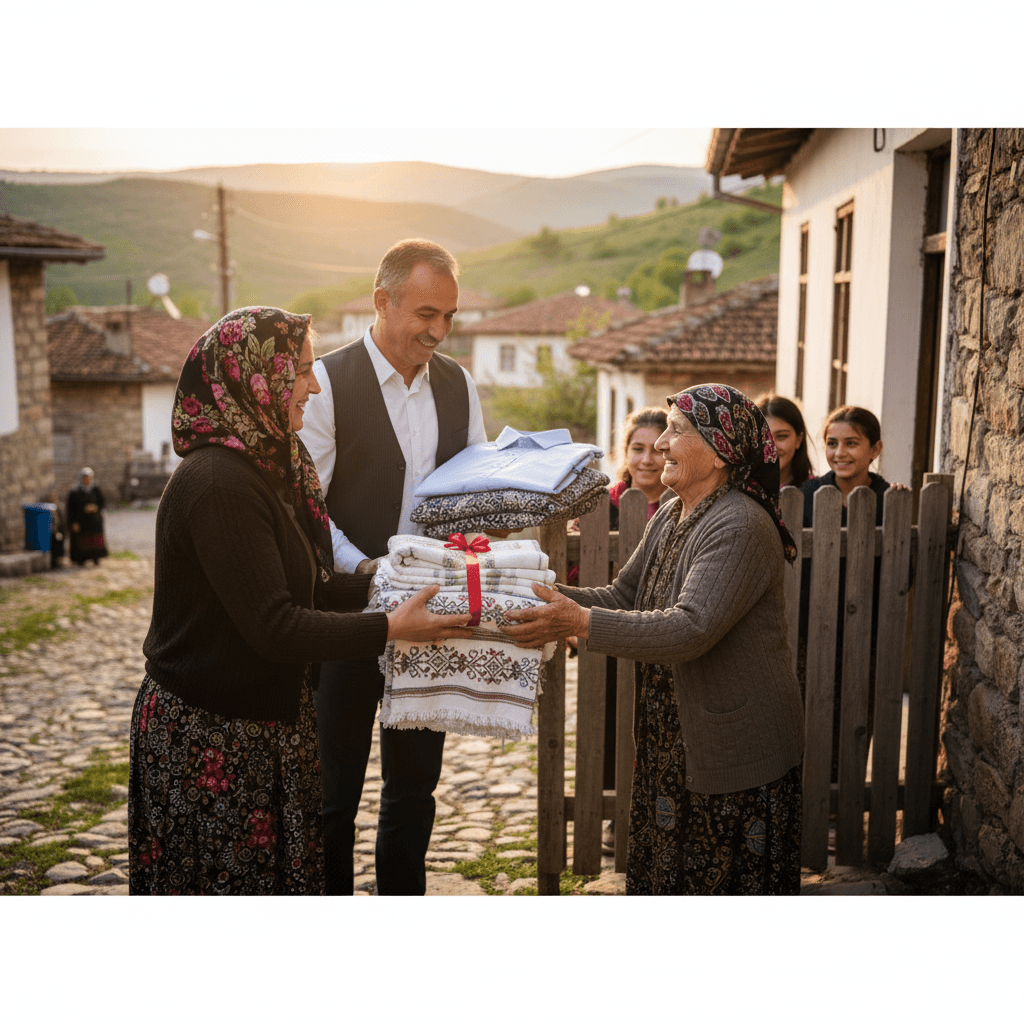
Reading Distribution Habit (generated with Artificial Intelligence)
Name(s) | Reading and Distribution Tradition | ||||||||
|---|---|---|---|---|---|---|---|---|---|
Other Name(s) | Okuntu Çağrılık Davetlik Ohuyuntu | ||||||||
Responsible Persons | Reader (one who reads), Reciter (one who distributes reading) | ||||||||
Geographic Region | Various regions of Anatolia | ||||||||
Types of Gifts | Towel, Shirt, Printed fabric | ||||||||
The custom of distributing “oku” is a symbolic method of conveying wedding invitations through small gifts. According to the Turkish Language Association, “oku” refers to “small gifts given to those invited to a wedding.”【1】 Additionally, the custom of distributing oku is found in various regions of Anatolia under similar names such as “okuntu,” “davetlik,” or “çağrılık.” Oku is a gift sent by the wedding hosts to their guests, carrying both material and spiritual value, and signifying an invitation to the wedding. The person who distributes the oku is called the “okuyucu,” while the recipient is known as the “okucu.”
Weddings are large community events that involve the entire village population. Before the wedding, both the bride’s and groom’s families distribute “oku” to those they wish to invite. Oku typically consists of textile products; the most common is the towel. Shirts, fabric for dresses, printed cloth, or fabric for loose trousers are also given as oku. In the past, small items such as soap, sugar, and handkerchiefs were often added to these gifts. The type and quality of oku are determined according to the recipient’s closeness to the family. For immediate relatives, it is customary to give separate gifts for women and men, known collectively as “çift oku,” while more distant acquaintances receive only a towel or a small textile item.

A visual representing the custom of distributing oku (generated by artificial intelligence).
The distribution of oku is part of the preparation process that begins approximately one month before the wedding. The wedding family first compiles a list of invitees. These lists include detailed information down to the level of village, neighborhood, and even nicknames. Tasks such as selecting fabric, matching colors, packaging gifts, and planning distribution are handled by women.
Oku packages are prepared. Towels are folded uniformly, placed in plastic wrapping, and accompanied by a small paper containing wedding details. This paper typically includes the wedding date, location, and the names of the bride and groom. Fabric is measured and cut. Brighter patterns are chosen for younger women, while simpler designs are selected for older recipients. In some cases, the length of the fabric is adjusted according to the height of the invitee. This process is carried out through the traditional communal labor system known as “imece.” Relatives and neighboring women come to the house, sit together, converse, and prepare the oku collectively.
When the time comes for distribution, oku is usually delivered personally by the wedding hosts or the okuyucular. Each household is visited, and the oku is handed over with the phrase, “We look forward to your presence at our wedding.” It is expected that every invited person receives an oku. Therefore, it is essential that no household is overlooked and that everyone is invited. In some cases, extra “backup okus” are prepared and kept for those who may have been forgotten or remembered later.
Rumors that a family has failed to distribute oku can lead to a loss of social prestige. For this reason, even though some young couples prefer modern wedding styles, family elders continue the tradition, believing that “oku must not be neglected.” Distributing oku at weddings also signifies repaying the okus received in the past.
The custom of distributing oku is also a form of social memory. Each oku symbolizes past relationships, kinship ties, and friendships. Beyond being a material object, it carries spiritual meaning: sharing, showing respect, and preserving community bonds.
Ministry of Culture and Tourism of the Republic of Türkiye. "Burdur’da Düğün Okusu: Okunun Hazırlanması." Ministry of Culture and Tourism of the Republic of Türkiye. Accessed November 10, 2025. https://www.kulturportali.gov.tr/mrepo/eKitap/eb-Burdurda%20Dugun%20Okusu-Okunun%20Hazirlanmasi/4/
Ministry of Culture and Tourism of the Republic of Türkiye. "Eskişehir Wedding Traditions – Düğün." *Turkey Culture Portal*. Accessed November 10, 2025. https://www.kulturportali.gov.tr/turkiye/eskisehir/kulturatlasi/dugun-geleneg#:~:text=D%C3%BC%C4%9F%C3%BCn%20g%C3%BCn%C3%BC%20haber%20verilir%2C%20k%C3%B6y,konu%2Dkom%C5%9Fu%20akraba%20kad%C4%B1nlar%C4%B1%20toplan%C4%B1r.
Turk Dil Kurumu. "Okuntu." *Türk Dil Kurumu*. Accessed November 10, 2025. https://sozluk.gov.tr/?ara=okuntu
YILMAZ, Tuğba. “Isparta’nın Eğirdir İlçesindeki Evlenme Âdetleri.” In *Current Debates on Social Sciences*, vol. 8. Ankara: Bilgin Kültür Sanat Yayınları, 2022: 638–642. Accessed November 10, 2025. https://www.researchgate.net/profile/Sila-Uzkul/publication/391739240_Rafadan_Tayfa_Cizgi_Filminin_Eylem_Modellerine_Gore_Incelenmesi/links/68250a35df0e3f544f547685/Rafadan-Tayfa-Cizgi-Filminin-Eylem-Modellerine-Goere-Incelenmesi.pdf#page=1.00
[1]
Türk Dil Kurumu, “Okuntu,” Türk Dil Kurumu, erişim 10 Kasım 2025, https://sozluk.gov.tr/?ara=okuntu

Reading Distribution Habit (generated with Artificial Intelligence)
Name(s) | Reading and Distribution Tradition | ||||||||
|---|---|---|---|---|---|---|---|---|---|
Other Name(s) | Okuntu Çağrılık Davetlik Ohuyuntu | ||||||||
Responsible Persons | Reader (one who reads), Reciter (one who distributes reading) | ||||||||
Geographic Region | Various regions of Anatolia | ||||||||
Types of Gifts | Towel, Shirt, Printed fabric | ||||||||
No Discussion Added Yet
Start discussion for "Reading and Distribution Custom (Wedding Reading)" article