


This article was automatically translated from the original Turkish version.
+1 More
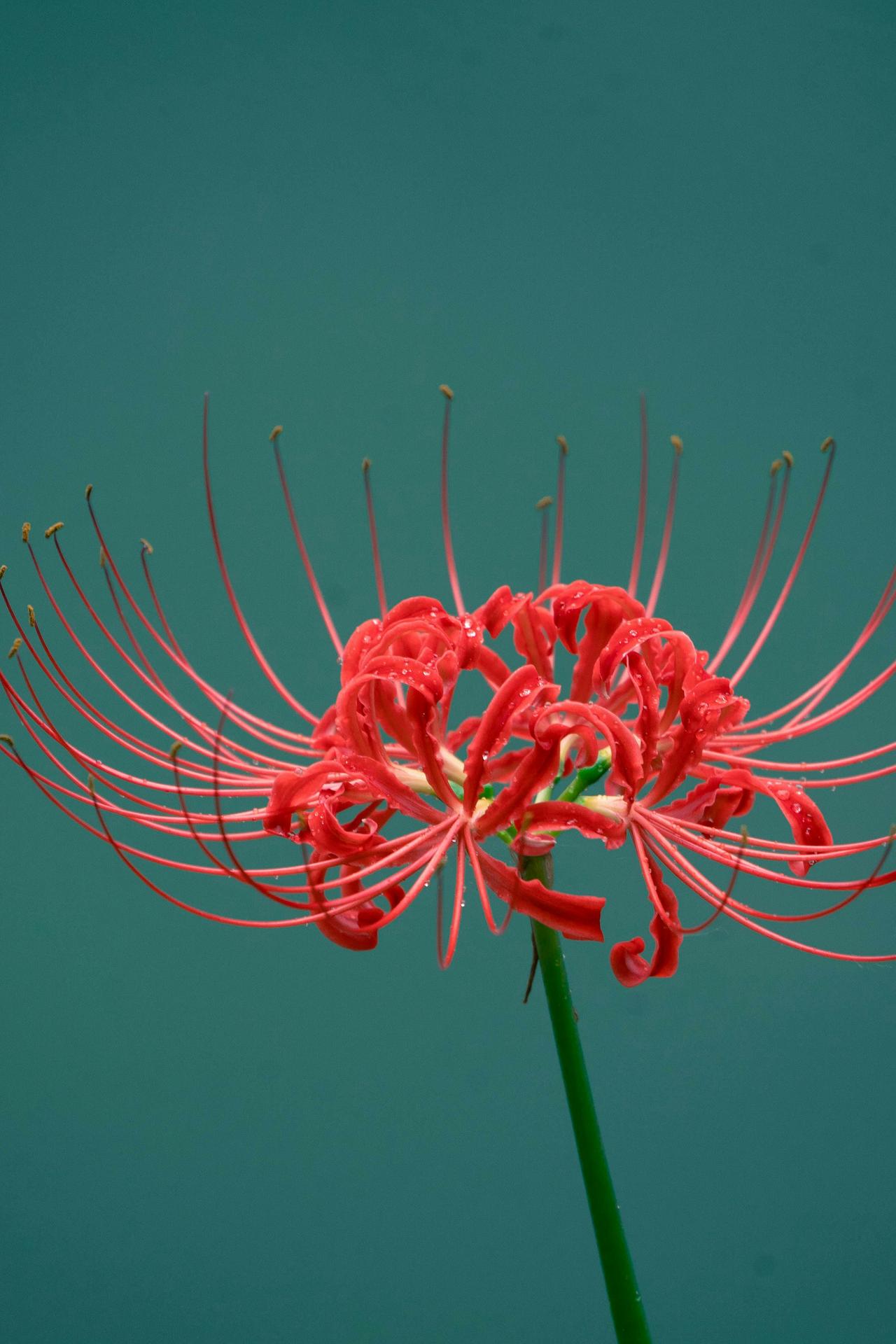
Red Spider Lily (Lycoris radiata)
Turkish Name | Red Spider Lily | ||||||||
|---|---|---|---|---|---|---|---|---|---|
Scientific Name(s) | Lycoris radiata (L'Hér.) Herb. | ||||||||
Family | Amaryllidaceae | ||||||||
Order | Asparagales | ||||||||
Class | Monocotyledonae | ||||||||
Habitat | Moist forest understories Agricultural field boundaries Riverbanks | ||||||||
Distribution Area | East Asia (particularly China, Korea, Japan) | ||||||||
Red Spider Lily is a flowering, perennial bulbous plant species belonging to the Amaryllidaceae (narcissus) family. Its scientific name is Lycoris radiata, and due to its bright red, spider-like flower structure, it holds high aesthetic and symbolic value. The plant was first described in China and later spread to East Asian countries such as Japan and Korea. In Japan, it is known as "higanbana" (彼岸花) and is commonly found around cemeteries.

Lycoris Radiata (Generated by Artificial Intelligence.)
L. radiata exhibits pronounced seasonal dimorphism. Its flowers emerge in autumn independently of the leaves, which typically develop after flowering, usually in spring. The plant bears red, spider-like flowers with six elongated tepals on stems 30–70 cm tall. This feature indicates a specialized morphological adaptation for pollination.
Diploid individuals (2n=22) are found in Chinese populations and are capable of sexual reproduction. In contrast, the majority of individuals in Japan are triploid (3n=33) and sterile. Triploid plants reproduce exclusively vegetatively, through bulb division. Molecular genetic analyses have shown that Japanese populations are largely clonal and exhibit very limited genetic diversity. This suggests that the plant was introduced to Japan historically through a narrow genetic pool.
L. radiata contains pharmacologically important alkaloid compounds. Galantamine, an Amaryllidaceae alkaloid, is an acetylcholinesterase inhibitor used in the treatment of Alzheimer’s disease. Other alkaloids such as lycorine, haemanthamine, and tazettine are prominent in pharmaceutical research due to their anticancer, antiviral, and antifungal properties. Most of these compounds are concentrated in the plant’s bulbs. However, this chemical composition also confers toxicity. Lycorine is poisonous to humans and animals; ingestion can cause symptoms such as nausea, vomiting, diarrhea, and central nervous system effects.

Lycoris Radiata (Photo: Anntphoto, pixabay)
The plant thrives in moist, well-drained soils under partial shade. It is commonly found around cemeteries, field edges, and forest clearings. Due to the toxic nature of its bulbs, it was traditionally used in Japanese agriculture as a natural barrier against insects and wild animals. It also functions as a boundary plant due to its ability to reduce soil erosion and its allelopathic (inhibitory) properties.
L. radiata is closely associated with death, separation, and rites of passage in East Asian cultures. In Japanese culture, known as "higanbana," the term "higan" symbolizes the transition to the realm of the dead. Its blooming around cemeteries and temples reinforces this symbolism. In China, it is also recognized within Buddhist belief systems as a plant linked to death. It is frequently employed as a metaphorical symbol in literature, poetry, visual arts, and modern popular culture such as anime and manga.
Anntphoto. “Lycoris radiata JPG.” Pixabay. Accessed May 4, 2025. https://pixabay.com/tr/photos/%C3%A7i%C3%A7ek-lycoris-%C3%BCretmektedir-bitki-6649919/
He, M., X. Yang, and Y. Yang. "Chemical Constituents from Lycoris radiata." Biochemical Systematics and Ecology 50 (2013): 324–326. .
Iwamoto, Makoto, Takashi Tani, Akira J. Nagano, Masaki N. Honjo, Hideki Kudoh, and Masanori Yasugi. "Transcriptomic Response of a Perennial Model Plant Lycoris radiata to Seasonal Environmental Change." Biology 8, no. 3 (2019): 63. .
Mateusz Walendzik. “Lycoris radiata JPG.” Pexels. Accessed May 4, 2025. https://www.pexels.com/tr-tr/fotograf/yesil-arka-plana-karsi-guzel-kirmizi-orumcek-zambagi-29241283/
Okabe, Yuko, Yukari Hirao, Hiroyuki Sato, and Yoshihisa Suyama. "Clonal Structure and Genetic Diversity in Lycoris radiata Populations in Japan Revealed by Nuclear Microsatellite Analysis." Genes & Genetic Systems 80, no. 3 (2005): 199–207. .

Red Spider Lily (Lycoris radiata)
Turkish Name | Red Spider Lily | ||||||||
|---|---|---|---|---|---|---|---|---|---|
Scientific Name(s) | Lycoris radiata (L'Hér.) Herb. | ||||||||
Family | Amaryllidaceae | ||||||||
Order | Asparagales | ||||||||
Class | Monocotyledonae | ||||||||
Habitat | Moist forest understories Agricultural field boundaries Riverbanks | ||||||||
Distribution Area | East Asia (particularly China, Korea, Japan) | ||||||||
No Discussion Added Yet
Start discussion for "Red Spider Lily (Lycoris radiata)" article
Morphology and Life Cycle
Genetic Characteristics and Reproduction
Chemical Composition and Pharmaceutical Significance
Ecology and Habitat
Cultural and Symbolic Meaning