


This article was automatically translated from the original Turkish version.
Throughout human history, the processing of metals has played a role in the development of civilizations. One of the most fundamental techniques to emerge during this process is welding. Welding is an almost as old a technique as the time when humans began working with metals. Throughout history, it was largely regarded as either an art form or a crude construction method. However, scientific advancements in the 19th century and the increasing availability of electrical energy accelerated the development of modern welding.
In 1800, Sir Humphry Davy invented a battery capable of generating an electric current. In 1831, Eugene Desbassyns de Richemont obtained a patent for fusion welding. In 1881, Auguste de Meritens and Nikolai Benardos developed a method of using the heat generated by an electric arc formed between carbon electrodes for welding. In 1900, Fouché and Charles Picard produced the first commercial oxyacetylene welding torch. By the 20th century, welding processes began to become increasingly automated.
The types of welding used in aviation are as follows:
MIG welding is a gas shielded welding method that uses inert gases, typically argon or an argon-carbon dioxide mixture, as a shielding gas during the welding process. In this method, a welding wire fed from a spool creates an electric arc between the electrode and the workpiece, melting the material to form the weld. The inert gas protects the weld pool from atmospheric contamination, resulting in a high-quality, clean weld bead. MIG welding is particularly preferred for materials sensitive to oxidation, such as aluminum and stainless steel.
Key advantages of MIG welding include high welding speed, compatibility with automated welding systems, low smoke generation, and ease of application across various materials. However, this method can increase costs due to continuous gas consumption, requires good ventilation during operation, and demands precise adjustment of welding parameters to achieve a high-quality result.
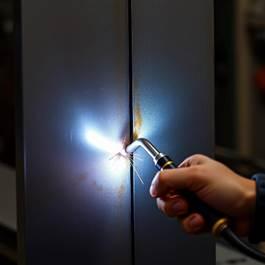
MIG welding method—Generated by artificial intelligence.
TIG welding is a welding method that creates an electric arc between a tungsten electrode and the workpiece. In this process, a thin metal filler rod is used to add material to the weld, while an inert gas such as argon simultaneously shields the weld zone. The gas flow prevents the molten metal from contacting air, thereby inhibiting oxidation and enhancing weld quality. Tungsten Inert Gas welding is especially preferred for welding thin and delicate materials, as it allows for low and controlled heat input during the welding process.
TIG welding stands out for producing high-quality, clean, and uniform weld beads. It can be applied to many types of metals and delivers excellent results with materials such as aluminum, magnesium, and titanium. The low levels of smoke and noise generated during welding improve the working environment. However, TIG welding is a slower process compared to other methods and requires a high level of operator skill, which can increase training time and costs.

TIG welding method—Generated by artificial intelligence.
Electron beam welding is a fusion welding method that uses the heat generated when high-velocity electrons strike the workpiece. In this process, electrons are focused in a vacuum environment and directed toward the base metal, creating a concentrated increase in temperature on the material’s surface. The resulting high temperature melts and vaporizes the metal, forming a deep and narrow molten zone. Because electrons move more freely in a vacuum, electron beam welding achieves deeper penetration than other welding methods, allowing thick sections to be welded in a single pass.
Electron beam welding offers significant advantages including high penetration depth, low heat input, minimal distortion, and reduced post-weld processing requirements. It also enables welding of thick sections in a single pass and produces high-strength joints with low internal stresses. Additionally, it allows joining of dissimilar or difficult-to-weld materials. However, its main disadvantages include the requirement for a vacuum environment, high equipment costs, and the need for precise control of the welding process.
Laser beam welding is an advanced technology used for joining materials. In this method, a high-energy laser beam is focused onto the interface between two materials, melting them and enabling fusion. The laser beam allows precise delivery of concentrated energy to the desired area through focused light beams. This welding type joins metal parts by focusing the concentrated energy emitted from the laser source using optical components. Laser welding features high welding speed, low heat input, a narrow weld bead, and a small heat-affected zone, making it ideal for very thin and delicate welding operations.
The advantages of laser welding include high automation potential, successful joining of diverse materials, low thermal impact, and a narrow weld bead. Additionally, laser welding is particularly suitable for lightweight metals. However, it has certain disadvantages, such as high initial investment costs, the risk of brittle welds in hardenable materials, difficulties in welding thick sections, and potential hazards to human health from laser radiation. Moreover, the penetration depth of laser welding is limited and can be challenging with materials exhibiting high reflectivity.
Friction welding is a welding method that converts electrical energy into mechanical energy to heat the parts through friction. In this process, the parts are heated by mechanical energy and pressure, achieving a bond at the surface without melting, reaching a plastic deformation temperature. During the heating phase, the surfaces become plasticized; in the second phase, forging pressure consolidates the bond through a forging action. Friction welding, as a solid-state welding method, produces high-quality welds by removing oxides and contaminants from the surfaces. No melting occurs between the materials during welding.
Advantages of this method include low energy consumption, the ability to join dissimilar metals, high joint strength, absence of slag or oxides, and formation of a fine-grained microstructure. However, disadvantages include limited geometric shape options, increased motor power and pressure requirements for large cross-sectional areas, difficulty in welding large components, and high equipment costs. Therefore, friction welding is particularly suitable for parts of specific dimensions and geometries.
Spot welding is a welding method that joins metal parts by passing an electric current between two electrodes. In this process, the electrodes apply a specific pressure to the metal surfaces and conduct current for a set duration. The current heats and melts the metal, causing the surfaces to fuse. The applied pressure ensures the joining of the weld zone, and a cooling period of several seconds is required after the current is stopped to complete the weld. This process can be fully automated, eliminating the need for manual intervention and enabling high efficiency.
Advantages of spot welding include short processing times, low cost, and high weld quality. Additionally, welding parameters can be automatically adjusted using digital systems, making the process more precise and repeatable. This increases production efficiency and reduces error rates. However, disadvantages include the difficulty of finding optimal parameters and the risk of poor weld quality due to incorrect settings. Setting the correct parameters can be time-consuming, and initial setup costs may be high.
Seam welding is an adaptation of resistance spot welding and involves creating a series of overlapping spot welds to form a continuous, leak-tight joint. In this process, rotating copper alloy electrodes are used, and the electrodes remain in contact throughout the operation. The electrode wheels apply a constant force to the workpieces and rotate at a controlled speed. Welding current is typically applied in pulses, although continuous current may be used in some high-speed applications. Seam welding equipment is generally stationary, and the parts to be welded are placed between the electrode wheels. This process can be automated, and various types of seam welding exist, such as wide-wheel seam welding, narrow-wheel seam welding, and seam welding using wire.
Advantages of seam welding include high welding speeds, effectiveness in welding coated steels, and the ability to support high-volume production. For example, it is used in manufacturing tin cans and vehicle fuel tanks. However, this method may be limited by component shape and electrode wheel accessibility. Some restrictions also exist regarding material weldability, but most production issues can be resolved with proper settings and process control. Risks associated with seam welding include pinching hazards to fingers and hands, burns from flying metal, and eye injuries. When welding coated steels or organic materials, fume generation must be controlled and appropriate safety measures must be implemented.

Table of materials used with welding types in aviation (Prepared and edited by Yusuf Cantürk)

No Discussion Added Yet
Start discussion for "Resource Methods Used in Aviation" article
MIG Welding
TIG Welding
Electron Beam Welding (EBW)
Laser Beam Welding (LBW)
Friction Welding (FW)
Spot Welding
Seam Welding