


This article was automatically translated from the original Turkish version.
Rewilding is a conservation and ecological restoration approach that aims to repair ecosystems and natural processes degraded by human intervention, primarily by reducing human control and allowing them to become self-sustaining. The concept fundamentally involves creating space for natural processes to restore the integrity and vitality of ecosystems, often through the reintroduction of keystone species.
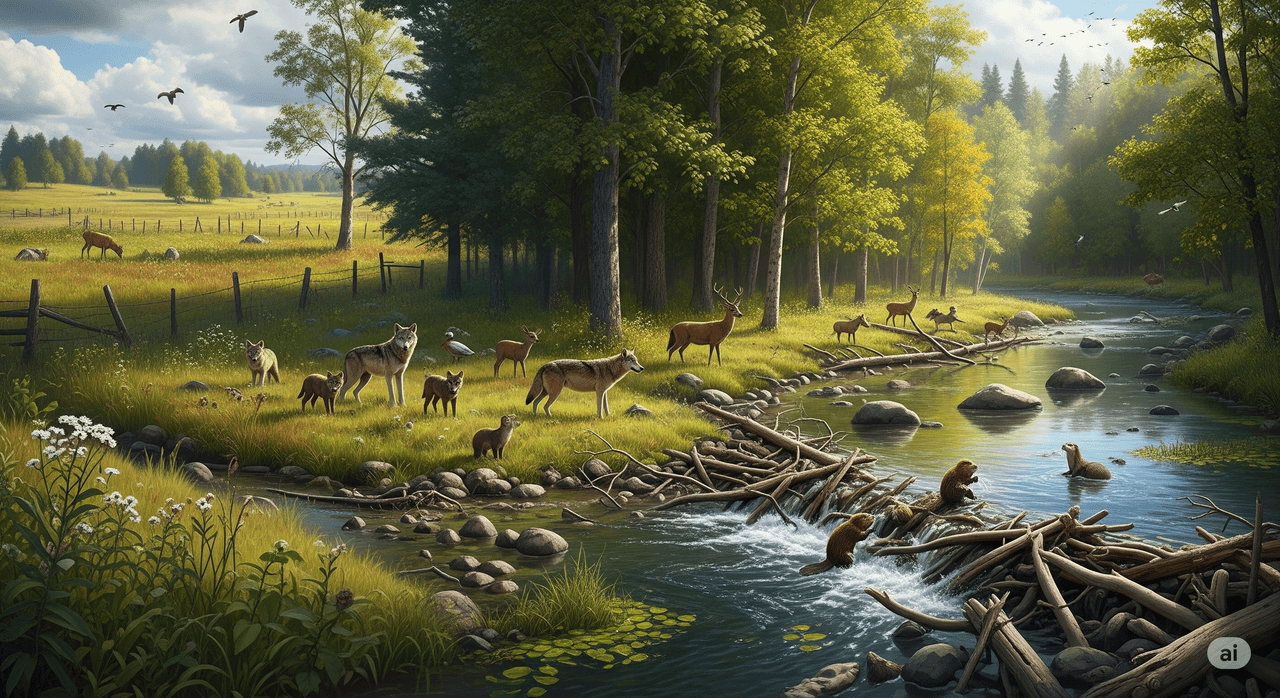
Ecosystem and Wildlife Revived Through Rewilding (Generated by Artificial Intelligence)
Rewilding is recognized as a new approach to managing degraded ecosystems. Its foundation lies in managing landscapes by reducing human control and restoring natural ecological processes. This process typically focuses on three key elements seen as the basis for maintaining ecosystem complexity and resilience: trophic complexity (food web interactions), natural disturbances (events such as fire and flooding), and species dispersal.
Rewilding differs from traditional ecological restoration. While restoration often aims to return an ecosystem to a specific “original” state, rewilding accepts that the end result will be a new and unpredictable ecosystem. In this approach, decisions are left to nature’s own dynamics rather than striving for a “correct” ecosystem or species composition.
The central idea of rewilding is “non-human autonomy.” This is a defining characteristic that distinguishes rewilding from other forms of ecological restoration. While restoration projects frequently require continuous human intervention and management, rewilding aims for the gradual withdrawal of human management after initiation, allowing wild organisms and ecological processes to become self-sustaining.
The foundations of the rewilding concept date back to the late 1990s. It first emerged through the “cores, corridors, carnivores” model, which emphasized the regulatory role of large predators in ecosystems. Initially, the focus was on reintroducing large predators and herbivores—known as keystone species—that had disappeared or declined over time. The idea that these species exert a cascading regulatory effect from the top of the food chain downward formed the core of the approach.
Over time, the concept has gained widespread recognition in both scientific and popular discourse. Particularly from the 2010s onward, there has been a noticeable increase in academic publications and media interest on the subject. During this period, the scope of the concept expanded and various application forms emerged.
Rewilding has evolved to encompass diverse approaches tailored to different scales and objectives. Jørgensen (2015) identified six distinct uses in the academic literature:
In addition to these classifications, distinctions can also be made based on the level of human intervention:
Rewilding projects are implemented across the globe, ranging from abandoned agricultural lands to river systems, mountain ecosystems, and marine environments.
Considered one of the pioneers of the rewilding movement in Europe, this project was established on land reclaimed from the sea (a polder). Originally planned as an industrial area, the site was transformed into a nature reserve after the colonization of wild geese. Later, the introduction of large herbivores such as Heck cattle and red deer turned it into a “wild experiment” demonstrating how natural grazing processes shape landscapes without human intervention.
This project involved the reintroduction of Eurasian beavers, which had gone extinct in Scotland 400–500 years ago, into Knapdale Forest in 2009. The project aimed to observe how beavers, as ecosystem engineers, affect aquatic systems and biodiversity. It also serves as an example of how human-wildlife coexistence can be managed through the participation of local communities and stakeholders.
An organization that supports rewilding initiatives across eight different regions in Europe. These include the dehesa landscapes of Portugal, the Southern Carpathians and the Danube Delta in Romania. Projects typically focus on restoring natural grazing, protecting keystone species, and developing nature-based economies.
In Türkiye, areas such as minimally disturbed high mountain ecosystems, abandoned agricultural lands, and protected forests hold potential for rewilding projects. Notable examples include Kamilet Valley, Küre Mountains National Park, and Kaçkar Mountains National Park.
The concept of rewilding has generated several debates. One criticism is that the term has expanded to encompass such diverse applications that it has become a “plastic word,” losing its semantic clarity. However, proponents argue that the concept of “non-human autonomy” serves as a unifying thread across all definitions of rewilding.
Another significant debate centers on the criticism that rewilding promotes a “wilderness” ideal that excludes humans from nature. According to this view, rewilding reproduces the human-nature dichotomy by ignoring human history and its impacts on landscapes. Yet, many modern rewilding projects, such as the Scottish Beaver Trial, are based on the premise that humans and non-human entities can coexist and jointly shape future landscapes. These projects aim not to exclude human-wildlife interactions but to manage them and foster sustainable coexistence.
Erdönmez, Cihan. “Yeniden Yabanlaştırma: Ekosistem Yönetiminde Bir Yaklaşım.” *JENAS Journal of Environmental and Natural Studies* 2, no. 1 (2020): 63–68. Accessed August 16, 2025. https://dergipark.org.tr/en/pub/jenas/issue/55049/719239
Prior, Jonathan, and Kim J. Ward. “Rethinking Rewilding: A Response to Jørgensen.” *Geoforum* 69 (2016): 132–35. Accessed August 16, 2025. https://orca.cardiff.ac.uk/id/eprint/84730/1/Prior%20and%20Ward%20Final%20%281%29.pdf


Definition and Scope
Historical Development
Theoretical Approaches and Types
Application Areas and Examples
Oostvaardersplassen (Netherlands)
Scottish Beaver Trial (SBT)
Rewilding Europe
Debates and Related Issues