


This article was automatically translated from the original Turkish version.
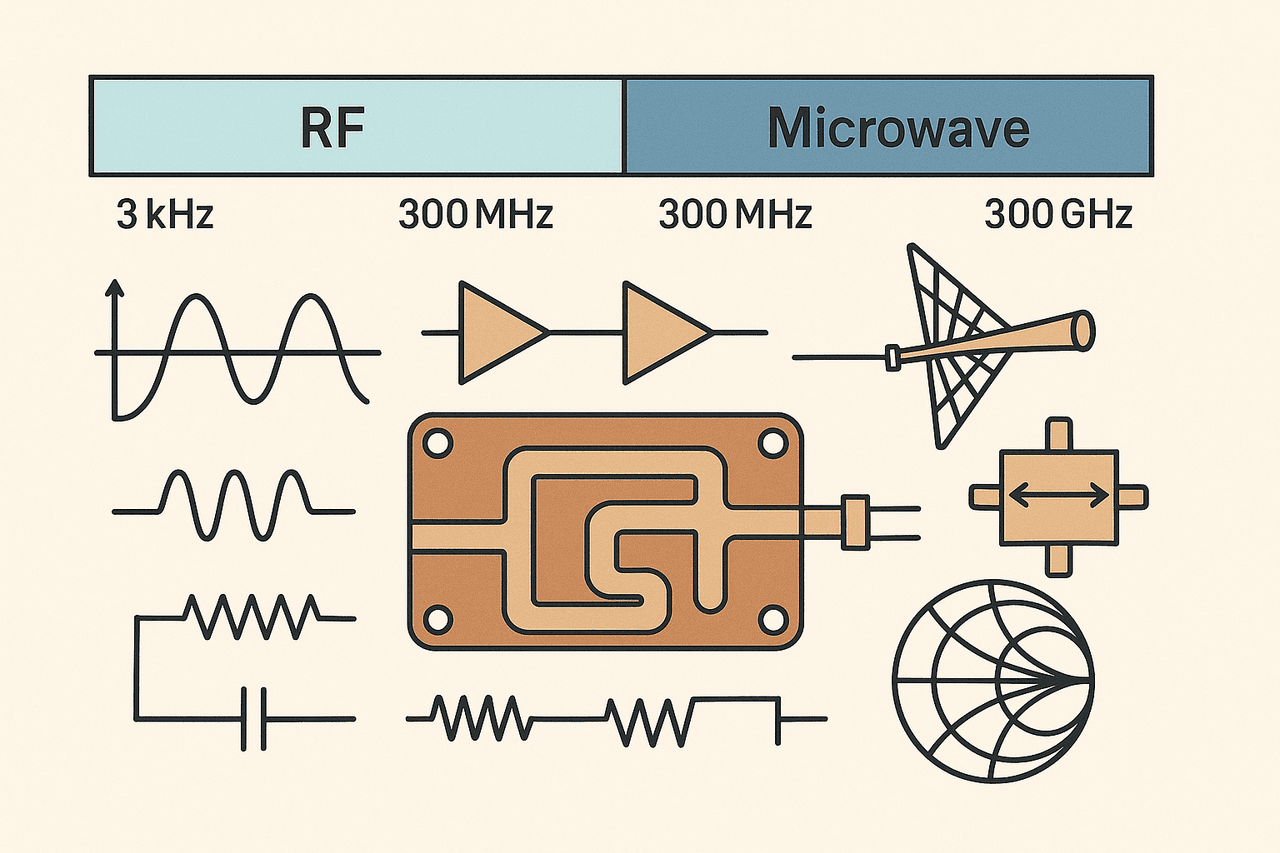
RF and Microwave Circuits (generated with artificial intelligence)
Frequency Range | RF: 3 kHz – 300 MHz Microwave: 300 MHz – 300 GHz | ||||||||
|---|---|---|---|---|---|---|---|---|---|
Basic Components | Passive: Resistors capacitors inductors transmission lines resonators filters couplers Active: Transistors (GaAs MESFET HEMT SiGe) diodes (PIN Schottky) | ||||||||
Design and Analysis Techniques | S-parameters (Scattering parameters) Impedance matching (Smith Chart) Electromagnetic simulation software (ADS HFSS CST) | ||||||||
Current Technologies | GaN and SiGe based active components Millimeter wave (mmWave) systems Flexible and printed electronic circuits | ||||||||
Radio Frequency (RF) and microwave circuits are fundamental components of electronic systems operating in the electromagnetic spectrum range from approximately 3 kHz to 300 GHz. These circuits perform functions such as signal generation transmission amplification filtering and detection. They hold critical importance in numerous fields ranging from communication technologies and defense systems to medical devices and spacecraft. The design of RF and microwave circuits involves unique physical and mathematical challenges arising from the nature of high frequencies which differ significantly from those encountered in low-frequency electronic circuits.
RF and microwave circuits are divided into two categories based on frequency range: RF circuits typically operate between 3 kHz and 300 MHz while microwave circuits operate between 300 MHz and 300 GHz. These frequency bands determine electromagnetic wave behavior antenna dimensions transmission line properties and the physical size of circuit components.
At microwave frequencies wavelengths approach the dimensions of circuit elements so distributed parameter models are used instead of lumped element models. In this context microstrip lines resonators tuned to the wavelength and couplers emerge as essential components.
The passive elements of RF and microwave circuits include conventional components such as resistors capacitors inductors and transmission lines as well as filters resonators couplers and waveguides. The behavior of passive components at high frequencies becomes complex due to parasitic effects and wave propagation phenomena.
Active components are transistors specifically designed to operate at high frequencies. Semiconductor technologies such as GaAs MESFET HEMT and SiGe BiCMOS are among the preferred components for RF and microwave frequencies. Additionally diodes including PIN and Schottky types play active roles in circuits such as frequency mixers detectors and modulators.
At high frequencies the concepts of voltage and current are superseded by the analysis of power wave propagation. Therefore circuit input-output characteristics are determined using S-parameters (scattering parameters). S-parameter analysis is well suited for measuring reflections and power losses caused by impedance mismatches.
The Smith Chart is a widely used graphical tool in RF engineering and is effectively employed for impedance matching and locating resonance points. In modern design electromagnetic simulations are performed using software such as ADS CST Microwave Studio and HFSS to optimize circuit performance in a virtual environment.
RF and microwave circuits form the foundation of modern wireless communication infrastructures such as Wi-Fi LTE and 5G. Base stations cellular phones and Wi-Fi modems operate at these frequencies and require sophisticated circuit designs alongside complex modulation techniques to achieve high data transmission rates.
Radar systems utilize microwave frequencies to detect the position and velocity of objects. In these applications high-sensitivity transceiver circuits frequency synthesizers and power amplifiers play crucial roles.
In satellite systems microwave circuits are used for high-frequency signal transmission and reception. Reliability and long-term performance are prioritized in the design of such systems.
Microwave technology is also employed in medical imaging and therapeutic applications. Microwave tomography and hyperthermia treatments are performed using devices that rely on the electromagnetic properties of internal body tissues.
In high-frequency circuits power losses electromagnetic interference impedance mismatches and thermal management are significant design challenges. Particularly at microwave frequencies even small-sized circuit elements exhibit complex behaviors requiring detailed electromagnetic analysis.
Additionally parameters such as frequency stability harmonic suppression phase noise and parasitic reduction are other critical considerations in the design of RF and microwave circuits.
In recent years intensive research has been conducted on semiconductor materials such as GaN (Gallium Nitride) and SiGe (Silicon Germanium). These materials offer superior performance higher power output and lower noise levels at high frequencies. Moreover millimeter wave (mmWave) technologies are being developed to enable high data rates in 5G and beyond communication systems.
Flexible and printed electronics technologies are creating new design opportunities by enabling RF circuits to be applied to flexible surfaces for use in wearable electronics and IoT applications.
RF and microwave circuits play a critical role as one of the foundational building blocks of modern electronic systems in high-frequency applications. As technology advances the design challenges in this field continue to grow and are met with the development of new materials modeling techniques and design methodologies. This domain remains an interdisciplinary field at the intersection of engineering physics and materials science.
De Marcellis, Andrea, and Giuseppe Ferri. Analog Circuits and Systems for Voltage-Mode and Current-Mode Sensor Interfacing Applications. 1st ed. Dordrecht, Heidelberg, London, New York: Springer, 2011.
Sen Gupta, Gourab, and Subhas Mukhopadhyay. "Smart Sensors Systems: Emerging Technologies and Applications." ResearchGate. Accessed August 2, 2025.

RF and Microwave Circuits (generated with artificial intelligence)
Frequency Range | RF: 3 kHz – 300 MHz Microwave: 300 MHz – 300 GHz | ||||||||
|---|---|---|---|---|---|---|---|---|---|
Basic Components | Passive: Resistors capacitors inductors transmission lines resonators filters couplers Active: Transistors (GaAs MESFET HEMT SiGe) diodes (PIN Schottky) | ||||||||
Design and Analysis Techniques | S-parameters (Scattering parameters) Impedance matching (Smith Chart) Electromagnetic simulation software (ADS HFSS CST) | ||||||||
Current Technologies | GaN and SiGe based active components Millimeter wave (mmWave) systems Flexible and printed electronic circuits | ||||||||
No Discussion Added Yet
Start discussion for "RF and Microwave Circuits" article
RF and Microwave Frequency Range and Characteristics
Basic Circuit Elements and Active Components
Design Principles and Analysis Methods
Application Areas of RF and Microwave Circuits
Communication Systems
Radar and Defense Technologies
Space and Satellite Communications
Medical Technologies
Technical Challenges in Design
Current Research and Technology Trends