


This article was automatically translated from the original Turkish version.
+2 More
High-Frequency Circuits
Definition(s) | Electronic circuits designed to process or receive electrical signals at frequencies above a certain threshold (typically above 3 MHz). transmit | ||||||||
|---|---|---|---|---|---|---|---|---|---|
Frequency Range | In radio technology: 3-30 MHz (HF); in microwave applications: >1 GHz | ||||||||
Basic Components | Resistors, capacitors, inductors, transistors, filters, amplifiers | ||||||||
PCB Materials | Low-loss substrates such as Rogers, Arlon, Taconic, PTFE (Teflon) | ||||||||
Application Area(s) | Communications ultrasonic devices high-speed digital systems radar satellite systems radio | ||||||||
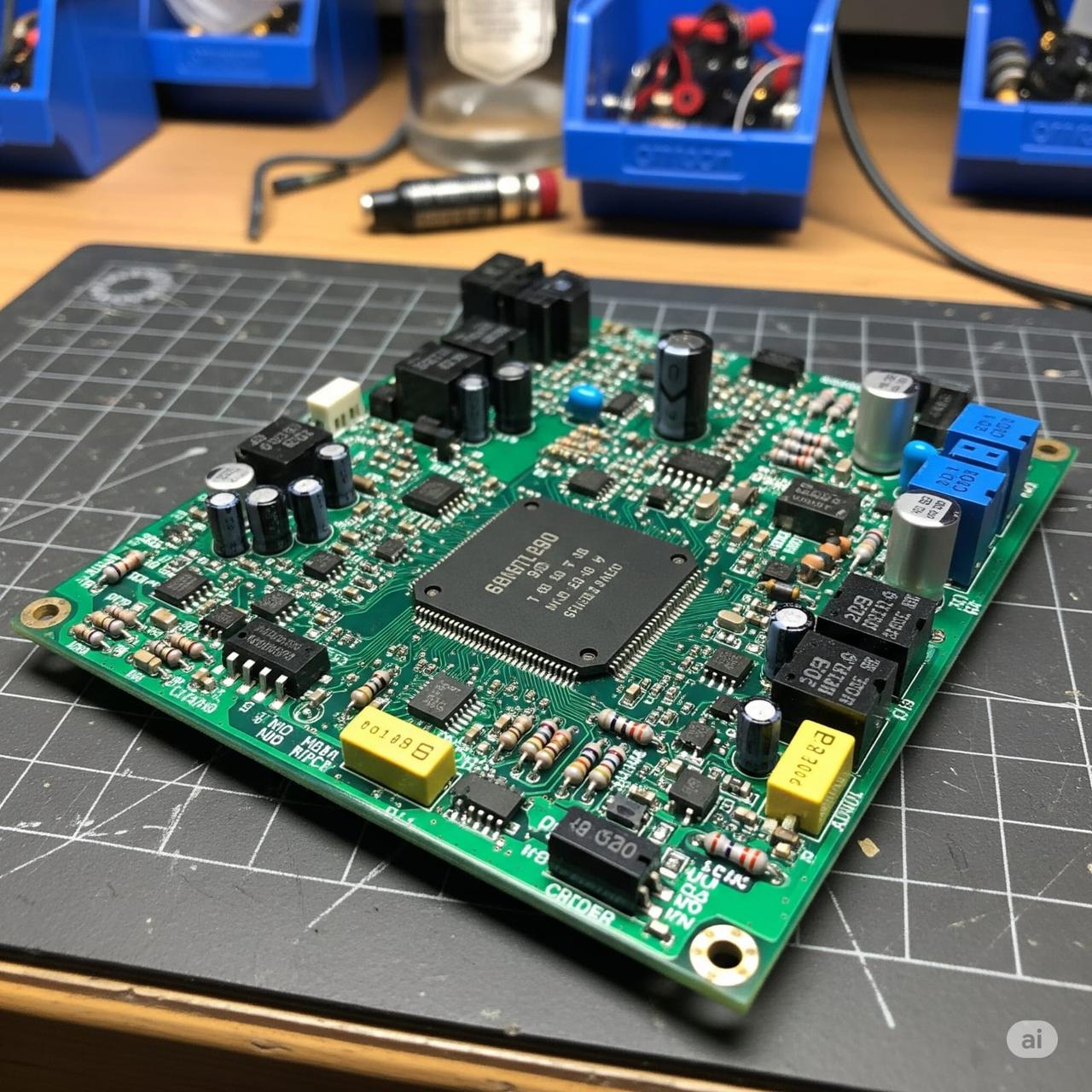
High-frequency circuits are specialized electronic circuits designed to process, transmit, or receive electrical signals operating at frequencies typically above 3 MHz. In radio technology, the range between 3 MHz and 30 MHz is defined as "high frequency (HF)", while in modern applications such as microwaves and 5G, this definition has expanded to include frequencies of 1 GHz and higher. The key distinction from low-frequency circuits lies in the deviation of circuit components from ideal behavior as signal frequency increases, and the critical importance of previously negligible parasitic effects such as distributed capacitance and inductance, along with signal propagation delay. These circuits perform functions such as signal transmission, frequency selection, and impedance transformation through passive components, active devices, and passive networks composed of these elements. With advances in science and technology, the importance of high-frequency circuits is steadily increasing in fields such as wireless communication, satellite systems, radar, and high-speed data transmission.

(This Image Was Generated by Artificial Intelligence.)
High-frequency circuits include not only standard electronic components but also specialized elements and structures that exhibit behavior unique to this frequency range. The selection and placement of components directly affect circuit performance.
Resistors, capacitors, and inductors are the fundamental passive components of high-frequency circuits. However, their behavior at these frequencies differs from that at low frequencies. For example, the parasitic inductance of a resistor or the inductance formed by the leads of a capacitor can alter the overall impedance and frequency response of the circuit. Therefore, Surface Mount Technology (SMT) components are frequently preferred due to their small size and low parasitic inductance, which minimize signal loss and reflections. Material selection is also critical; metal film resistors are favored for their low temperature coefficients and stability, while carbon composite resistors offer a cost advantage.
Electronic filters are used to suppress unwanted frequency components (noise) and allow desired frequencies to pass. They are classified into two types based on structure: passive (composed of resistors, capacitors, and inductors) and active (containing power-dependent elements such as op-amps). Based on operating principles, they are divided into four main categories:
In low-frequency circuits (<100 kHz), simple RC (Resistor-Capacitor) filters are often sufficient, whereas in high-frequency circuits (>100 kHz), RLC (Resistor-Inductor-Capacitor) circuits are typically used. The order of the filter (the number of reactive components it contains) determines the steepness of the transition region. For example, a second-order filter provides a sharper frequency transition than a first-order filter.
Active components such as transistors and integrated circuits are used to amplify, switch, or process signals. Amplifiers are among the most important active circuits in this domain. High-frequency amplifiers are designed to boost radio frequency (RF) signals in the range of 3 MHz to 30 MHz or higher microwave frequencies. They exhibit different characteristics depending on their operating class:

(This Image Was Generated by Artificial Intelligence.)
The performance of high-frequency circuits depends heavily on the design of the Printed Circuit Board (PCB). Poor design can cause a circuit to fail even when using the highest quality components. Therefore, specific design rules must be strictly followed.
Standard FR-4 PCB materials can cause increased signal loss at high frequencies. For this reason, specialized substrate materials such as Arlon, Rogers, Taconic, and PTFE (Teflon) are used. The key properties of these materials include:
In high-frequency PCB design, strict rules are applied to maintain signal integrity and minimize parasitic effects.

(This Image Was Generated by Artificial Intelligence.)
High-frequency circuits are indispensable in many areas of modern technology:
Testing and measuring high-frequency circuits require specialized equipment and techniques, as important parameters such as resistance, capacitance, and inductance vary with frequency. Devices such as oscilloscopes, spectrum analyzers, and vector network analyzers are used to verify circuit performance. Quality control tests applied at every stage of production ensure that circuits operate reliably, durably, and at the desired performance level.
Electrica Journal. "YÜKSEK FREKANSLI HABERLEŞME DEVRELERİ İÇİN, TOPLU." ElectricaJournal.org. Accessed July 17, 2025. https://electricajournal.org/Content/files/sayilar/84/32%20%E2%80%93%2040.pdf.
Erk Rezistans. "Yüksek Frekansta Direnç Kontrolü." ErkRezistans.com.tr. Accessed July 17, 2025. https://www.erkrezistans.com.tr/yuksek-frekansta-direnc-kontrolu/.
MAXWELL Mühendislik. "Elektronik Filtreler Frekans Geçişleri İle Kullanımı." MaxwellMuhendislik.com.tr. June 6, 2020. Accessed July 17, 2025. https://maxwellmuhendislik.com.tr/2020/06/06/elektronik-filtreler/.
Rps-sonic. "Yüksek Frekanslı Güç Kaynağı Devresi PCB Yüksek Verimli Güçlü Çıkış." UltrasonicWeldingTool.com. Accessed July 17, 2025. https://turkish.ultrasonicweldingtool.com/quality-12623206-high-frequency-power-supply-circuit-pcb-high-efficiency-strong-output.
Taşaltın, Ramazan. "Frekans Demodulasyonu Devreleri." Lecture Note. RamazanTaşaltın.net. Accessed July 17, 2025. http://www.ramazantasaltin.net/dersler/B26_Haberlesme_Sistemleri/notlar/622_frekans_demodulasyon_devreleri.pdf.
Xiamen Kabasi Electric Co., Ltd. "Size Yüksek Frekanslı Devre Kablolamasının On Yöntemini Öğretin." KBS-Connector.com, October 21, 2020. Accessed July 17, 2025. https://tr.kbs-connector.com/news/teach-you-ten-methods-of-high-frequency-circui-39397224.html.
diyot.net. "AMPLİFİKATÖR." Accessed July 17, 2025. https://diyot.net/amplifikatorler/.
iPCB. "Yüksek frekans PCB." iPCB.com. Accessed July 17, 2025. https://www.ipcb.com/tr/high-frequency-pcb.html.
iPCB. "Yüksek frekans devresi ve yüksek frekans ve düşük frekans arasında." iPCB.com, September 15, 2021. Accessed July 17, 2025. https://www.ipcb.com/tr/hfpcb/2498.html.

High-Frequency Circuits
Definition(s) | Electronic circuits designed to process or receive electrical signals at frequencies above a certain threshold (typically above 3 MHz). transmit | ||||||||
|---|---|---|---|---|---|---|---|---|---|
Frequency Range | In radio technology: 3-30 MHz (HF); in microwave applications: >1 GHz | ||||||||
Basic Components | Resistors, capacitors, inductors, transistors, filters, amplifiers | ||||||||
PCB Materials | Low-loss substrates such as Rogers, Arlon, Taconic, PTFE (Teflon) | ||||||||
Application Area(s) | Communications ultrasonic devices high-speed digital systems radar satellite systems radio | ||||||||
No Discussion Added Yet
Start discussion for "High-Frequency Circuits" article
Basic Components of High-Frequency Circuits
Passive Components and Filters
Active Components and Amplifiers
Printed Circuit Board (PCB) Design and Layout
Material Selection
Cabling and Layout Rules
Application Areas
Testing and Measurement