


This article was automatically translated from the original Turkish version.
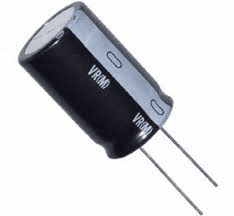
Capacitor
Electronics | Capacitor is an electronic circuit component. | ||||||||
|---|---|---|---|---|---|---|---|---|---|
A capacitor is a circuit element consisting of a dielectric (insulating) material placed between two conductive plates, storing energy in an electric field. Due to its property known as capacitance (C), it can temporarily store electric charge and release it into the circuit when needed. Figure 1 shows the schematic symbol of a nonpolarized capacitor.

Figure 1. Schematic Representation of a Nonpolarized Capacitor
(Source: Robotistan, 2025).
Capacitors are components that temporarily store electrical energy and deliver it to the circuit when required. In electronic circuits, they are used for filtering, timing, and noise reduction purposes. In power electronics, they function as voltage regulators in inverter and converter circuits. In industrial facilities, they are employed to improve power factor, provide phase shifting in asynchronous motors, and enable regulation in generators. In electric vehicles, supercapacitors are preferred for meeting sudden energy demands. In renewable energy systems and smart grid networks, they play a critical role in energy storage and voltage regulation. With their wide range of applications, capacitors are one of the indispensable components of electronics.
Capacitors are classified into different types based on their construction and intended use. Ceramic capacitors are used in high-frequency circuits and noise filtering applications, while electrolytic capacitors are preferred in circuits requiring high-capacity energy storage. Tantalum capacitors are found in mobile devices and sensitive electronics due to their compact size and high stability. Film capacitors are long-lived and are used in alternating current circuits and high-power applications. Supercapacitors, with their high energy storage capacity, play a key role in power backup systems and renewable energy applications. Each capacitor type is optimized for a specific application and performs critical functions in electronic and electrical engineering. Figure 2 shows a film capacitor and Figure 3 shows a ceramic capacitor.

Figure 2. Film Capacitor (Source: Robotistan, 2025).

Figure 3. Ceramic Capacitor (Source: Robotistan, 2025).
For capacitors connected in series, the total capacitance is calculated similarly to the parallel connection of resistors, using the formula 1/C_total = 1/C₁ + 1/C₂ + ... + 1/Cn; in this case, the total capacitance is lower than the smallest individual capacitor value. For capacitors connected in parallel, the total capacitance equals the sum of the individual capacitances and is calculated using the formula C_total = C₁ + C₂ + ... + Cn, meaning the capacitances are directly added to increase the total capacitance. Series connection is generally used to achieve higher voltage tolerance, while parallel connection is employed to obtain larger capacitance.
Alexander, Charles K., and Matthew N. O. Sadiku. Fundamentals of Electric Circuits. 6th ed. New York: McGraw-Hill Education, 2017.
Horowitz, Paul, and Winfield Hill. The Art of Electronics. 3rd ed. New York: Cambridge University Press, 2015.
Nilsson, James W., and Susan A. Riedel. Electric Circuits. 10th ed. Boston: Pearson, 2014.
Rashid, Muhammad H. Power Electronics: Circuits, Devices, and Applications. 4th ed. New York: Pearson, 2013.
Sedra, Adel S., and Kenneth C. Smith. Microelectronic Circuits. 7th ed. New York: Oxford University Press, 2015.

Capacitor
Electronics | Capacitor is an electronic circuit component. | ||||||||
|---|---|---|---|---|---|---|---|---|---|
Where Are Capacitors Used?
What Are the Types of Capacitors?
How Is the Capacitance Calculated for Series and Parallel Connected Capacitors?