


This article was automatically translated from the original Turkish version.
+1 More
Renyum
Symbol | Re | ||||||||
|---|---|---|---|---|---|---|---|---|---|
Periodic Table | 6 | ||||||||
Atomic Number | 75 | ||||||||
Group | 7 (Transition Metal) | ||||||||
Atomic Weight | (186.21) g/mol | ||||||||
Electron Configuration | [Xe] 4f¹⁴5d⁵6s² | ||||||||
Density | 21.02 g/cm³ | ||||||||
Melting Point | 3186 °C | ||||||||
Boiling Point | 5596 °C | ||||||||
Atomic Radius | 2.16 pm | ||||||||
Electronegativity | 1.9 | ||||||||
Electron Affinity | 14.47 kJ/mol | ||||||||
Important Isotopes | ¹⁸⁷Re (radioactive) ¹⁸⁵Re (stable) | ||||||||
Year of Discovery(ies) | 1925 | ||||||||
Discoverer(s) | Otto Berg Ida Tacke Walter Noddack | ||||||||
Etymology(s) | Latin "Rhenus" (Rhine River) | ||||||||
Rhenium is a rare transition metal located at the 75th position in the periodic table with a silvery white appearance. Rhenium is one of the densest elements and is notable for its exceptionally high melting and boiling points. Discovered in 1925 this element derives its name from the Rhine River in Europe and plays a key role in the production of high-temperature resistant superalloys.
Rhenium (Re) is a transition metal located in the 6th period and 7th group of the periodic table. Its electron configuration is [Xe] 4f¹⁴5d⁵6s². It exists as a solid at room temperature. Despite being an extremely dense metal it is highly machinable. It is known for having the second highest melting point after tungsten and the highest boiling point of all elements.
Rhenium was discovered in 1925 in Germany by Walter Noddack Ida Tacke and Otto Berg. These three scientists identified the presence of a new element while studying platinum ores and the mineral columbite using X-ray spectroscopy. They named the element after the Latin name of the Rhine River Rhenus reflecting the region where the discovery was made.

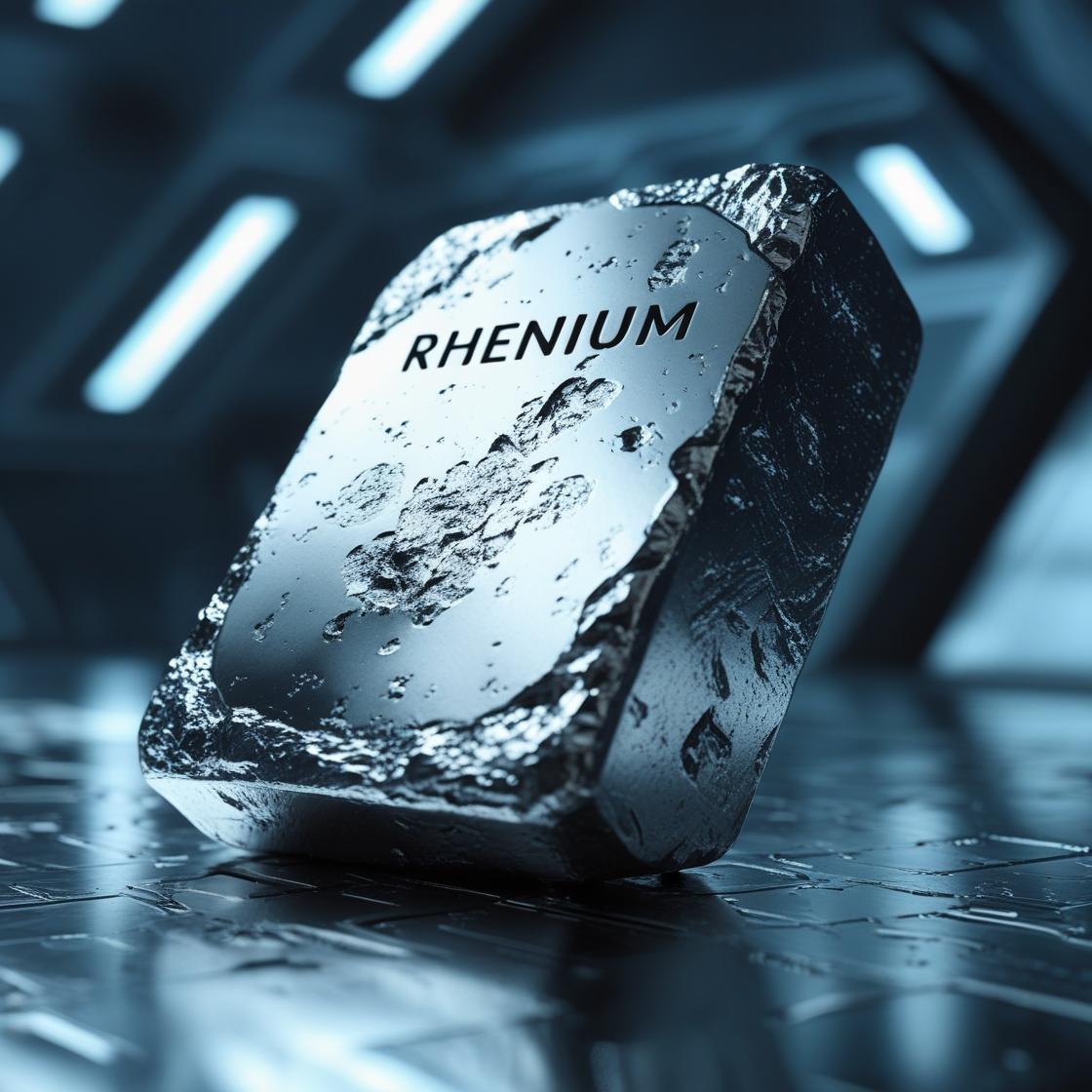
Rhenium (Generated by Artificial Intelligence.)
The name of the element is derived from the Latin word Rhenus which refers to the Rhine River one of Europe’s most important rivers.
Rhenium is one of the rarest elements in the Earth’s crust. It does not occur naturally in its free state. It is typically found in very low concentrations within molybdenum ores such as molybdenite. In fact only about one gram of rhenium can be extracted from approximately 660 kilograms of molybdenite ore. Commercially it is produced as a byproduct of copper and molybdenum mining operations primarily in countries such as Chile the United States and Poland.
Rhenium is a silvery white extremely dense metal with a density of approximately 21.02 g/cm³. Its melting point is 3186 °C and its boiling point is an extraordinary 5596 °C. These properties make it ideal for high-temperature applications.
Chemically it is quite stable and resistant to corrosion. However it can dissolve in strong acids such as nitric acid and sulfuric acid.
Rhenium has two naturally occurring isotopes. One is the stable isotope ¹⁸⁵Re and the other is the radioactive isotope ¹⁸⁷Re which has an extremely long half-life of approximately 41 billion years. The decay of ¹⁸⁷Re over time into the isotope ¹⁸⁷Os (Osmium) is known in geology as the rhenium-osmium (Re-Os) dating method and is used to determine the age of rocks.
Rhenium has no known biological role. The element and its compounds have low toxicity. Due to its rarity and high cost the likelihood of most people encountering rhenium in daily life is extremely low. Therefore it poses no significant hazard to the general public.
National Center for Biotechnology Information. "Rhenium." *PubChem Compound Database.* Accessed July 7, 2025. https://pubchem.ncbi.nlm.nih.gov/compound/Rhenium
TÜBİTAK Bilim Genç. "Renyum." *Bilim Genç.* Accessed July 7, 2025. https://bilimgenc.tubitak.gov.tr/periyodik-tablo/renyum

Renyum
Symbol | Re | ||||||||
|---|---|---|---|---|---|---|---|---|---|
Periodic Table | 6 | ||||||||
Atomic Number | 75 | ||||||||
Group | 7 (Transition Metal) | ||||||||
Atomic Weight | (186.21) g/mol | ||||||||
Electron Configuration | [Xe] 4f¹⁴5d⁵6s² | ||||||||
Density | 21.02 g/cm³ | ||||||||
Melting Point | 3186 °C | ||||||||
Boiling Point | 5596 °C | ||||||||
Atomic Radius | 2.16 pm | ||||||||
Electronegativity | 1.9 | ||||||||
Electron Affinity | 14.47 kJ/mol | ||||||||
Important Isotopes | ¹⁸⁷Re (radioactive) ¹⁸⁵Re (stable) | ||||||||
Year of Discovery(ies) | 1925 | ||||||||
Discoverer(s) | Otto Berg Ida Tacke Walter Noddack | ||||||||
Etymology(s) | Latin "Rhenus" (Rhine River) | ||||||||
Classification and Basic Properties
Discovery
Etimology
Natural Occurrence
Physical and Chemical Properties
Isotopes
Applications
Biological Role and Precautions