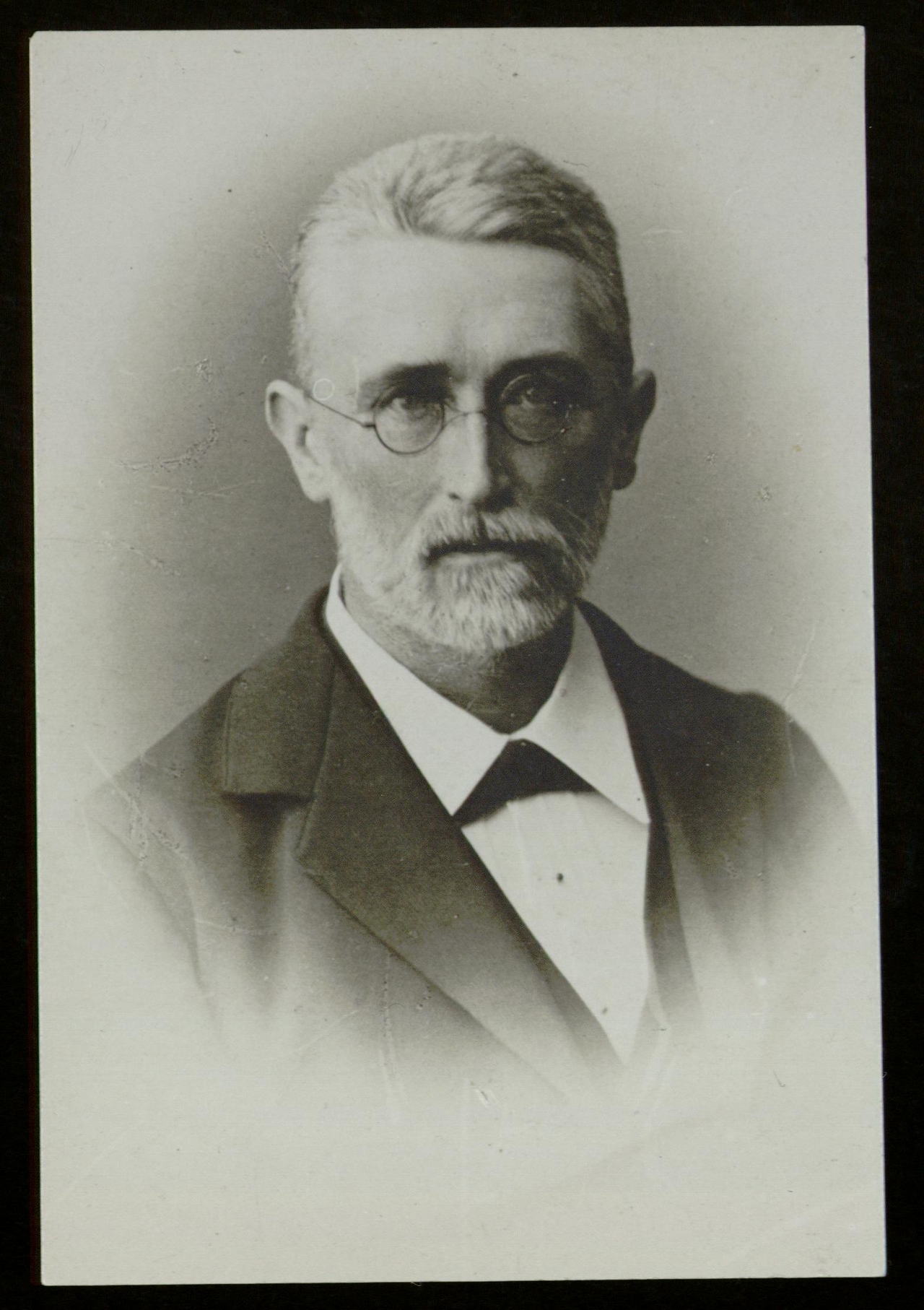

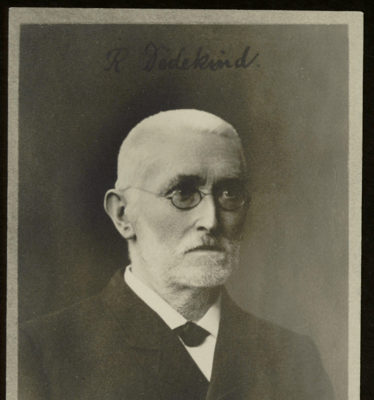

Richard Dedekind (1831–1916) was a central figure in the theoretical transformation of 19th-century mathematics, playing a foundational role in the arithmetization of analysis and the construction of the structural foundations of modern algebra. By advocating a structural and logical methodology that viewed mathematics as a logical system—through the axiomatic definition of natural numbers (Dedekind-Peano axioms) and the systematic use of set-theoretic methods—he laid the theoretical framework for 20th-century abstract mathematics.
Julius Wilhelm Richard Dedekind was born on 6 October 1831 in Braunschweig, Germany, as the youngest child of an academic family. His father was a professor of law at the Collegium Carolinum, and his mother was the daughter of another professor. He began his education at the age of seven at the Martino-Catharineum school in Braunschweig, where he initially showed interest in physics and chemistry. However, dissatisfied with the methodological rigor of physics, he shifted his focus to mathematics. In 1848 he entered the Collegium Carolinum, which served as a bridge between secondary and university education, where he gained proficiency in differential and integral calculus and analytic foundations.
In 1850 Dedekind moved to the University of Göttingen, one of Europe’s leading centers for scientific research. There he became the last doctoral student of Carl Friedrich Gauss and completed his doctorate in 1852 with a thesis on Euler integrals. After graduation, he undertook two years of private study to address gaps in his mathematical training. In 1854 he obtained his habilitation simultaneously with his colleague Bernhard Riemann and began lecturing at Göttingen as a privatdozent without salary【1】.
During his four-year tenure as a lecturer at Göttingen, Dedekind was deeply influenced by his scientific contacts with P.G.L. Dirichlet, Gauss’s successor, and Bernhard Riemann. In particular, his regular academic discussions with Dirichlet played a decisive role in his mathematical maturation. In 1858 he was appointed to his first full professorship at the Zurich Polytechnic, now known as ETH Zurich, where he remained until 1862. In 1862 he returned to his native Braunschweig, accepted a professorship at the local university, and continued his academic activities there until his retirement in 1896.
Dedekind’s scientific output focused on establishing analysis on an axiomatic foundation and defining modern algebraic structures. In his 1872 work Stetigkeit und irrationale Zahlen (Continuity and Irrational Numbers), he defined irrational numbers purely through an arithmetical method known as “Dedekind cuts,” eliminating reliance on geometric intuition and clarifying the concept of continuity【2】. In his 1888 work Was sind und was sollen die Zahlen? (What Are Numbers and What Should They Be?), he defined natural numbers within the framework of set theory and formulated the principles now known as the Dedekind-Peano Axioms. In algebraic number theory, he developed the theory of Ideals through additions to Dirichlet’s lecture notes and introduced fundamental mathematical concepts such as “field,” “module,” and “lattice” into the literature【3】.
Dedekind regarded mathematics as a free creation of the human mind and argued that numbers are not ontological entities but logical structures. Within the framework of logicism, he pursued a methodology that reduced arithmetic and analysis to the concepts of object, set (system), and function (mapping). This approach, which emphasized the relational and structural properties of mathematical objects over their intrinsic features, has led him to be recognized as one of the pioneers of modern structuralism【4】.
Dedekind never married and spent much of his adult life living with his sister. This domestic arrangement is understood to have provided him with the stable environment necessary for his scientific research. He had a lifelong interest in music, playing the cello in his youth and the piano in later years. By nature modest and introverted, he declined prestigious academic appointments offered by leading institutions and chose instead to live a quiet life in Braunschweig.
Even after retirement, Dedekind maintained his academic interests and was elected a member of prestigious scientific academies in Göttingen, Berlin, and Paris, and received honorary doctorates from various universities. He died in Braunschweig on 12 February 1916 at the age of 84. The theoretical foundations and methodological approaches he developed proved decisive for the evolution of 20th-century abstract algebra and exerted a profound influence on the work of figures such as Cantor, Hilbert, and Noether.
[1]
J. J. O’Connor ve E. F. Robertson, “Richard Dedekind,” MacTutor History of Mathematics Archive, University of St Andrews, accessed 20 February 2026, https://mathshistory.st-andrews.ac.uk/Biographies/Dedekind/
[2]
Michael Hallett, “Dedekind’s Contributions to the Foundations of Mathematics,” Stanford Encyclopedia of Philosophy, accessed 20 February 2026, https://plato.stanford.edu/entries/dedekind-foundations/
[3]
Michael Hallett, “Dedekind’s Contributions to the Foundations of Mathematics,” Stanford Encyclopedia of Philosophy, accessed 20 February 2026, https://plato.stanford.edu/entries/dedekind-foundations/
[4]
Erich H. Reck, “Dedekind’s Contributions to the Foundations of Mathematics,” colloquium presentation, University of California, Irvine, November 2007, accessed 20 February 2026, https://www.lps.uci.edu/files/colloquia/07-08/Reck-D%27s%20Contr.%20%28Nov.%2007%29.pdf

Early Life and Academic Preparation
Göttingen Period and Scientific Formation
Academic Career and Institutional Activities
Mathematical Work and Theoretical Contributions
Methodological and Philosophical Perspective: Logicism and Structuralism
Personal Life and Social Identity
Later Years and Scientific Legacy