

This article was automatically translated from the original Turkish version.
+2 More
Structure Type(s) | Circular Structure Formed by Magmatic Intrusion | ||||||||
|---|---|---|---|---|---|---|---|---|---|
Location | Taoudeni Basin Adrar Plateau Northwestern Mauritania | ||||||||
Cultural Significance | Tourist Visit Area Scientific Research Geological and Geomorphological Value | ||||||||
Important Features | Hydrothermally Altered Central Area Circular Magnetic Anomalies | ||||||||
Main Rock Types | Siliceous Breccia Carbonatite Rhyolite Gabbro | ||||||||
Geological Period | Upper Cretaceous | ||||||||
Diameter | Approximately 50 km | ||||||||
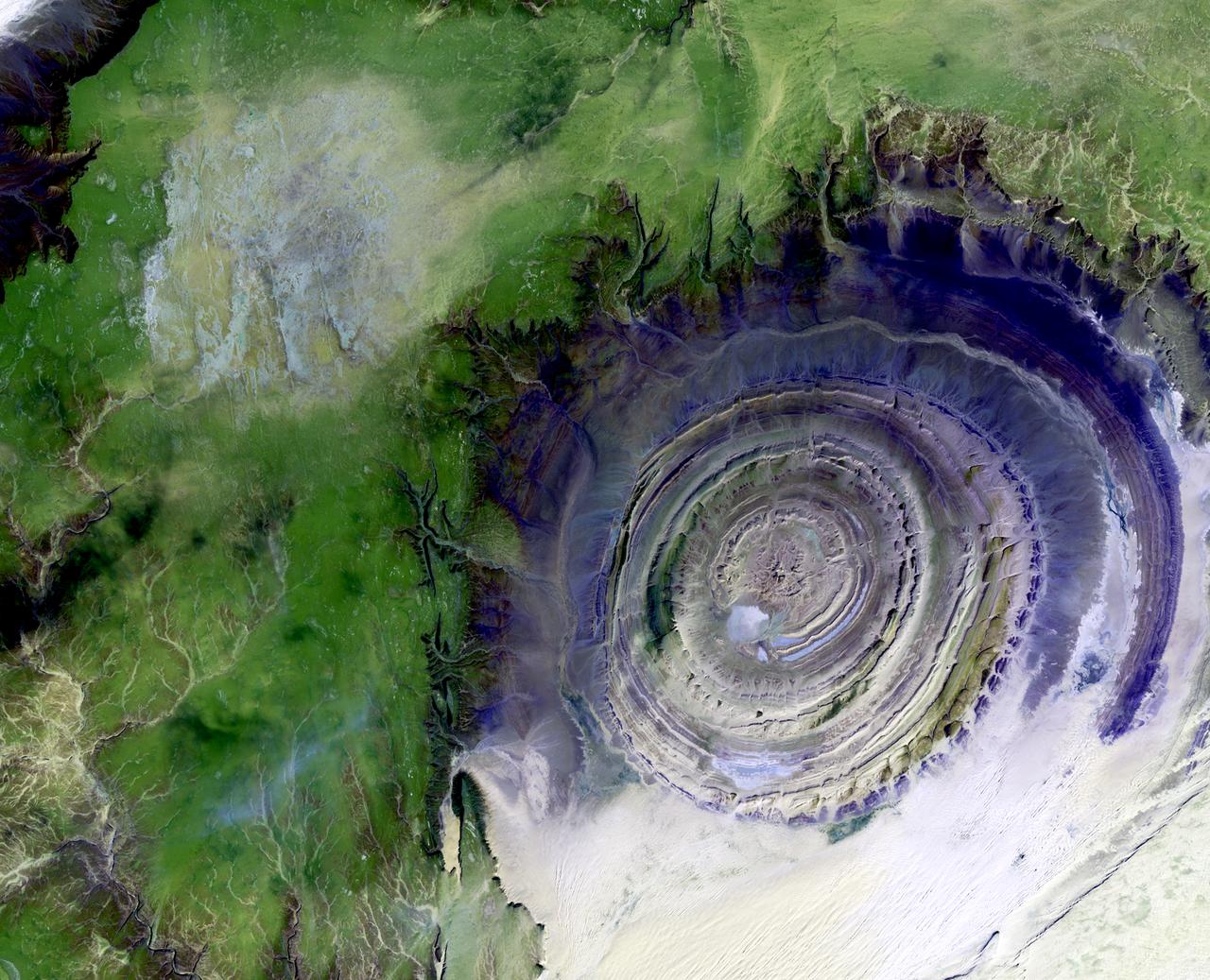
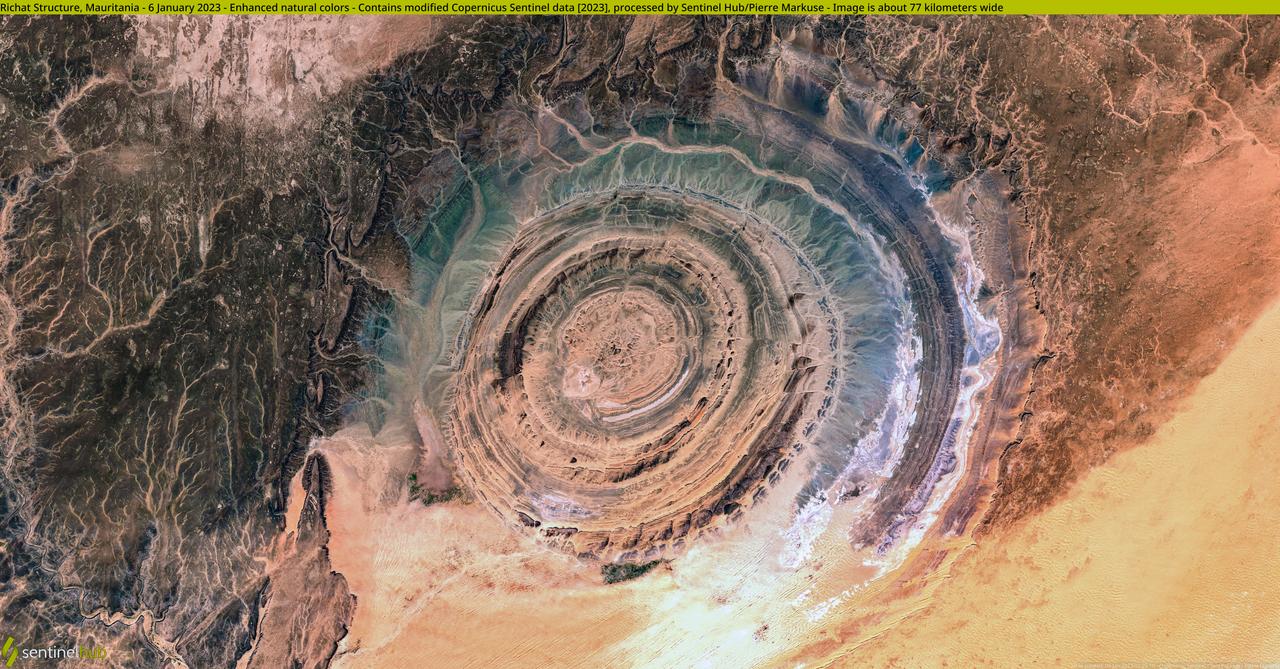
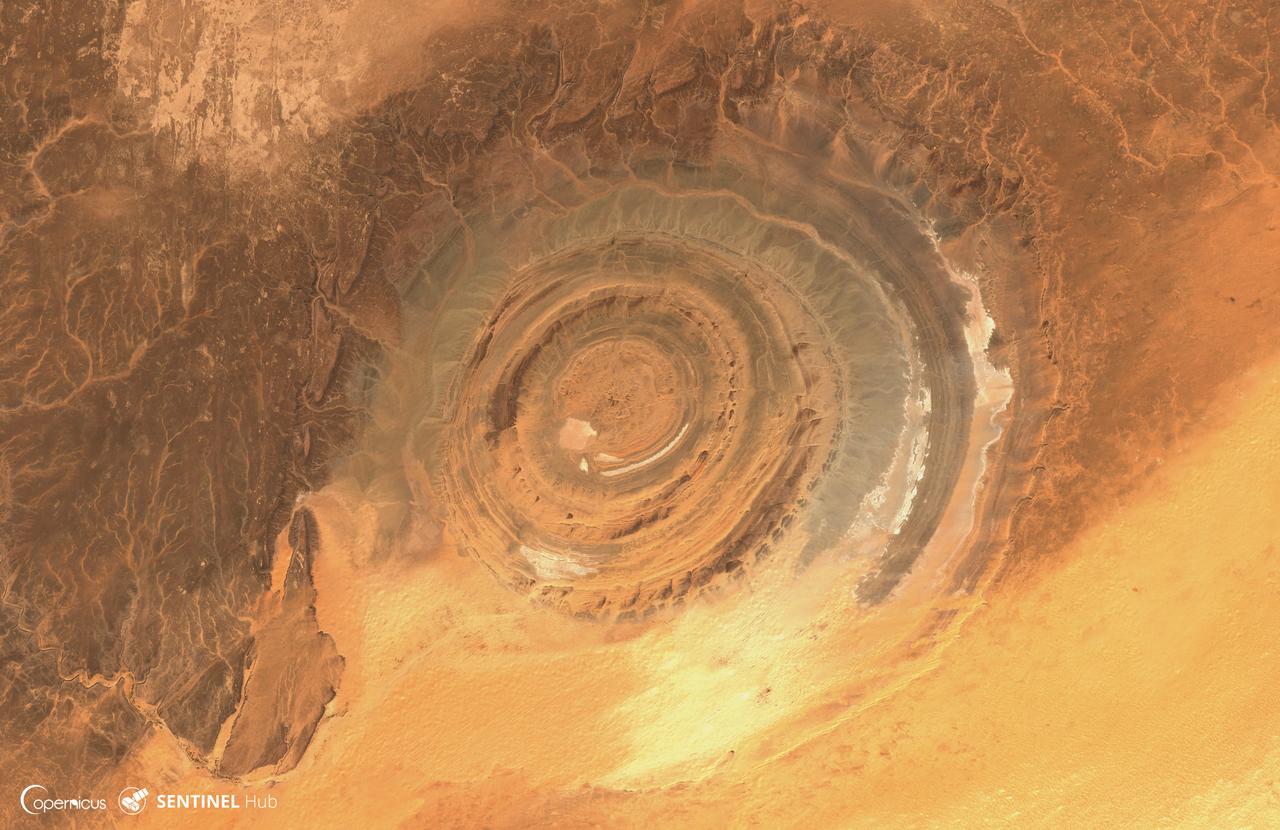
Richat Structure (Richat Structure), located within the Taoudeni basin in northwestern Mauritania, is a circular geological feature approximately 40 km in diameter. At the surface, concentric ridges and depressions formed by Proterozoic and Early Paleozoic sedimentary rocks are observed. The structure is cut by various magmatic rocks including gabbro, rhyolite, carbonatite and breccia. Multiple geophysical data indicate the presence of a large mafic magmatic body beneath Richat and suggest that the surface circular structure resulted from this intrusion. Due to its geological and geophysical characteristics, Richat constitutes an important example for studying magmatic circular structures.
The discovery and scientific study of the Richat Structure began in the 1950s through aerial photographs. Initial observations revealed its ring-shaped map pattern and approximate 50 km diameter. Initially, the distribution of magmatic and sedimentary rocks on the structure was determined solely by surface observations and limited field studies. In the 1960s, Cailleux and colleagues proposed the meteorite impact hypothesis, leading to Richat being referred to as the “Eye of Africa”. However, subsequent geological research and radiometric dating revealed that the structure formed primarily due to magmatic intrusion and associated doming. Ages obtained from sedimentary and magmatic rocks within the structure have been dated to the Cretaceous period, largely invalidating the meteorite hypothesis.【1】
Richat Structure (Flickr)
Since the 1970s, the Richat Structure has been the focus of geochemical, petrographic and geophysical studies. Work by Blanc and Pomerol, Trompette, and Woolley and colleagues has provided detailed analyses of rock types, magmatic characteristics and dike distributions. From the 1990s onward, high-resolution airborne magnetic and satellite-based gravity data have been used to model deep magmatic intrusions and ring gabbroic dikes within the structure.【2】 This process has comprehensively revealed the history of the Richat Structure not only in terms of discovery and surface observations but also through modern geophysical techniques for deep structure analysis.
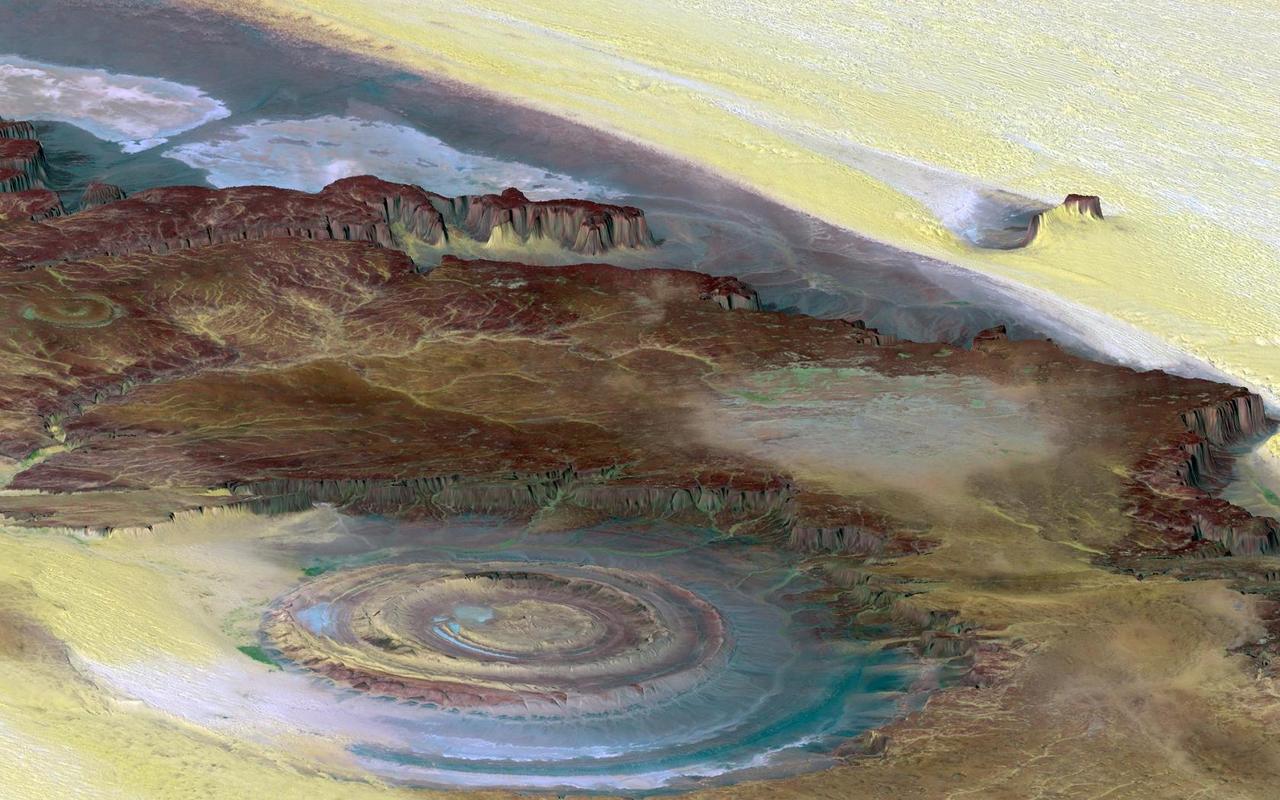
The Richat Structure is located in the northwestern part of the Taoudeni intracratonic basin in western Mauritania and encompasses the region’s late Proterozoic–Early Paleozoic sedimentary sequences. The central area, known as “Guelb”, consists of stromatolitic dolomites and siliceous breccias and covers a surface area of approximately 4 km².【3】 The sedimentary layers dip outward at angles of 10–20° toward the center, forming concentric ridges and depressions around the structure.【4】 These sedimentary sequences consist of sandstones, limestones and siliceous breccias, and the different lithological units within the structure reveal the region’s geological evolutionary history.
The Richat Structure is characterized by distinct magmatic rocks overlying this sedimentary basement. Gabbro, dolerite, rhyolite, carbonatite and volcanic breccias constitute the main intrusions. Gabbroic rocks are particularly abundant in the inner and outer ring dikes, while carbonatite dikes are limited to smaller areas in the north and south. Rhyolitic outcrops occur around the central depression and show signs of hydrothermal alteration. These magmatic units indicate that the structure formed during Cretaceous volcanic and plutonic activity and interacted with the surrounding sedimentary rocks.
The Richat Structure features a central area surrounded by concentric rings, with a core composed of siliceous breccias. This core is defined as a zone where upper sedimentary layers have been dissolved and brecciated by hydrothermal processes. Surrounding sedimentary ridges are arranged in concentric rings according to lithological differences, and the outer rings contain Proterozoic and Paleozoic sandstones and limestones. This structure demonstrates a doming phenomenon caused by magmatic intrusion.
Richat Structure (Flickr)
The magmatic features of the structure are evident in the distribution of rock types and intrusion geometry. Gabbroic dikes found in the inner and outer rings are defined as ring dikes with thicknesses ranging from 30 to 70 m, locally exposed at the surface. Carbonatite dikes are narrower and more vertical, extending up to approximately 300 m in length.【5】 Rhyolitic rocks occur around the central depression and typically display red-pink coloration with evidence of hydrothermal alteration. Magmatic intrusions, particularly the gabbroic bodies, are inferred to extend to depths of 1.5–2 km in width and approximately 1.8 km in depth, indicating that a large intrusive magmatic mass lies beneath the surface dome structure of Richat.【6】
Fault and fracture systems identified around the Richat Structure reveal a multi-stage tectonic evolution affecting both its magmatic and sedimentary components. Two main fault systems observed in the structure differ in origin and scale. The first consists of long faults cutting through the outer rings, predominantly oriented NNE-SSW; these faults extend up to 10 km and exhibit sinistral strike-slip with extensional characteristics.【7】 Their presence reflects stress regimes that reactivated older structures during the regional Pan-African tectonic event. The second system includes shorter faults oriented NE-SW and ENE-WSW, observed in the core and eastern part of the structure; these faults exhibit both extensional and dextral or sinistral movement.
The morphology of the fault and fracture network directly influences the surface shape of the Richat Structure and the distribution of magmatic intrusions. Radially arranged short fractures indicate syn-magmatic extension formed during magma ascent. These structures may have controlled the orientation and emplacement of intrusions by cutting across the concentric rings. The combination of regional and local fault systems explains the complex tectonic character of the structure and supports the mechanism of doming caused by intrusive magmatic bodies.
High-resolution airborne magnetic, satellite gravity and radiometric datasets play a fundamental role in investigating the deep structure of the Richat Structure. Airborne magnetic data have been used to identify gabbroic ring dikes and smaller deep-seated magnetic anomalies. Analytical signal and vertical magnetic gradient calculations enable differentiation between shallow structures and deeply buried magmatic bodies. Satellite gravity data confirm the presence of a high-density magmatic mass beneath the structure and reveal that a broad mafic intrusion underlies the surface circular feature of Richat.
Richat Structure (Flickr)
Geophysical modeling, combining these datasets, provides detailed reconstructions of the internal structure of the Richat Structure. Two-dimensional (2D) models compare magnetic and gravity anomalies to determine the dip angle and depth of gabbroic dikes. Models indicate that the main intrusion lies beneath the surface circular structure and suggest the possible presence of an undetected kimberlite intrusion in the northern part of the structure. These geophysical approaches facilitate understanding of the deep geometry of Richat and its relationship with regional structures linked to hydrothermal activity.
Conservation of the Richat Structure requires sustainable management of its natural geological features and scientific value. The region is largely covered by natural stone and sedimentary formations and is highly susceptible to wind and water erosion; therefore, limited access and controlled field studies are implemented to protect geological formations. Relevant official institutions in Mauritania are developing site management plans by inventorying geological heritage areas and regulating mining, construction and tourism activities in the region. Additionally, under the framework of geotourism, visitor pathways and informational signage are established to ensure visitor safety and prevent damage to sensitive rocks and surface formations. Management strategies also regulate data collection and sampling activities to enable scientific research, aiming for long-term geological and ecological preservation.
The Richat Structure holds cultural and touristic importance in addition to its geological uniqueness. The region is frequently visited by scientists and geotourists due to its prominent ring formation visible from space. Tourism activities are restricted to specific routes and observation points to ensure safe visits and protect the natural structure. Visitors receive educational information through interpretive signage and guided tours regarding the region’s sedimentary layers and magmatic formations, while local communities are supported through balanced management of cultural heritage and economic activities.
Abdeina, El Houssein, Sara Bazin, Gilles Chazot, Hervé Bertrand, Bernard Le Gall, Nasrrddine Youbi, Mohamed Salem Sabar, Mohamed Khalil Bensalah, and Moulay Ahmed Boumehdi. “Geophysical modelling of the deep structure of the Richat magmatic intrusion (northern Mauritania): insights into its kinematics of emplacement.” *Arabian Journal of Geosciences* 14, no. 22 (2021): 1–19. Accessed March 6, 2026. https://www.researchgate.net/publication/355898398_Geophysical_modelling_of_the_deep_structure_of_the_Richat_magmatic_intrusion_northern_Mauritania_insights_into_its_kinematics_of_emplacement
Copernicus. "The Richat Structure, Mauritania." Image of the Day. October 4, 2025. Accessed March 6, 2026. https://www.copernicus.eu/en/media/image-day-gallery/richat-structure-mauritania
European Space Agency. “The Richat structure, Mauritania.” ESA – Observing the Earth. November 11, 2004. Accessed March 6, 2026. https://www.esa.int/Applications/Observing_the_Earth/The_Richat_structure_Mauritania
Hub, Sentinel. “Richat Structure, Mauritania – 6 January 2023.” Flickr. Accessed March 6, 2026. https://www.flickr.com/photos/sentinelhub/52616008386/
Hub, Sentinel. “Richat Structure, Mauritania.” Flickr. Accessed March 6, 2026. https://www.flickr.com/photos/sentinelhub/49657367588/
Matton, Guillaume, and Michel Jébrak. “The ‘eye of Africa’ (Richat dome, Mauritania): An isolated Cretaceous alkaline-hydrothermal complex.” *Journal of African Earth Sciences* 97 (2014): 109–124. Accessed March 6, 2026. https://www.academia.edu/9220436/The_eye_of_Africa_Richat_dome_Mauritania_An_isolated_Cretaceous_alkaline_hydrothermal_complex
Motion, Sparkle. “Richat-Structure.” Flickr. Accessed March 6, 2026. https://www.flickr.com/photos/54125007@N08/14872181138/
NASA Earth Observatory. "Richat Structure, Mauritania." NASA Science. June 26, 2002. Accessed March 6, 2026. https://science.nasa.gov/earth/earth-observatory/richat-structure-mauritania-2561/
NASA Goddard Space Flight Center. “Richat Structure.” Flickr. Accessed March 6, 2026. https://www.flickr.com/photos/gsfc/4404055899/
Trodel, Jim. “Richat Structure – Sahara Desert, Ouadane, Mauritania.” Flickr. Accessed March 6, 2026. https://www.flickr.com/photos/trodel/3598598633/
[1]
El Houssein Abdeina, Sara Bazin, Gilles Chazot, Hervé Bertrand, Bernard Le Gall, Nasrrddine Youbi, Mohamed Salem Sabar, Mohamed Khalil Bensalah ve Moulay Ahmed Boumehdi, “Geophysical Modelling of the Deep Structure of the Richat Magmatic Intrusion (Northern Mauritania): Insights into Its Kinematics of Emplacement,” Arabian Journal of Geosciences 14, no. 22 (2021): 2, Son Erişim: 6 Mart 2026, https://www.researchgate.net/publication/355898398_Geophysical_modelling_of_the_deep_structure_of_the_Richat_magmatic_intrusion_northern_Mauritania_insights_into_its_kinematics_of_emplacement
[2]
A.e., syf. 1
[3]
A.e., syf. 4
[4]
A.e., syf. 2
[5]
A.e., syf. 4-5
[6]
A.e., syf. 11
[7]
A.e., syf. 5

Structure Type(s) | Circular Structure Formed by Magmatic Intrusion | ||||||||
|---|---|---|---|---|---|---|---|---|---|
Location | Taoudeni Basin Adrar Plateau Northwestern Mauritania | ||||||||
Cultural Significance | Tourist Visit Area Scientific Research Geological and Geomorphological Value | ||||||||
Important Features | Hydrothermally Altered Central Area Circular Magnetic Anomalies | ||||||||
Main Rock Types | Siliceous Breccia Carbonatite Rhyolite Gabbro | ||||||||
Geological Period | Upper Cretaceous | ||||||||
Diameter | Approximately 50 km | ||||||||
History
Geology and Rocks
Structure and Magmatic Features
Faults and Tectonic Structure
Geophysical Data and Models
Conservation and Management
Cultural and Touristic Significance