This article was automatically translated from the original Turkish version.
+1 More
Rock-Hewn Churches of Lalibela
Location | Lalibela Ethiopia Amhara Region | ||||||||
|---|---|---|---|---|---|---|---|---|---|
Construction Date(s) | 12th–13th centuries (between 1181 and 1221) | ||||||||
Patron | King Gebre Mesqel Lalibela (Zagwe Dynasty) | ||||||||
Number of Churches | Total of 11 rock-hewn churches | ||||||||
World Heritage | On the UNESCO World Heritage List since 1978 | ||||||||
Elevation(s) | Approximately 2 630 metres 500–2 | ||||||||
Rock-Hewn Churches of Lalibela are located in the town of Lalibela, in the Amhara region of Ethiopia, at an elevation of approximately 2,500–2,630 meters above sea level and about 600 kilometers north of the capital Addis Ababa. Built between the 12th and 13th centuries, this complex is one of the holiest sites of Ethiopian Orthodox Christianity and remains an active place of worship and pilgrimage today.
The rock-hewn churches were commissioned by King Gebre Mesqel Lalibela of the Zagwe Dynasty, who ruled from 1181 to 1221, in response to the increasing difficulty of Christian pilgrimages to Jerusalem due to Muslim conquests. Lalibela intended the site to be a “New Jerusalem,” and its names and symbols explicitly reference holy sites in Jerusalem: “River Jordan,” “Golgotha,” and “Tomb of Adam.” According to traditional accounts, divine assistance from angels played a role in the construction of these churches. The structures form part of a sacred capital project designed to reinforce both the religious leadership and political authority of King Lalibela.

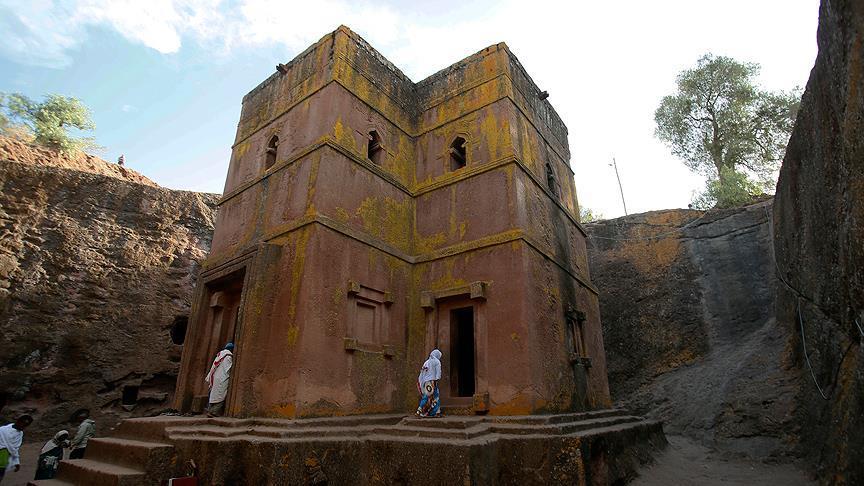
Rock-Hewn Churches of Lalibela (Anadolu Agency)
A total of eleven churches were carved out of a single reddish-brown soft volcanic rock. The structures are divided into two main complexes—north and southeast—and one independent church.
The churches were constructed using monolithic and semi-monolithic techniques. First, the rock mass was outlined in a rectangular form, then carved downward from the top; doors, windows, arches, columns, and ceiling structures were excavated from within the single rock block. Cisterns, drainage channels, passageways, and underground tunnels connected the churches and protected them from flooding. Most of the churches show architectural influences from the Aksumite Empire.
The structures attract attention not only for their religious function but also for their rich symbolism. Architectural decorations incorporate figurative and geometric elements from Aksumite culture, the Bible, and Ethiopian Christianity. The façade of Biete Meskel is surrounded by blind arches symbolizing the Ten Commandments of the Old Testament. Biete Mariam features fresco-like colored wall decorations alongside cross motifs.

Rock-Hewn Churches of Lalibela (Anadolu Agency)
Lalibela has remained one of Ethiopia’s most important religious centers since the country adopted Christianity in the 4th century. Worship continues daily in the churches. During major festivals such as 7 January (Genna – Ethiopian Orthodox Christmas), thousands of pilgrims flock to these sacred sites.
Lalibela was inscribed on the UNESCO World Heritage List in 1978 due to its universal value in both religious and architectural terms. However, over time, seismic activity, water erosion, structural deterioration, and tourism pressure have caused damage to some churches. Some structures, such as Biete Amanuel, face risks of collapse, and significant deterioration is evident in wall paintings. Temporary shelters have been erected to protect the sites, but these interventions affect visual integrity.
Management of the Lalibela site is carried out in collaboration between the Authority for Research and Conservation of Cultural Heritage (ARCCH) of Ethiopia and the Ethiopian Orthodox Church. However, a comprehensive management plan has not yet been approved, and a buffer zone has not been officially designated. The Conservation Plan prepared in 2006 has not yet been fully implemented. A holistic planning approach that includes community participation is needed to ensure sustainable conservation of the site.
Abbate, Michelle. “Rock-Hewn Churches of Lalibela.” Biblical Archaeology Society, April 19, 2016. https://www.biblicalarchaeology.org/daily/ancient-cultures/ancient-near-eastern-world/rock-hewn-churches-of-lalibela/.
Anadolu Ajansı. “Etiyopyalıların İkinci Kudüs’ü: Lalibela.” Anadolu Ajansı, March 9, 2019. Accessed June 20, 2025. https://www.aa.com.tr/tr/dunya/etiyopyalilarin-ikinci-kudusu-lalibela-/1384805.
UNESCO Dünya Heritage Centre. "Rock-Hewn Churches of Lalibela." UNESCO World Heritage Centre. Accessed June 20, 2025. https://whc.unesco.org/en/list/18/.
Windmuller-Luna, Kristen. “The Rock-Hewn Churches of Lalibela.” Heilbrunn Timeline of Art History. New York: The Metropolitan Museum of Art, September 1, 2014. https://www.metmuseum.org/essays/the-rock-hewn-churches-of-lalibela.
World Monuments Fund. "Rock-Hewn Churches." World Monuments Fund. Accessed June 20, 2025. https://www.wmf.org/projects/rock-hewn-churches.

Rock-Hewn Churches of Lalibela
Location | Lalibela Ethiopia Amhara Region | ||||||||
|---|---|---|---|---|---|---|---|---|---|
Construction Date(s) | 12th–13th centuries (between 1181 and 1221) | ||||||||
Patron | King Gebre Mesqel Lalibela (Zagwe Dynasty) | ||||||||
Number of Churches | Total of 11 rock-hewn churches | ||||||||
World Heritage | On the UNESCO World Heritage List since 1978 | ||||||||
Elevation(s) | Approximately 2 630 metres 500–2 | ||||||||
No Discussion Added Yet
Start discussion for "Rock-Hewn Churches of Lalibela" article
Historical and Religious Significance
Architectural Features
Structures
Construction Technique and Structural System
Artistic and Symbolic Details
Pilgrimage and Daily Use
Conservation Status and UNESCO Designation
Management and Conservation Needs