


This article was automatically translated from the original Turkish version.
+1 More
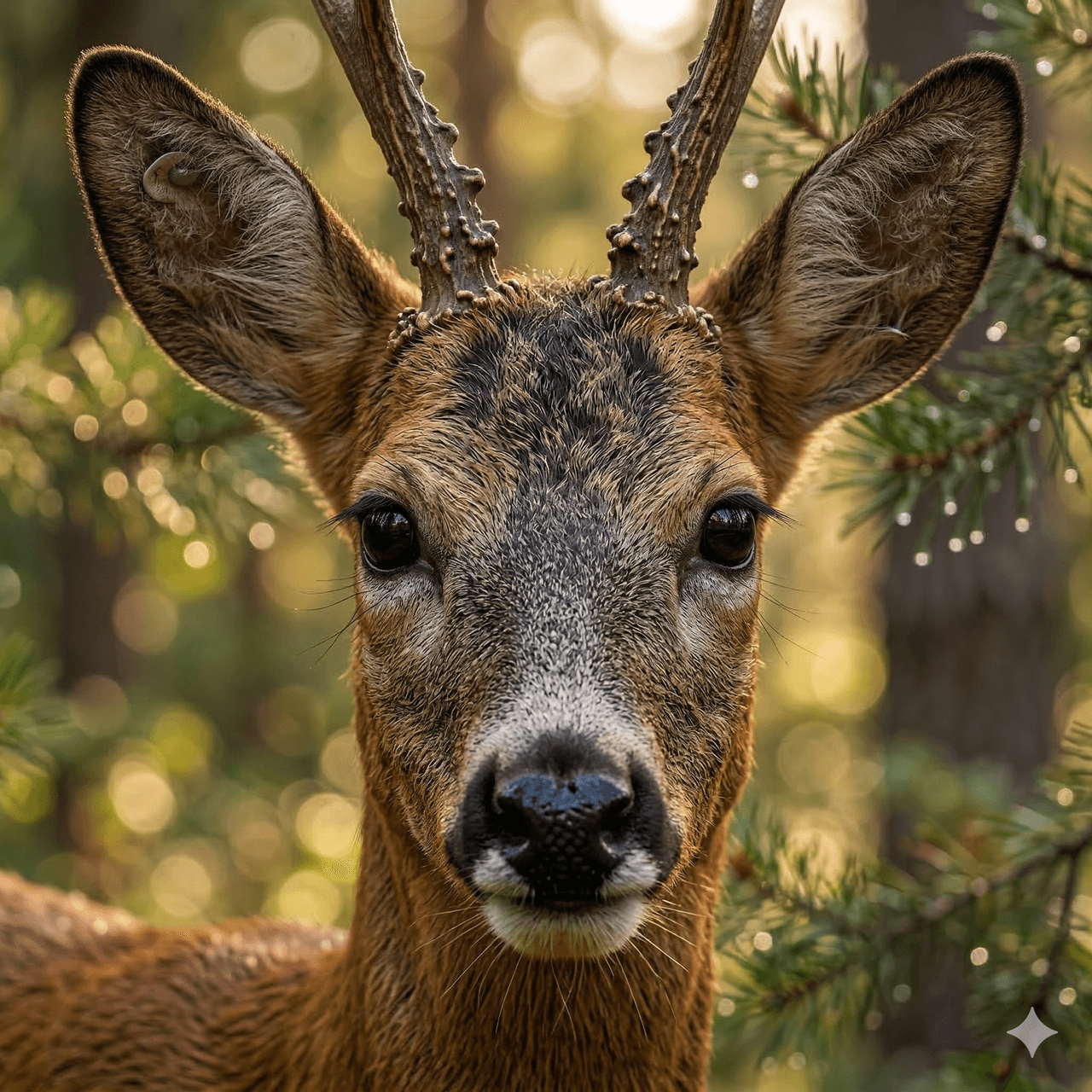
Karaca
(Görsel Yapay Zeka ile Oluşturulmuştur)
Roe deer (Capreolus capreolus)
Scientific Name(s) | Capreolus capreolus | ||||||||
|---|---|---|---|---|---|---|---|---|---|
Weight(s)(Text) | 18-35 kg average mass | ||||||||
Size(s) | 65-75 cm height 100-126 cm length | ||||||||
Conservation Status(es) | Low risk (LC) status | ||||||||
Distinguishing Mark | White spot known as 'mirror' in the tail region | ||||||||
Natural Lifespan | Average 7-8 years, maximum 18 years | ||||||||
Gestation Period | Between 264 and 318 days | ||||||||
Active Period | Sunrise and sunset hours | ||||||||
Horn Characteristic | Short and branched structure present only in males | ||||||||
Speed Capacity | Short bursts, running up to 70 km per hour | ||||||||
Feeding Model | Tree leaves, shoots, fruits, grasses | ||||||||
Winter Fur Color | Pale buff color, grayish brown | ||||||||
Summer Fur Color | Bright rust red, reddish brown | ||||||||
Distribution in Türkiye | All regions with high density in the Black Sea and Marmara | ||||||||
Distribution Area | Wide geographic range from Northern Europe to Central Asia | ||||||||
Roe deer (Capreolus capreolus) is the smallest deer species found in Europe and Türkiye, belonging to the family Cervidae (deer) within the order Artiodactyla (even-toed ungulates) of the class Mammalia. Body weights range from an average of 18 to 35 kilograms, with heights of 65–75 centimetres and total lengths of 95–140 centimetres. Only males possess short, branched, and rough-surfaced antlers, a clear indicator of sexual dimorphism; however, there is little size difference between males and females.

Roe deer (Capreolus capreolus)
(Generated by Artificial Intelligence)
Roe deer have a slender build characterized by long, thin legs and a relatively long neck. Their eyes are large, with long eyelashes on the upper eyelids. Ears are notably large compared to body size (12–16 centimetres), oriented forward and slightly upward.
The tail is very short, measuring only 2 to 3 centimetres, with a prominent, broad, white patch known as the “mirror” at its base. The coat colour varies seasonally: in summer it is reddish-brown or rust-coloured, while in winter it thickens and turns grey or brownish-grey. The underparts of the body are generally lighter in colour.
Two species are recognized under the genus Capreolus: Capreolus capreolus and Capreolus pygargus, the latter found in Northeast Asia. Capreolus capreolus is distributed across the entire European continent except its northernmost regions, as well as in the Caucasus, northern Syria, Iraq, and Iran.
In Türkiye, the population is primarily concentrated in the Black Sea and Marmara regions, but also inhabits remnant forested areas in the Aegean, Mediterranean, Southeastern Anatolia, Hakkari, and Central Anatolia. Systematically, Turkish roe deer are generally classified as the nominate subspecies (European form); however, taxonomic records indicate that populations in eastern Black Sea belong to C. c. armenius, while those in Hatay and Hakkari belong to C. c. coxi.
In terms of habitat, the species primarily inhabits deciduous, coniferous, or mixed forests, agricultural lands, grasslands, and forest clearings. The species generally avoids areas with high human activity such as roads and settlements.

Roe deer and fawn
(Generated by Artificial Intelligence)
Roe deer are active throughout the 24-hour cycle, showing peak activity around dawn and dusk. Their diet consists of fresh shoots and leaves of deciduous trees, herbaceous plants, ferns, fruits such as blackberry, and in winter, mosses and lichens, depending on habitat and season.
They are short-distance sprinters capable of reaching speeds up to 70 kilometres per hour. Although they do not undertake long-distance migrations, they make seasonal vertical movements, ascending to higher elevations in summer and descending to valleys or fields in winter in response to climatic conditions and food availability.
Social structure varies seasonally: in winter, individuals form small groups of 4–5 animals, while in summer adult males become solitary and exhibit territorial behaviour. During the breeding season, dominant males engage in intense antler fights to defend their territories, sometimes resulting in death.
The breeding season begins in July and lasts until late August. After mating, the fertilized egg remains dormant in the female’s uterus for several months before implantation begins; this makes the roe deer the only even-toed ungulate known to exhibit delayed implantation.

Roe deer (Capreolus capreolus)
(Generated by Artificial Intelligence)
After a total gestation period of approximately 264 to 318 days, fawns are born between April and July. Females typically give birth to twins, occasionally singletons or triplets; newborns weigh between 1 and 1.7 kilograms. Fawn coats are spotted with white markings for the first six weeks, providing camouflage in their natural environment.
The mother isolates her fawns in the wild while foraging. Although both males and females reach sexual maturity at 14 months, males rarely mate before the age of three due to social hierarchy constraints within groups.
The average lifespan of roe deer in the wild is 7–8 years, with most individuals dying before reaching 8 years of age; however, recorded maximum lifespans have reached 14 to 18 years.
The roe deer is listed as Least Concern on the IUCN Red List at the global level. However, certain subspecies in specific regions, such as C. c. coxi in the Middle East, may face population risks.
In natural ecosystems, predation by wolves, golden jackals, foxes, and red foxes, along with hunting, road accidents, and habitat loss, are the main factors limiting population growth. In Türkiye, females and fawns have been legally protected since 1937, and males since 1956. In some areas, restrictions on agricultural activity and hunting have led to population increases, and in recent years roe deer have expanded their range into new regions such as the Central Anatolian steppe forests.【1】
Okatan, Ayşenur. “Türkiye'nin En Küçük Geyik Türü: Karaca.” *TÜBİTAK Bilim Genç*. Accessed March 14, 2026. https://bilimgenc.tubitak.gov.tr/yeryuzu-turkiyenin-en-kucuk-geyik-turu-karaca
Tramem. “Capreolus capreolus (Linnaeus, 1758) – Karaca.” Accessed March 14, 2026. http://host.nigde.edu.tr/akaratash/mammalia2000_dosyalar/Capcap.htm
Özcan, Ali Uğur. “Karaca’nın (Capreolus capreolus L. 1758) Yeni Bir Dağılım Alanı: Karagüney Dağları, Kırıkkale.” Turkish Journal of Forestry. Accessed March 14, 2026. https://dergipark.org.tr/en/download/article-file/1493227
[1]
Tramem. “Capreolus capreolus (Linnaeus, 1758) – Roe deer.” Accessed 14 March 2026,
http://host.nigde.edu.tr/akaratash/mammalia2000_dosyalar/Capcap.htm

Karaca
(Görsel Yapay Zeka ile Oluşturulmuştur)
Roe deer (Capreolus capreolus)
Scientific Name(s) | Capreolus capreolus | ||||||||
|---|---|---|---|---|---|---|---|---|---|
Weight(s)(Text) | 18-35 kg average mass | ||||||||
Size(s) | 65-75 cm height 100-126 cm length | ||||||||
Conservation Status(es) | Low risk (LC) status | ||||||||
Distinguishing Mark | White spot known as 'mirror' in the tail region | ||||||||
Natural Lifespan | Average 7-8 years, maximum 18 years | ||||||||
Gestation Period | Between 264 and 318 days | ||||||||
Active Period | Sunrise and sunset hours | ||||||||
Horn Characteristic | Short and branched structure present only in males | ||||||||
Speed Capacity | Short bursts, running up to 70 km per hour | ||||||||
Feeding Model | Tree leaves, shoots, fruits, grasses | ||||||||
Winter Fur Color | Pale buff color, grayish brown | ||||||||
Summer Fur Color | Bright rust red, reddish brown | ||||||||
Distribution in Türkiye | All regions with high density in the Black Sea and Marmara | ||||||||
Distribution Area | Wide geographic range from Northern Europe to Central Asia | ||||||||
No Discussion Added Yet
Start discussion for "Roe deer (Capreolus capreolus)" article
Physical Characteristics
Taxonomy and Biogeography
Diet and Behaviour
Reproduction and Lifespan
Population and Conservation Status