

This article was automatically translated from the original Turkish version.
+2 More
Location | Bahçeli Village Bor/Niğde | ||||||||
|---|---|---|---|---|---|---|---|---|---|
Period(s) | Period: Roman Imperial Period 3rd century CE | ||||||||
Dimension(s) | 62 × 20.7 m depth: 2.24 m | ||||||||
Function(s) | Water reservoir Possible sacred area Swimming pool | ||||||||
Water Source | Köşk Spring | ||||||||
Connection | Tyana Ancient City water system, water aqueducts | ||||||||
Current Status | Preserved, to be opened for tourism | ||||||||
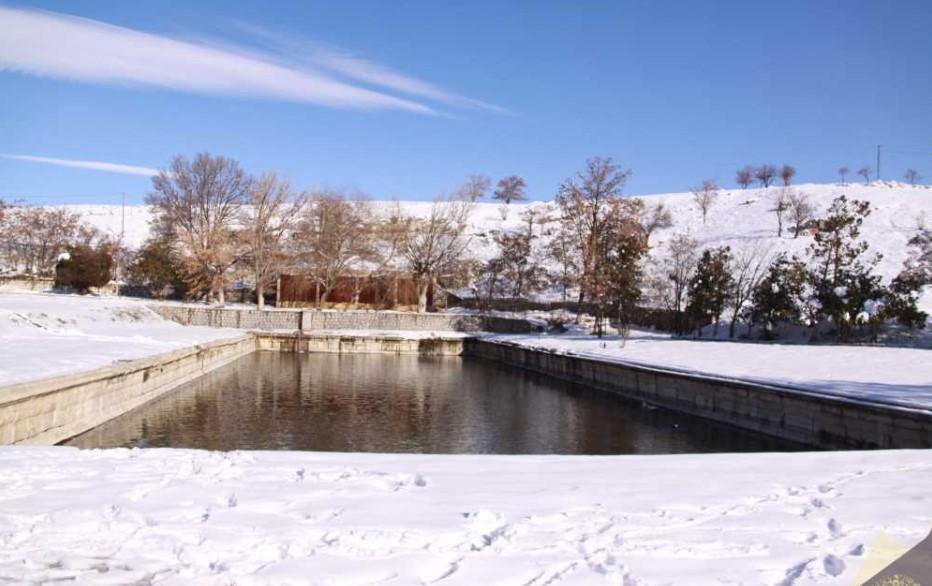
The Roman Pool is an architectural structure dated to the Roman Imperial period, located approximately 3 kilometers northeast of the ancient city of Tyana, in the village of Bahçeli, within the district of Bor, Niğde Province, Türkiye. This structure is of significant importance as it demonstrates Tyana’s advanced water infrastructure during the Roman period, both through its role in the ancient water supply system and its architectural features. The pool served as the starting point of Tyana’s water system and formed part of a complex engineering network that delivered water to the city.

The Roman Pool (Türkiye Culture Portal)
The Roman Pool is situated on a rocky terrain near Köşk Höyük, north of the village of Bahçeli. It is a rectangular structure oriented east-west, with the eastern short side measuring 20.75 metres, the western short side 20.62 metres, and the long sides each 62 metres. The pool has a depth of approximately 224 centimetres. Its inner walls were constructed using large porous stone blocks and marble cladding. The walls rest on a foundation of regular marble blocks and rise upward with orthostat blocks and profiled cornice stones. The southwest corner was repaired with concrete in the modern era.
The pool is fed by a natural spring emerging from nearby rocky areas, known today as Köşk Spring. The spring continues to flow consistently to this day. The water is collected in the pool to meet the needs of the ancient city of Tyana and is then channeled through an underground canal system as far as the area around the Saray Camii in Bahçeli. From there, the water is transferred to Tyana’s aqueducts and distributed to various parts of the city. The approximately 3-kilometre stretch between the pool and the aqueducts is traversed by underground channels.
The construction of the Roman Pool is dated to the early third century CE, particularly to the Severan period. Archaeological excavations conducted in 2003 along the western edge of the pool uncovered coins from this period. This evidence confirms that the pool was planned and implemented simultaneously with Tyana’s water system. Furthermore, the architectural decorations and marble craftsmanship suggest that the structure possessed not only functional but also representational value.
Although primarily identified as a water collection reservoir, the size and architectural features of the Roman Pool suggest it may have served additional purposes. The presence of imperial-era sculptural elements in its vicinity raises the possibility that it was part of a villa or a rural complex. Some sources also propose that it may have been designed as a possible swimming pool or as part of a sacred area.
Today, the Roman Pool is largely well preserved. Cleaning and restoration works were carried out in the 1940s and 1960s, and in 1996–1997, German researchers conducted documentation and planning studies. Under a master plan prepared by the Ministry of Culture and Tourism and the Niğde Governorship, the pool is targeted for restoration in accordance with its original form and integration into tourism.
Anadolu Ajansı. “1800 Yıllık Havuz Turizme Açılıyor.” Accessed June 27, 2025. https://www.aa.com.tr/tr/kultur-sanat/1800-yillik-havuz-turizme-aciliyor/358949.
T.C. Ministry of Culture and Tourism. "Roma Havuzu." *Türkiye Kültür Portalı*. Accessed June 27, 2025. https://www.kulturportali.gov.tr/turkiye/nigde/gezilecekyer/roma-havuzu.
T.C. Ministry of Culture and TourismNiğde İl Directorate of Culture and Tourism. "Roma Havuzu." Accessed June 27, 2025. https://nigde.ktb.gov.tr/Eklenti/51219,roma-havuzupdf.pdf.
Şener, H. Hayri, Kısmet Bacak, and Osman Doğanay. “Tyana Antik Kenti Su Kemerleri ve Roma Havuzu Üzerine Genel Bir Değerlendirme.” *Sosyal Bilimler Enstitüsü Dergisi* 13, no. 4 (December 2023): 2477–2498. Accessed June 27, 2025.

Location | Bahçeli Village Bor/Niğde | ||||||||
|---|---|---|---|---|---|---|---|---|---|
Period(s) | Period: Roman Imperial Period 3rd century CE | ||||||||
Dimension(s) | 62 × 20.7 m depth: 2.24 m | ||||||||
Function(s) | Water reservoir Possible sacred area Swimming pool | ||||||||
Water Source | Köşk Spring | ||||||||
Connection | Tyana Ancient City water system, water aqueducts | ||||||||
Current Status | Preserved, to be opened for tourism | ||||||||
Location and Architectural Features
Water Source and Function
Dating and Archaeological Findings
Interpretations of Its Purpose
Current Condition and Conservation Efforts