This article was automatically translated from the original Turkish version.
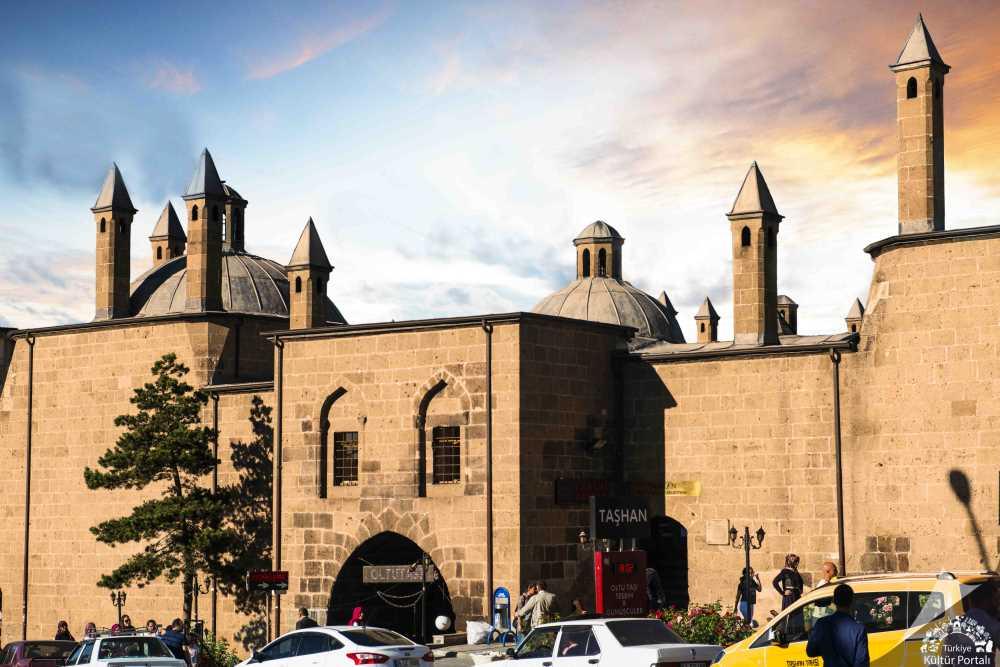
Rüstem Paşa Kervansarayı is a historical trade and accommodation structure from the Ottoman period located in the Fevziye Neighborhood on Menderes Street in the Yakutiye district of Erzurum. Known locally as "Taşhan," the structure was commissioned in 1561 by Kanuni Sultan Süleyman’s grand vizier Rüstem Paşa.【1】 Due to its strategic location along the historical Silk and Spice Routes, the kervansaray has remained one of the economic centers of the region for centuries and is currently used for the production and trade of oltu stone.

Rüstem Paşa Kervansarayı(Anadolu Ajansı)
Kervansarays were foundation buildings constructed along major trade routes to provide security and lodging for caravans. The marble inscription above the western entrance of the Rüstem Paşa Kervansarayı, written in sulus script, refers to the structure as a "ribat." Ribats were originally military installations surrounded by defensive walls, located along frontiers and strategic points to house military units and pack animals. Because Erzurum was a "serhat city" at the time of its construction, Taşhan primarily functioned as an advanced outpost with approximately 40 to 50 akıncı units stationed within it, aimed at securing the borders.【2】 As the Ottoman Empire expanded its borders over time to include Tbilisi and the Caspian Sea, the structure evolved to serve as a center for lodging, shelter, stabling, and commerce.
Taşhan is one of the classic examples of Ottoman kervansaray architecture. It is a two-story structure built of cut stone around a rectangular courtyard. Its plan belongs to the group of open-court hans. Due to the region’s harsh climatic conditions, the shops open inward toward the central courtyard rather than outward.
The western facade of the structure projects slightly forward. At the lower level is a deep entrance with a cradle vault, while at the upper level is a room believed to have belonged to the kervansaray’s administrator. The building underwent a major restoration in 1965.
Today, the Rüstem Paşa Kervansarayı serves as a production and sales center for oltu stone artisans. Within the structure, various souvenirs such as prayer beads, rings, and necklaces made from oltu stone are sold.【4】

Rüstem Paşa Kervansarayı(Anadolu Ajansı)
Anadolu Ajansı. "Asırlardır ticaretin kalbinin attığı çarşı: Taşhan." Accessed February 3, 2026.
Culture Portal. "Rüstem Paşa Kervansarayı - Erzurum." Accessed February 3, 2026. https://www.kulturportali.gov.tr/turkiye/erzurum/gezilecekyer/rustem-pasa-kervansarayi-tashan
Eryavuz, Şebnem Akalın. "Kervansaray." *TDV İslâm Ansiklopedisi*. Accessed February 3, 2026.
Erzurum Ticaret of Commerce and Industry. "Rüstem Paşa Kervansarayı." Accessed February 3, 2026. https://www.erzurumtso.org.tr/KentRehberiDetay/rustem-pasa-kervansarayi-16420218
Köşklü, Zerrin. "Erzurum'da Osmanlı Dönemi Hanları." *Sosyal Bilimler Enstitüsü Dergisi* 5 (2010): 113–134. Accessed February 3, 2026.
T.C. Erzurum Valiliği. "Rüstem Paşa Bedesteni (Taşhan)." Accessed February 3, 2026. https://erzurum.gov.tr/rustem-pasa-bedesteni-tashan
T.C.Yakutiye Kaymakamlığı Governorship. "Rüstem Paşa Bedesteni (Taşhan)." Accessed February 3, 2026. https://www.yakutiye.gov.tr/rustem-pasa-kervansarayi-tashan
Özkan, Haldun. "Rüstem Paşa Kervansarayı (Erzurum)." *Türkiye Turizm Ansiklopedisi*. 2024. Accessed February 3, 2026.
[1]
Erzurum Ticaret ve Sanayi Odası, "Rüstem Paşa Kervansarayı," Erişim Tarihi: 3 Şubat 2026,https://www.erzurumtso.org.tr/rustem-pasa-kervansarayi.
[2]
T.C. Yakutiye Kaymakamlığı, "Rüstem Paşa Bedesteni (Taşhan)," Erişim Tarihi: 3 Şubat 2026,http://www.yakutiye.gov.tr/rustem-pasa-bedesteni-tashan.
[3]
T.C. Yakutiye Kaymakamlığı, "Rüstem Paşa Bedesteni (Taşhan)," Erişim Tarihi: 3 Şubat 2026,http://www.yakutiye.gov.tr/rustem-pasa-bedesteni-tashan.
[4]
Erzurum Ticaret ve Sanayi Odası, "Rüstem Paşa Kervansarayı," Erişim Tarihi: 3 Şubat 2026,https://www.erzurumtso.org.tr/rustem-pasa-kervansarayi.

No Discussion Added Yet
Start discussion for "Rüstem Pasha Caravanserai (Taşhan)" article
Historical Development and Function
Architectural Features
Plan and Floor Layout
Facade and Restoration
Current Use and Tourism