



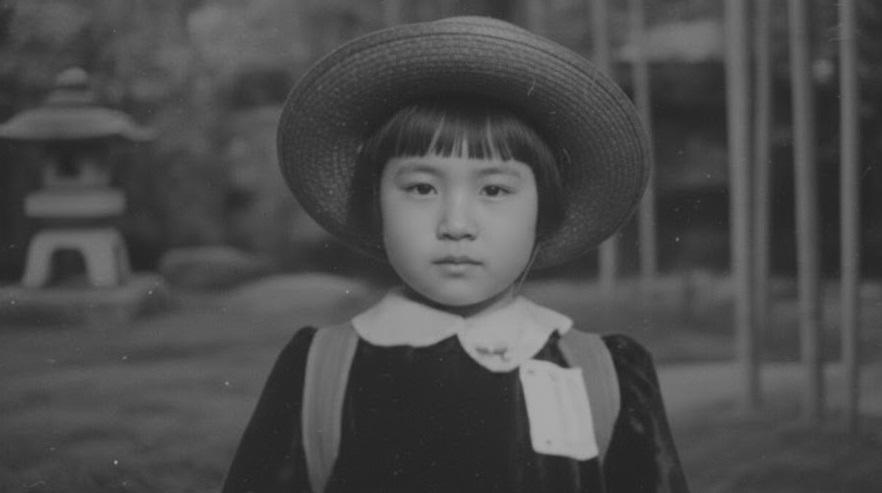
(Generated by Artificial Intelligence)
Sadako Sasaki
Name(s) | Sadako Sasaki (佐々木禎子) | ||||||||
|---|---|---|---|---|---|---|---|---|---|
Doğum tarihi | 1943-01-07 | ||||||||
Ölüm tarihi | 1955-10-25 | ||||||||
Nationality | Japan | ||||||||
Sadako Sasaki was a Japanese girl who was exposed to the effects of the atomic bomb dropped on Hiroshima and later developed leukemia as a result of radiation from the explosion. Through the paper cranes she folded while hospitalized, she became one of the enduring symbols of peace and nuclear disarmament in the postwar period.

Sadako Sasaki (Generated by Artificial Intelligence)
Sadako Sasaki was born on 7 January 1943 in Hiroshima. On 6 August 1945, the B-29 bomber Enola Gay, operated by the United States Army Air Forces and commanded by pilot Paul Tibbets, dropped the atomic bomb named “Little Boy” on Hiroshima. At the time, the city’s population was approximately 350,000.
The Sasaki family lived about one mile (approximately two kilometers) from the blast center. After the explosion, widespread destruction and fires engulfed the city, followed shortly by radioactive “black rain.” Sadako and her family survived the blast physically unharmed but were exposed to the long-term effects of radiation.
Before the bombing, Sadako was known as a healthy child. In 1955, after participating in a school running race, she began experiencing fatigue and dizziness. Medical examinations confirmed a diagnosis of leukemia caused by radiation from the atomic bomb. She was admitted to the Hiroshima Red Cross Hospital on 21 February 1955.
During her hospitalization, she learned of a Japanese folk belief that anyone who folds one thousand paper cranes will have their wish granted. Inspired by this belief, she began folding origami cranes. According to sources, Sadako continued folding cranes even after completing the thousand, ultimately making approximately 1,300 in total. One of the cranes she folded was made from the red wrapping paper of methotrexate, the drug used in her treatment and obtained from the United States.
Sadako died on 25 October 1955 at the age of 12 from leukemia. Following her death, a campaign was launched by her classmates and various donors to erect a memorial in her honor and in memory of all children who perished as victims of the atomic bomb. As a result of this effort, the Children’s Peace Monument (original name: 原爆の子の像 - Genbaku no Ko no Zō) was unveiled on 5 May 1958 in Hiroshima Peace Park. The monument features a statue of Sadako holding a paper crane in her hands.

Hiroshima Peace Park / Children’s Peace Monument (Generated by Artificial Intelligence)
Sadako Sasaki’s life and death have become a powerful narrative symbolizing the human impact of the atomic bombings of Hiroshima and Nagasaki. Origami cranes have since become a global symbol of peace, hope, and the call for nuclear disarmament. In 2007, the Sasaki family donated one of Sadako’s cranes to the families of those who lost their lives in the 11 September 2001 attacks. This crane was displayed at the 9/11 Tribute Museum and, following the museum’s closure in 2022, was transferred to the collection of the New York State Museum.
National Park Service. “The Story of Sadako Sasaki.” National Park Service. Accessed November 15, 2025. https://www.nps.gov/articles/000/the-story-of-sadako-sasaki.htm.
New York State Museum. "New Exhibition Feature: Sadako’s Crane." Accessed November 15, 2025. https://nysm.nysed.gov/exhibitions/news/sadakos-crane.
Public Relations Office Government of Japan. "Prayers for Peace Embodied in Origami Cranes." Accessed September 19, 2025. https://www.gov-online.go.jp/eng/publicity/book/hlj/html/202312/202312_07_en.html.
(Generated by Artificial Intelligence)
Sadako Sasaki
Name(s) | Sadako Sasaki (佐々木禎子) | ||||||||
|---|---|---|---|---|---|---|---|---|---|
Doğum tarihi | 1943-01-07 | ||||||||
Ölüm tarihi | 1955-10-25 | ||||||||
Nationality | Japan | ||||||||
Early Life and the Atomic Bomb
Illness and Origami Cranes
Death and Memorial
Cultural and Historical Legacy