

This article was automatically translated from the original Turkish version.
History | 9 August 1945 (Nagasaki) 6 August 1945 (Hiroshima) | ||||||||
|---|---|---|---|---|---|---|---|---|---|
Location | Japan Hiroshima and Nagasaki | ||||||||
Parties | Empire of Japan United States | ||||||||
Bombs Deployed | Fat Man (Nagasaki) Little Boy (Hiroshima) | ||||||||
Explosive Power | Nagasaki: 21 kilotons TNT Hiroshima: 15 kilotons TNT | ||||||||
Immediate Loss of Life | 000 in Nagasaki 000–45 approximately 40 000 in Hiroshima 000–80 Approximately 70 | ||||||||
Number of Injured | 000+ in Nagasaki 70 000+ in Hiroshima 120 | ||||||||
Diplomatic Outcome | End of World War II Japan's Unconditional Surrender | ||||||||
Commemoration | 6–9 August Commemorations Nagasaki Peace Park Hiroshima Peace Memorial Dome (Genbaku Dome) | ||||||||
During the final phase of World War II, the intense military campaign conducted in the Pacific Theater against Japan severely weakened the country’s industrial capacity and military strength. By mid-1945, Japan had lost most of its strategic dominance, its naval and air forces had suffered heavy losses, and its civilian infrastructure had been systematically destroyed by bombing raids.
Regarding the Moments of the Atomic Bombing of Hiroshima (CGTN)
Nevertheless, the Japanese government rejected calls for unconditional surrender and maintained its strategic determination to continue the war by defending the home islands. In particular, the Battle of Okinawa, which took place between April and June 1945, demonstrated to the Allies that an invasion of Japan would entail extremely high military and civilian casualties.
Under these conditions, the United States assessed the nuclear weapons developed under the Manhattan Project, initiated in 1942, as a tool capable of rapidly turning the course of the war in its favor. The use of the atomic bomb was not only intended to compel Japan’s surrender but was also seen as a decisive factor in shaping the postwar international balance of power.
Regarding the Moments of the Atomic Bombing of Nagasaki (British Pathe)
At the Potsdam Conference held in July 1945, Allied leaders discussed plans for the Asia-Pacific region and the framework of the postwar order; in this context, target cities, operational planning, and political declarations were finalized. The Soviet Union’s commitment to enter the war against Japan was a crucial element of these strategic calculations.
Ultimately, an atomic bomb was dropped on Hiroshima on 6 August 1945 and on Nagasaki on 9 August 1945. These attacks marked the first and only use of nuclear weapons in armed conflict. While they accelerated the end of World War II, they also constituted a turning point in human history due to the massive loss of life, widespread urban destruction, and long-term health and environmental consequences.
The development of the atomic bomb was the product of the Manhattan Project, one of the most extensive and secretive scientific-military endeavors of the 20th century. In the late 1930s, the discovery of nuclear fission in Europe demonstrated that splitting an atomic nucleus could release enormous amounts of energy. This development was viewed as a potential source of military superiority within the international political climate of the time.
A letter sent by Albert Einstein to U.S. President Franklin D. Roosevelt on 2 August 1939 emphasized the strategic importance of this technology. The letter stated that uranium could be transformed into a new and powerful energy source through a chain reaction, that such a process could produce bombs of immense destructive power, and that strategic access to raw materials was essential.【1】 The translation of the letter is as follows:
Albert Einstein
Old Grove Rd.
Nassau Point
Peconic, Long Island
2 August 1939
F.D. Roosevelt,
President of the United States of America
The White House
Washington, D.C.
Some recent work, communicated to me in draft form by E. Fermi and L. Szilard, leads me to believe that uranium may be transformed into a new and important source of energy in the near future. Certain aspects of the situation require careful attention by the administration and, if necessary, prompt action. For this reason, I consider it my duty to bring the following information and recommendations to your attention:
In the past four months, thanks to the work of Joliot in France and Fermi and Szilard in the United States, it has become probable that a nuclear chain reaction can be established in a large mass of uranium, producing vast quantities of energy and new elements similar to radium. It is now understood that this situation can almost certainly be realized in the near future.
This new phenomenon may also lead to the construction of bombs, and although not certain, it is possible to produce new and extremely powerful bombs by this method. Such a bomb, transported by ship and detonated in a harbor, could destroy the entire harbor and surrounding areas. However, these bombs may be too heavy to be carried by air.
The United States has only low-grade and limited quantities of uranium ore. Good-quality ore is available in Canada and former Czechoslovakia; the most important source is the Belgian Congo. Considering this situation, you may wish to maintain permanent contact between the government and the group of physicists working on chain reactions in the United States. One way to achieve this could be to appoint a person whom you trust, perhaps in an unofficial capacity, whose duties might include:
a) Contacting government agencies, informing them of developments, and making recommendations regarding necessary steps, especially drawing attention to the problem of securing uranium ore for the United States.
b) Securing funds through private donors and ensuring cooperation with industrial laboratories possessing the necessary equipment, if required, to accelerate experimental work currently limited by university laboratory budgets.
I am aware that Germany has halted the sale of uranium from the mines it controls in Czechoslovakia. Its early action may be due to the fact that the son of the German Undersecretary of State von Weizsäcker is employed at the Kaiser-Wilhelm Institute in Berlin, where research on uranium is currently being repeated as in the United States.
Respectfully,
(Albert Einstein)
This warning laid the groundwork for the U.S. administration to prioritize nuclear research, leading to the official launch of the Manhattan Project in 1942. The project was conducted under the military leadership of General Leslie R. Groves and the scientific coordination of theoretical and experimental physicist J. Robert Oppenheimer. Research at facilities such as Los Alamos (New Mexico), Oak Ridge (Tennessee), and Hanford (Washington) focused on obtaining, purifying, and initiating a controlled nuclear chain reaction using the isotopes uranium-235 and plutonium-239. Thousands of scientists, engineers, and technicians participated in the project, with research advancing simultaneously in physics, chemistry, metallurgy, and engineering.

Preparing the Atomic Bomb on Tinian Island (National Archives)
In later stages of the project, ethical concerns regarding the wartime use of the developed weapon came to the fore. On 17 July 1945, a group of scientists submitted a petition to President Harry S. Truman arguing that the use of atomic bombs should only be considered after detailed surrender terms had been presented to Japan and rejected. The petition warned that otherwise, the use of such weapons would establish a dangerous precedent in history and could lead to destruction on an unprecedented scale.【2】 However, these warnings did not influence the military and political decision-making processes of the time; the technical successes of the Manhattan Project were quickly moved into operational use. The translation of the petition is as follows:
14 July 1945
APPEAL TO THE PRESIDENT OF THE UNITED STATES OF AMERICA
Some discoveries, unknown to the American public, may affect the future welfare of this nation. The nuclear energy we have obtained has placed atomic bombs in the hands of the military, thereby placing in your hands as Commander-in-Chief the vital decision of whether to use these bombs in the current phase of the war against Japan.
We, the undersigned scientists working in the field of nuclear energy, were until recently concerned about the possibility of the United States being attacked by atomic bombs during this war, with the only defense being a counterattack using the same weapons. Today, with Germany’s defeat, this threat has vanished, and we feel compelled to state the following:
The war must be ended quickly and successfully, and attacks using atomic bombs may be an effective method. However, we believe that such an attack cannot be justified against Japan. (At least not until the terms to be imposed on Japan after the war are clearly communicated to the public and Japan is given a chance to surrender.)
Such a public announcement would assure the Japanese people that they can continue to live peacefully in their own country, and if Japan still refuses to surrender, then under certain conditions our nation may feel compelled to use atomic bombs. But this step must not be taken without seriously weighing the moral responsibilities it entails.
The development of nuclear energy will provide nations with new instruments of destruction. The atomic bombs we now possess are only the first step on this path, and the destructive power achievable in the future is nearly limitless. Therefore, a country that sets an example by using newly unleashed natural forces for destruction may be forced to bear the responsibility of opening the door to an unimaginable age of devastation.
If, after this war, we allow a world situation to develop in which rival states can possess these new instruments of destruction without restriction, all world cities—including those of the United States—will remain under constant threat of sudden annihilation. To prevent such a situation, all of the United States’ material and moral resources may need to be mobilized. Preventing this danger is, at present, the most important responsibility of the United States, thanks to its leadership in nuclear energy.
The additional power this leadership provides also brings with it the obligation to act with restraint. If we violate this obligation, our moral standing in the eyes of the world and in our own eyes will weaken, and our responsibility to control the unleashed forces of destruction will become even more difficult to fulfill.
In light of the above, we, the undersigned, respectfully request:
First, that you, in your capacity as Commander-in-Chief, decide not to use atomic bombs in this war until the terms to be imposed on Japan have been clearly communicated to the public and Japan has been given the opportunity to surrender while fully aware of those terms;
Second, that in such a situation, you make the decision on whether to use atomic bombs after taking into account all the moral responsibilities outlined in this petition.
Signatures
R. E. Lapp
R. S. Mulliken
E. P. Wigner
George S. Monk
Leo Szilard
J. J. Nickson
W. H. Zachariasen
Francis R. Shonka
John A. Simpson, Jr.
Walter Bartky
John P. Howe
Frank Foote
The decision to use the atomic bomb in warfare was not merely the result of scientific and technological progress but also the product of intense diplomatic and military negotiations during the final phase of World War II. The conference held in Potsdam, Germany, in July 1945 brought together Allied leaders—U.S. President Harry S. Truman, British Prime Minister Winston Churchill (later Clement Attlee), and Soviet leader Joseph Stalin—to shape the postwar order and determine the strategy against Japan.
During the conference, the Soviet Union reaffirmed its commitment, under the Yalta Agreement, to enter the war against Japan. In his presidential diary on 17 July 1945, Truman noted that Stalin informed him the Soviet Union would join the war against Japan on 15 August.【3】 This development was viewed by the Allies as a two-pronged strategic advantage: on one hand, Soviet entry would exert additional military pressure on Japan; on the other, when combined with the use of the atomic bomb, it could accelerate Japan’s surrender.

Clement Attlee, Joseph Stalin, and Winston Churchill side by side (Library of Congress)
On 26 July 1945, the Potsdam Declaration issued at the conference called on Japan to surrender unconditionally and warned that refusal would result in “prompt and utter destruction.” Japan left this declaration unanswered; the Tokyo government argued that the terms of surrender were unclear, particularly regarding the future of the imperial institution. This situation provided the United States with a strategic justification for continuing military operations and using the atomic bomb.
In this context, diplomatic developments and military planning progressed in tandem; the Soviet Union’s entry into the war became part of the Allies’ psychological pressure strategy. The timing of the attacks aimed to create simultaneous pressure from the Soviet offensive and to hasten Japan’s decision to surrender. Thus, the use of atomic bombs in early August 1945 took shape not merely as a demonstration of technological superiority but as the execution of a multifaceted military-diplomatic strategy.
The process of selecting target cities for the atomic bombings involved the simultaneous evaluation of military-strategic, geographic, and psychological factors. The Target Committee, established during the later stages of the Manhattan Project, assessed potential targets based on technical suitability, strategic value, and expected psychological impact. Committee reports emphasized that targets should be chosen not only to include military installations but also to encompass the urban fabric, as this would maximize the weapon’s effect both materially and morally.

Aerial View of Hiroshima Before the Attack (National Archives)
Hiroshima was identified as one of the primary targets under these criteria. As the largest city in the Chūgoku region, it served as a major military headquarters, logistical center, and supply hub. Its topography—a flat terrain surrounded by river branches—facilitated the widespread propagation of the blast effects. Hiroshima had not suffered large-scale aerial bombing during the war; this made it possible to observe the bomb’s effects on an intact urban structure.
Nagasaki was not initially on the list of primary targets. However, due to heavy cloud cover over the primary target, Kokura, on the operation day, Nagasaki was selected as the secondary target. Nagasaki, an important industrial and port city on the island of Kyūshū, held strategic value due to Mitsubishi’s shipbuilding yards, arms factories, and other heavy industrial facilities. Although its bay-like topography and hilly surroundings partially limited the blast effects, the city’s industrial zone and surrounding areas still suffered massive destruction.

Topographic Map of Nagasaki (National Archives)
Psychological impact was also considered in target selection. The Committee assessed that the Japanese public and leadership would be more likely to surrender upon confronting a new and extremely destructive weapon. Therefore, the attacks were planned to target not only military installations but also centers of civilian life, a decision that later sparked significant ethical debates.
On the morning of 6 August 1945, Hiroshima, having suffered relatively limited aerial attacks compared to other major Japanese cities, retained much of its urban structure. Geographically situated between the branches of the Ota River and spread across a flat terrain, the city held strategic importance as both an administrative and military center and as a node in transportation and supply networks.
President Harry S. Truman’s Radio Announcement of the Atomic Bombing of Hiroshima (National Archives)
The meteorological conditions on the day of the attack were favorable for aerial operations. The sky was clear in the early morning, visibility was high, and wind speed was low. These conditions enhanced targeting precision. On the same morning, work had begun in industrial facilities and public buildings, and workers had taken their positions in production areas.

Captain of the Enola Gay Just Before Departing for Hiroshima (National Archive)
Many students of secondary school age were engaged in civil defense measures under the “fire prevention” program, tasked with clearing debris and demolishing structures in the city center. This program aimed to create open spaces in narrow streets to limit fire spread during conventional air raids. However, the concentration of students in open areas intensified the demographic impact of the nuclear attack.

Document Authorizing the Use of the Atomic Bomb on Hiroshima (National Archives
About 45 minutes earlier, after reconnaissance aircraft in the area had departed, civil defense sirens had broadcast an “all clear” announcement.【4】 This prompted the population to leave shelters and return to daily activities. As a result, the majority of civilians in the city at the moment of the attack were caught in open areas or inadequately protected spaces. These conditions are considered one of the primary factors explaining the high rates of casualties and injuries caused by the explosion.
At 8:15 local time on 6 August 1945, the U.S. Army Air Forces B-29 bomber Enola Gay dropped “Little Boy,” a uranium-235-based fission bomb, over Hiroshima. The bomb detonated approximately 580 meters above the ground, near the Aioi Bridge in the city’s slightly northwestern area. This altitude was chosen to maximize the spread of both the blast wave and thermal radiation.

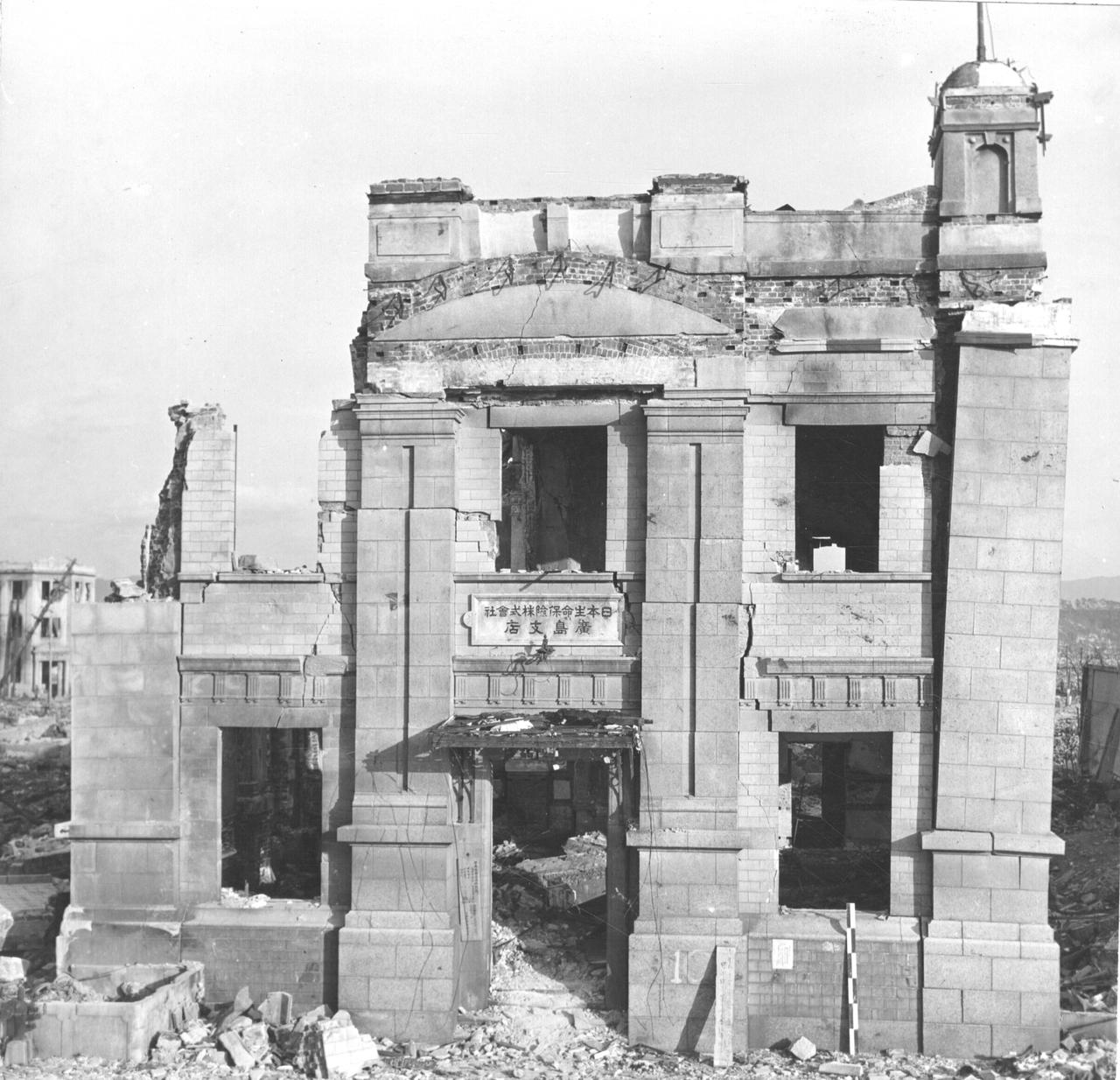
Hiroshima After the Nuclear Explosion (National Archives)
The energy released at the moment of detonation was equivalent to approximately 15 kilotons of TNT. Within the first seconds, intense thermal radiation caused severe “flash burns” in individuals within a one-kilometer radius of the epicenter. This radiation left distinct marks on skin and clothing due to the light and heat of the explosion. Simultaneously, the intense blast wave created a circular zone of destruction radiating outward from the center. Nearly all wooden and light structures were destroyed; reinforced concrete buildings suffered heavy damage, with only skeletal frames remaining standing.
Detailed Video Footage of the Damage Suffered by Hiroshima (National Archives)
The initial effects of the explosion were not limited to structural damage. People were thrown several meters by the sudden and violent force of the blast wave; secondary injuries from flying glass and metal fragments were widespread. Those near the epicenter were killed instantly by vaporization or extreme carbonization due to the intense heat.

Report Confirming the Occurrence of the Explosion (Truman Library
The multidimensional destruction occurring within the first few seconds of the explosion created irreversible physical and human devastation in Hiroshima’s central area.【5】 The losses at this stage were further compounded by fires and radiation effects in the hours following the attack.
In the first minutes after the nuclear explosion in Hiroshima, hundreds of fires ignited across the city. Two primary mechanisms contributed to their formation. First, the intense thermal radiation from the explosion rapidly raised the surface temperature of wooden structures and flammable materials to ignition point. Second, the physical destruction caused by the blast wave led to secondary effects: overturned stoves and furnaces, sparks from severed electrical lines, and ruptured gas lines accelerated the spread of fires.

Little Boy Atomic Bomb Being Loaded onto the Aircraft Before the Hiroshima Attack (National Archives)
Hiroshima’s urban structure facilitated the merging of individual fires into a large-scale disaster. The city was largely composed of wooden buildings, narrow streets, and flat topography. These conditions allowed fire clusters to rapidly coalesce into a unified fire zone. Approximately two to three hours after the explosion, a meteorological and fire dynamics phenomenon known as a “firestorm” developed in the city center.
A firestorm is characterized by strong air currents flowing from the periphery toward the center, driven by rising hot air from intense heat. In Hiroshima, these winds reached speeds of 30–40 miles per hour. The influx of oxygen toward the center intensified the fires and increased temperatures, rendering them uncontrollable. This process completely destroyed existing structures and caused secondary destruction in areas not directly affected by the blast.

Hiroshima After the Explosion (National Archives)
The human impact of the firestorm was devastating. People in open or partially sheltered areas died from intense heat and smoke; others suffered severe burns from exposure. Carbon monoxide and other toxic gases produced during the fires increased mortality rates among those trapped under debris or in enclosed spaces.
This phase constituted the second wave of fatalities in Hiroshima’s disaster chain, causing the greatest number of deaths after the initial explosion and nearly eliminating the city’s physical integrity.
The nuclear attack on Hiroshima on 6 August 1945 was one of the most destructive single events of World War II in terms of human loss. An estimated 70,000 to 80,000 people died at the moment of the attack or shortly thereafter. This number does not include thousands who died in the following weeks and months from injuries and radiation sickness. By year’s end, the total death toll was estimated at approximately 140,000. Deaths and injuries can be grouped into three primary categories:
1. Thermal Burns: The intense thermal radiation released at the moment of detonation caused deep burns in individuals within several kilometers of the epicenter. Those exposed outdoors suffered severe tissue damage on body surfaces facing the blast. Clothing was burned or melted by the light and heat; fabric patterns and garment edges left distinct burn marks on the skin.
2. Mechanical Injuries from the Blast Wave: The sudden pressure change caused by the explosion led to building collapses, the shattering of glass into high-velocity fragments, and the detachment of metal debris. These effects resulted in traumatic injuries such as fractures, lacerations, crush injuries, and internal organ damage.
3. Radiation Exposure: The intense gamma radiation and neutron flux released during the explosion caused cellular and genetic damage. Symptoms of acute radiation sickness included nausea, vomiting, fever, skin reddening, bleeding, and hair loss. In cases of severe exposure, death typically occurred within days to weeks.
The attack occurred in an environment where medical intervention capacity was nearly eliminated. Of Hiroshima’s 45 hospitals, only three remained partially operational; a significant portion of medical personnel had been killed or severely injured. This situation significantly increased mortality rates, particularly among victims of radiation sickness and severe burns.
The casualties in Hiroshima resulted not only from the immediate effects of the attack but also from secondary effects that persisted for weeks and months. Long-term consequences of radiation exposure manifested as increased rates of leukemia and other cancers in the years that followed.
The nuclear attack on Hiroshima on 6 August 1945 nearly obliterated the city’s infrastructure and urban fabric. Approximately 4.4 square miles (about 11.4 square kilometers) of land were severely damaged by the explosion and subsequent fires. Buildings closest to the epicenter were completely destroyed; even reinforced concrete structures suffered heavy damage, with only skeletal frames remaining standing.
1. Transportation Network: Bridges, roads, tram lines, and railway connections became unusable due to blast pressure and heat waves. Most of the city’s tram system was destroyed; bridges either collapsed or sustained major structural damage. This severely hindered both civilian evacuation and the delivery of relief supplies.
2. Energy and Communication Systems: Power plants and transmission lines were disabled at the moment of detonation. The resulting power outage led to the failure of water pumps and communication systems. Most telephone lines were severed; radio stations were damaged or completely destroyed.

The Church That Became a Symbol of the Disaster in Hiroshima (National Archives)
3. Water and Gas Networks: The explosion ruptured water pipes and gas lines; gas leaks contributed to further fires, expanding the scale of the disaster. Water supply was nearly cut off entirely, making firefighting impossible and allowing fires to spread uncontrollably.
4. Health Infrastructure: Of Hiroshima’s 45 hospitals, 42 were severely damaged or completely destroyed. A significant portion of medical personnel were killed or injured during the attack. The few remaining medical facilities were overwhelmed by the number of casualties. This situation rendered treatment for severe burns and radiation exposure nearly impossible.
5. Collapse of Urban Fabric: The attack did not merely cause physical destruction; it also paralyzed the city’s economic, administrative, and social structure. Municipal buildings, schools, commercial centers, and residential areas were largely erased. This made coordination of rescue and relief efforts nearly impossible.
The scale of infrastructure destruction in Hiroshima demonstrates that the attack targeted not only military objectives but also the city’s vital systems. This factor played a crucial role in shaping the attack’s impact on the course of the war and on international legal and ethical debates.
The nuclear attack on Hiroshima on 6 August 1945 was not limited to physical destruction and loss of life; it also caused deep and lasting psychological trauma and abrupt, fundamental changes in the social structure. The sudden and devastating impact of the explosion triggered intense shock among survivors. People lost their loved ones, homes, and entire life environments within seconds, resulting in emotional collapse at both individual and societal levels.
1. Traumatic Effects: A significant portion of survivors witnessed the visual and auditory intensity of the explosion, the condition of the injured, and the sight of burned and dead bodies. This experience led to what was later termed the “Hibakusha Syndrome,” characterized by symptoms of post-traumatic stress disorder (PTSD). Sleep disturbances, nightmares, hypersensitivity to sudden noises, and persistent fear of death were commonly reported symptoms.
2. Collapse of Social Order: After the attack, administrative structures became nonfunctional. The destruction of municipal buildings and communication infrastructure severely hampered relief and rescue operations. A significant portion of personnel available for rescue efforts had been killed or injured. This led to chaos in the first days following the disaster.
3. Damage to Family and Community Ties: The high number of casualties resulted in the fragmentation of countless families. Children who lost their parents and elderly people requiring care were left defenseless due to the collapse of social support networks. During this period, neighborhood and kinship relationships weakened due to displacement and migration caused by the disaster.
4. Social Stigmatization: In the postwar period, Hibakusha (survivors of the explosion) in some regions of Japan faced social stigmatization and discrimination due to the false belief that radiation was contagious. This created additional difficulties in employment, marriage, and social acceptance.
5. Collective Memory and Commemorative Culture: The legacy of the attack in the collective memory was institutionalized over the years through spaces such as the Hiroshima Peace Memorial. However, in the early years, the sheer scale of physical destruction and social trauma made organized commemorative activities difficult.
These psychological and social effects demonstrated that Hiroshima needed to be rebuilt not only physically but also socially—a process that played a significant role in Japan’s domestic politics and international peace movements for decades.
Nagasaki, located on the island of Kyūshū in Japan, held strategic importance as a major industrial and port city. The city played a critical role in Japan’s war industry, particularly due to Mitsubishi Heavy Industries’ shipbuilding yards, arms factories, and other heavy industrial facilities. Geographically, Nagasaki lies within a deep bay surrounded by mountainous and hilly terrain, giving it a more rugged urban structure than Hiroshima. These geographic features would directly influence the spread of the blast effects during the attack.
Initially, Nagasaki was not designated as the primary target for the nuclear attack. On the morning of 9 August, due to heavy cloud cover over the primary target, Kokura, and unfavorable targeting conditions, the bombing fleet redirected to the secondary target, Nagasaki. This change in route altered the operational timeline slightly but did not impede the execution of the mission.

The “Fat Man” Atomic Bomb Dropped on Nagasaki (National Archives)
Weather conditions on the day of the attack were variable. The sky above the city was partly cloudy in the early morning. This made targeting difficult; the bombing crew had to rely on gaps in the cloud cover to identify the detonation point. Daily life in the city continued under wartime conditions; production continued in industrial facilities and logistics operations proceeded at the port.
The civilian population, accustomed to conventional bombing raids, did not anticipate the possibility of a full-scale nuclear attack due to the city’s settlement pattern and geographic location. These conditions intensified the human and industrial impact of the attack, which would occur within hours, making Nagasaki the second American nuclear target in history.
At 11:02 on 9 August 1945, the U.S. Army Air Forces B-29 bomber Bockscar dropped “Fat Man,” a plutonium-239-based implosion-type nuclear bomb, over Nagasaki. The bomb detonated at an altitude of approximately 503 meters above the Urakami Valley. This altitude was chosen considering the city’s rugged topography, aiming to ensure effective spread of both the blast wave and thermal radiation across the city. The energy yield of the explosion was approximately 21 kilotons of TNT, greater than that of the bomb dropped on Hiroshima.
The intense thermal radiation released at the moment of detonation caused instantaneous burns in individuals within several kilometers of the epicenter. As in Hiroshima, “flash burns” were widespread; however, Nagasaki’s hilly terrain and fragmented urban layout partially restricted the spread of heat and light, resulting in less severe thermal effects in areas not directly in line of sight. Nevertheless, settlements and structures directly exposed along the blast path in the Urakami Valley suffered heavy damage.

The Moment of the Explosion in Nagasaki (National Archives)
The blast wave completely destroyed buildings near the epicenter; in more distant areas, it caused roofs to be torn off, walls to collapse, and glass and metal fragments to be propelled at high speeds, resulting in serious injuries. The enclosed structure of the valley caused the blast wave to concentrate in certain directions, intensifying destruction in narrow areas.
The explosion also triggered widespread fires; numerous flammable materials in industrial and residential zones ignited rapidly. In the first minutes after the explosion, dust, smoke, and debris formed a dark mushroom cloud over the city, reducing visibility and delaying rescue efforts.
The effects experienced in Nagasaki at the moment of detonation and immediately afterward differed in distribution from those in Hiroshima due to geographic conditions; however, the city suffered similar levels of physical and human loss, particularly in areas close to the explosion epicenter.
Immediately after the nuclear explosion in Nagasaki on 9 August 1945, numerous fires erupted rapidly across the city. Two main factors contributed to their formation. First, the intense thermal radiation from the explosion caused instantaneous ignition of wooden buildings, textiles, and other flammable materials. Second, secondary sources emerged from the physical destruction caused by the blast wave: overturned stoves, ruptured gas lines, severed electrical cables, and exploding fuel tanks accelerated the spread of fires.

Nagasaki After the Explosion (National Archives)
Nagasaki’s geographic structure played a decisive role in the spread of fires, in contrast to Hiroshima. The city’s mountainous and uneven terrain partially prevented the merging of fire clusters, preventing the formation of a full-scale “firestorm.” Nevertheless, fires in the Urakami Valley and surrounding industrial zones rapidly expanded over wide areas and became uncontrollable. Industrial areas such as Mitsubishi’s shipbuilding yards and arms factories, which contained large quantities of flammable materials, burned intensely after the explosion.
The impact of the fires extended beyond structural damage. The extreme heat and dense smoke produced by the flames caused many survivors to die. Those trapped under debris succumbed to oxygen deprivation and carbon monoxide poisoning. Those in open areas suffered severe burns due to intense heat waves.

Debris in Nagasaki After the Explosion (National Archives)
The destruction caused by the fires, combined with the physical damage from the explosion, nearly eliminated Nagasaki’s industrial capacity. For months after the attack, the cleanup and reconstruction of burned areas presented major logistical challenges.
The nuclear attack on Nagasaki on 9 August 1945 resulted in a high number of casualties and injuries both at the moment of detonation and in the following weeks and months. Estimates suggest that between 40,000 and 45,000 people died at the moment of the attack or shortly thereafter; by year’s end, this number exceeded 70,000. The majority of deaths occurred at the moment of detonation; the remainder resulted from severe injuries, radiation sickness, and inadequate medical care in the following days.
1. Thermal Burns: The high-intensity thermal radiation released at the moment of detonation caused third-degree burns in individuals near the epicenter. Clothing worn by those exposed outdoors ignited or melted instantly; this resulted in distinct burn patterns on the skin corresponding to fabric designs.
2. Blast Wave Injuries: The shock wave from the explosion caused building collapses and propelled sharp fragments of glass and metal at high speeds. This resulted in numerous cases of fractures, lacerations, crush injuries, and internal organ damage. The enclosed structure of the valley concentrated the blast wave in specific areas, increasing the rates of destruction and injury in those zones.
3. Radiation Exposure: The intense gamma radiation and neutron flux released during the explosion caused cellular damage and collapse of the immune system in directly exposed individuals. Acute radiation syndrome (ARS) manifested in the first days after the attack with symptoms such as vomiting, fever, bleeding, and hair loss. In cases of severe exposure, death typically occurred within one to three weeks.
4. Inadequate Medical Intervention: A significant portion of Nagasaki’s medical facilities were destroyed or rendered unusable; a large portion of medical personnel were killed or injured. The limited number of remaining medical facilities were overwhelmed by the number of casualties and lacked sufficient supplies. This significantly reduced survival rates, particularly for severe burns and radiation cases. Rescue teams were unable to reach the injured in time due to damaged transportation infrastructure and the dense smoke and debris following the explosion.
The human losses in Nagasaki resulted not only from the immediate effects of the attack but also from secondary effects that emerged in the following weeks. Long-term effects of radiation exposure led to increased rates of leukemia and solid tumors in the years that followed.
The nuclear attack on Nagasaki on 9 August 1945 severely damaged the city’s infrastructure and urban fabric. The explosion concentrated primarily in the Urakami Valley and surrounding areas, but its destructive effects extended across a wide geographic area from industrial zones to residential neighborhoods.
1. Transportation Network: The explosion caused extensive damage to roads, bridges, and railway lines. The city’s tram system, which provided internal transportation, was rendered inoperable due to bent rails and destroyed power systems. Some bridges collapsed, while others sustained heavy damage and became unusable. This severely hindered both the evacuation of the injured and the delivery of relief supplies.
2. Energy and Communication Systems: Power transmission lines and generator stations were disabled by the explosion. Power outages led to the collapse of communication infrastructure; telephone lines were severed, and radio stations were damaged. This disruption significantly hampered coordination of rescue efforts.
3. Water and Gas Networks: The explosion ruptured the city’s water pipes and destroyed the gas network. Gas leaks from ruptured lines contributed to post-explosion fires. With water supply cut off, firefighting efforts were impossible, and fires spread uncontrollably, particularly in industrial zones.
4. Industrial Facilities: Mitsubishi Heavy Industries’ shipbuilding yards, arms factories, and other heavy industrial facilities became largely nonfunctional after the explosion and fires. This effectively eliminated Nagasaki’s production capacity within Japan’s war industry.
5. Health Infrastructure: A significant portion of Nagasaki’s hospitals were either destroyed or severely damaged. A large portion of medical personnel were killed or injured. The limited number of remaining medical facilities could not adequately respond to the number of casualties or the shortage of supplies.
The severe damage inflicted on Nagasaki’s infrastructure demonstrates that the attack targeted not only military installations but also the city’s vital life-support systems. This led to the paralysis of the city’s economic, administrative, and social structure and prolonged the reconstruction process for many years.
The nuclear attack on Nagasaki on 9 August 1945 caused lasting psychological trauma and fundamental changes in the social structure beyond physical destruction. The sudden, intense, and unexpected nature of the explosion led to long-term mental disorders among survivors.
1. Traumatic Effects: Those who witnessed the explosion experienced an extraordinary moment of extreme violence, with intense heat, blinding light, the blast wave, and destruction occurring simultaneously. The condition of the injured, the smell of severe burns, sounds from under the rubble, and bodies among the debris left indelible marks on survivors’ minds. This led to symptoms of post-traumatic stress disorder (PTSD) in subsequent years, including nightmares, hypersensitivity to sudden noises, sleep disturbances, and persistent anxiety.
2. Collapse of Social Order: The explosion paralyzed the city’s administrative and social infrastructure. The destruction of municipal buildings and communication networks rendered relief organizations nonfunctional. Rescue efforts were inadequate due to personnel losses and damaged transportation infrastructure. In the first days, lack of coordination, chaos, and panic intensified the disaster’s impact.
3. Damage to Family and Community Ties: The attack fragmented countless families and collapsed family support mechanisms. Children who lost their parents and elderly or disabled individuals lost their caregivers. This made the reconstruction of social solidarity networks particularly difficult in the postwar period.
4. Social Stigmatization: Survivors of the attack, known as Hibakusha, faced social exclusion and discrimination in the postwar period due to the false belief that radiation was contagious. This stigmatization negatively affected their employment, marriage, and social relationships.
5. Collective Memory and Commemorative Culture: Nagasaki became an integral part of collective memory in the postwar period; the Nagasaki Peace Park and Atomic Bomb Museum, opened in 1955, became institutionalized symbols of this memory. However, in the early years, the sheer scale of physical destruction and the depth of social trauma made organized commemorative activities difficult.
These psychological and social effects demonstrate that the attack transformed Nagasaki’s society not only physically but also culturally and socially. The enduring nature of trauma has been preserved in the life stories of Hibakusha and the city’s collective memory to this day.
The majority of deaths in both cities resulted from thermal radiation, blast waves, and fires at the moment of detonation. In Hiroshima, individuals within one kilometer of the epicenter were nearly instantly killed; the heat reached levels sufficient to vaporize body tissues.
In areas 2–3 kilometers from the epicenter, the rate of third-degree burns reached 90%; burns were characterized by distinct patterns on the skin corresponding to clothing designs, particularly on body surfaces facing the blast. In Nagasaki, the rugged topography reduced direct radiation and thermal effects in some areas, but 70% of the population in the blast path of the Urakami Valley died at the moment of the explosion.

Thermal Heat and Radiation Effects (National Archive)
Blast waves caused widespread traumatic injuries due to building collapses and the high-speed projection of glass and metal fragments. In Hiroshima, 90% of buildings within 1.5 kilometers of the epicenter were completely destroyed. In Nagasaki, this rate was 60–70% within one kilometer of the epicenter. Blast-related injuries accounted for approximately 15% of deaths, including fractures, crush injuries, internal organ damage, and lacerations from flying glass.

Example of Medical Effects of Radiation (National Archive)
The acute effects of radiation caused thousands of deaths in both cities in the days and weeks following the explosion. In Hiroshima, radiation-related deaths in the first month accounted for approximately 20% of total casualties. Within the first 24 hours, victims exhibited symptoms such as nausea, vomiting, dizziness, fever, and skin reddening; subsequent days brought hair loss, internal bleeding, and immune system collapse. Similar symptoms were observed in Nagasaki; in cases of severe exposure, death typically occurred within 10–20 days.
Regarding the “Nuclear Shadow” Phenomenon After the Explosion (National Archives)
In the medium and long term, a significant increase in leukemia and other cancers was observed among survivors. In Hiroshima, leukemia cases peaked five years after the explosion, showing an increase of approximately 20 times compared to pre-explosion levels. Similar significant increases in leukemia incidence were observed in Nagasaki. Additionally, long-term increases were reported in thyroid, breast, lung, and stomach cancers. Radiation’s genetic effects increased the risk of hereditary mutations in subsequent generations; this was monitored through comprehensive health studies initiated in 1947.
These data demonstrate that the nuclear attacks on Hiroshima and Nagasaki did not merely produce immediate destructive effects but also caused lasting health problems spanning decades.
The rescue and relief efforts following the nuclear attacks on Hiroshima and Nagasaki were conducted under conditions of catastrophe unprecedented in modern warfare history. In both cities, the scale of physical destruction and human loss at the moment of detonation nearly eliminated initial response capacity. In Hiroshima, 42 of the 45 hospitals present on the day of the explosion were either destroyed or severely damaged; 90% of over 200 doctors and approximately 93% of 1,780 nurses were killed or injured. In Nagasaki, 70% of 21 hospitals became nonfunctional, and more than half of the medical personnel were unable to provide care.
In the first 24 hours, approximately 70,000 people died in Hiroshima and over 40,000 in Nagasaki. The number of injured exceeded 70,000 in Hiroshima and 60,000 in Nagasaki. More than 60% of the injured suffered severe burns, many of whom were workers and students who were outdoors at the time of the attack. Records indicate that 15–20% of the injured in Hiroshima were school-age youth, as students had been assigned to demolition and debris-clearing tasks in the city center on the morning of the attack.

Doctors Attempting to Treat Victims of Nuclear Radiation (National Library of Medicine)
The collapse of infrastructure paralyzed rescue operations. Explosions completely disabled electricity, water, and communication systems; roads, bridges, and railway lines were destroyed. It took 24 hours after the explosion for rescue teams to reach Hiroshima from outside; in Nagasaki, mountainous terrain prevented access to some areas for days. Records indicate that the first Japanese military units entering Hiroshima described the blast area as “silent, smokeless, and completely motionless”; most corpses were either charred or found seated with their faces turned toward the explosion epicenter.
The effects of radiation also affected rescue personnel. In the first days after the attacks, soldiers, nurses, and civilian volunteers entering the area exhibited acute radiation symptoms such as weakness, vomiting, and fever within a few days. This further reduced initial response capacity. In Hiroshima, approximately 10% of personnel involved in rescue efforts became incapacitated due to these symptoms within the first 10 days after the explosion.

Victims of Radiation Waiting for Treatment (National Library of Medicine)Delays also occurred in delivering external aid. The United States’ continued air superiority over Japan and damage to transportation routes slowed the flow of supplies. The first significant medical supplies reached Hiroshima four days after the explosion. Although this time was reduced to two days in Nagasaki, available supplies were grossly insufficient compared to the number of injured.
Records indicate that during the first night after the explosion in Hiroshima, rescue teams could hear the cries of people trapped in burning areas but were unable to approach due to extreme heat and dense smoke. By dawn, rescue teams found numerous charred corpses in these areas after the fires subsided.
All these conditions severely limited the effectiveness of rescue and relief efforts; a significant portion of survivors died without receiving adequate medical care. One of the primary reasons the death toll in Hiroshima reached 140,000 within the first month and 70,000 in Nagasaki was the inadequate quantity and quality of medical intervention.
The nuclear attacks on Hiroshima on 6 August and Nagasaki on 9 August fundamentally altered Japan’s strategic calculations regarding continuing the war. However, the decision to surrender emerged not solely from these two attacks but from a multidimensional military and diplomatic pressure that included the Soviet Union’s declaration of war against Japan on 8 August.
In Japan, the decision-making process was conducted by the Supreme War Council, the highest authority of the imperial government. There were deep divisions among council members regarding surrender. The civilian faction, particularly Foreign Minister Tōgō Shigenori, favored negotiating an end to the war before further destruction occurred. In contrast, some military figures, especially representatives of the army, argued that accepting the Allies’ unconditional surrender terms would be unacceptable to national honor.

Japanese Delegation Signing the Surrender Agreement on the USS Missouri (Library of Congress)
On the night of 8 August, the Soviet Union’s declaration of war and subsequent attack on the Japanese Kwantung Army in Manchuria changed the course of these debates. The possibility of the Soviet Union acting as a mediator vanished; Japan now found itself fighting a two-front war, both in the Pacific and on the Asian mainland.
The day after the Nagasaki attack, on 10 August, the Japanese government conveyed its intention to surrender to the Allies through Switzerland. However, the critical point was the demand to preserve the imperial institution. Japan essentially accepted the terms of the Potsdam Declaration but insisted that the surrender be arranged to preserve Emperor Hirohito’s sovereignty. U.S. President Harry S. Truman and the Allies responded that the emperor could remain only as a symbolic figure, with all authority transferred to Allied occupation authorities.
Under these conditions, on 14 August, the emperor approved the surrender decision to prevent further catastrophe for the nation. Notably, records indicate that the emperor made this decision not by consensus in the Supreme War Council but by personally stating his will in the case of a tied vote. This was an extremely rare occurrence in Japanese political tradition and demonstrates the decisive role of the emperor’s personal initiative in ending the war.

Official Surrender Proclamation Sealed by the Emperor (National Archives
On 15 August 1945, Emperor Hirohito addressed the nation via radio.【6】 This speech, known as the “Gyokuon-hōsō” (Jewel Voice Broadcast), was the first time the majority of the Japanese people heard the emperor’s voice. In the speech, the phrase “enduring the unendurable” became the historical justification for the surrender decision.
The Jewel Voice Broadcast (Historical Recordings)
However, the speech did not directly mention the destructive power of the atomic bombs; instead, it referred obliquely to “a new and most cruel bomb.” This process symbolized the end of Japan’s military resistance in World War II and the beginning of the Allied occupation period.
The nuclear attacks on Hiroshima and Nagasaki accelerated the end of World War II but also sparked deep debates both within Japan and internationally. After the surrender, Japan’s initial reaction focused on comprehending the scale of shock and destruction. The first reports from Hiroshima and Nagasaki emphasized the mystery and fear generated by the “new type of bomb” rather than the physical dimensions of the catastrophe. Due to official censorship, details of radiation effects and casualties were not immediately disclosed to the public.
In the United States, initial reactions were largely focused on victory and the end of the war. President Harry S. Truman, in his 6 August 1945 announcement, described the Hiroshima attack as a step “to destroy Japan’s industrial power and eliminate its war capacity.” While the American press presented the attack as a strategic success that quickly ended the war, some columnists and academics soon began questioning its ethical and humanitarian dimensions. Some scientists involved in the Manhattan Project, particularly those who signed the Szilárd Petition, expressed profound disappointment over the use of the bomb.
Interview with a Survivor of Hiroshima (BBC Turkish)
The Soviet Union, having declared war on Japan on 9 August and entered Manchuria, perceived the attacks as a strong warning that the United States would gain nuclear superiority in the postwar period. It is known that Stalin, having already learned of Truman’s mention of a “new and extraordinary weapon” at the Potsdam Conference through intelligence, remained calm but decided to accelerate the Soviet nuclear program after the attacks.
In Allied countries such as Britain and Australia, reactions largely paralleled those of the United States. However, immediately after the war, neutral countries and nations engaged in independence struggles against colonial rule—such as India, Sweden, and Switzerland—began questioning this scale of destruction against civilians under international law.
At its first General Assembly in 1946, the United Nations adopted its first resolution calling for the peaceful use of nuclear energy. This resolution was a direct reflection of the global anxiety generated by Hiroshima and Nagasaki.
In Japan, the plight of Hibakusha gained symbolic power in both domestic public opinion and international peace movements in the postwar years. Beginning in 1947, the U.S. occupation administration gradually lifted censorship on photographs of the atomic bomb and documents depicting radiation effects, allowing the true scale of these events to take their place in national memory.
Survivors of the explosions in Hiroshima and Nagasaki were known as hibakuşa in the postwar period. By the end of 1945, approximately 140,000 deaths had occurred in Hiroshima and 70,000 in Nagasaki; thousands more survived and continued to live with the acute and chronic effects of radiation. Early 1950s surveys indicated that the total number of Hibakusha in both cities exceeded 350,000.
Thousands died in the first weeks after the explosions due to acute radiation syndrome; those exposed exhibited hair loss, bleeding, immune system collapse, and infections within a short time. In subsequent years, there was a marked increase in leukemia cases; in Hiroshima, the incidence of this disease between 1950 and 1955 rose approximately twentyfold compared to pre-explosion levels. From the 1960s onward, long-term increases were observed in other types of cancers, including thyroid, breast, lung, and stomach cancer.
Effects of Atomic Bombs and Hibakusha (İmineo Documentaries)
Babies whose mothers were pregnant at the time of the explosion exhibited low birth weight, developmental delays, and some congenital anomalies; however, the definitive genetic effects on subsequent generations could not be clearly established. In the postwar period, Hibakusha also faced serious social problems. False beliefs that radiation was contagious led to discrimination in marriage and employment. Some employers avoided hiring Hibakusha, and health histories were scrutinized during marriage processes.
In 1947, the “Atomic Bomb Victims Medical Research Commission” was established to study the health conditions of Hibakusha over the long term. However, its focus on data collection rather than treatment created trust issues among survivors. In addition to physical effects, psychological impacts were also enduring. Survivors who lost loved ones or witnessed the intensity of the explosion commonly experienced nightmares, hypersensitivity to sudden noises, chronic anxiety, and fear of the future use of nuclear weapons.
Over time, Hibakusha became symbolic figures not only in Japan but also in the international nuclear disarmament movement. Their testimonies shared at postwar peace memorial ceremonies and international conferences significantly contributed to public awareness and strengthened global campaigns to ban nuclear weapons.
The nuclear attacks on Hiroshima and Nagasaki played a decisive role in ending World War II but also sparked debates regarding the laws of war and ethics. The international law in effect in 1945, particularly the 1907 Hague Conventions, anticipated the protection of civilians and the prevention of unnecessary suffering during war. However, the absence of nuclear weapons from international legal frameworks at the time rendered the legal status of the attacks controversial.
Supporting arguments maintained that the attacks shortened the war, prevented a land invasion of Japan, and saved the lives of millions of soldiers and civilians in Japan and the Pacific theater. U.S. military planning estimated casualties from an invasion of the Japanese home islands at hundreds of thousands of American soldiers and far more Japanese civilians. This argument was also presented to the public by political leaders of the time, who framed the use of the bombs as an “inevitable” strategic decision.
Candles Lit in Memory of Those Who Died from Nuclear Bombs (Euronews Turkish)
In contrast, critical perspectives argued that the attacks went beyond military targets by focusing on densely populated urban centers, thereby violating the principle of proportionality, a fundamental tenet of international humanitarian law. Although the long-term health effects of radiation were not fully understood at the time, their scale became clear after the war, leading to more severe criticism of the attacks’ humanitarian consequences.
Ethical debates extended beyond legal frameworks to address the responsibility of scientists. Some physicists involved in the Manhattan Project, particularly Leo Szilárd and other signatories of the petition, had advocated testing the bomb in an unpopulated area or offering conditional surrender terms before its use. However, these proposals were not accepted by decision-makers.
In the postwar period, the United Nations initiated its first efforts to control and ban nuclear weapons, adopting in 1946 a resolution that endorsed the principle of using nuclear energy exclusively for peaceful purposes. Nevertheless, with the onset of the Cold War, the existence and proliferation of nuclear weapons became one of the central determinants of international relations. In this context, Hiroshima and Nagasaki remain not merely historical events but symbols of the ethical and legal debates of the nuclear age.
Hiroshima and Nagasaki have become enduring symbols, beyond the end of World War II, of the nuclear age in both national and global memory. Immediately after the war, both cities focused on meeting the basic needs of survivors—shelter, food, and healthcare—so systematic commemorative activities were limited in the early years.
However, the Hiroshima Peace Memorial Law enacted in 1949 established the legal foundation for transforming the city into a symbol of peace alongside its reconstruction. Similarly, in Nagasaki, the ruins of the Urakami Cathedral, which survived amid the destruction, became a focal point for local and international commemorative efforts.
Commemoration Ceremony for the Anniversary of the Atomic Bombing of Nagasaki (Euronews Turkish)
From the 1950s onward, commemorative culture became institutionalized; annual peace memorial ceremonies are held in Hiroshima on 6 August and in Nagasaki on 9 August. The testimonies of Hibakusha at these ceremonies have been the most powerful means of transmitting the devastation caused by nuclear weapons to future generations. The design of commemorative sites deliberately preserves elements that recall the destruction.
The Hiroshima Peace Memorial Dome (Genbaku Dome), one of the few structures remaining standing closest to the explosion epicenter, was inscribed on the UNESCO World Heritage List in 1996; in Nagasaki, the Atomic Bomb Museum and Peace Park are the primary spaces that embody the city’s memory.
Commemoration Ceremony for the Anniversary of the Atomic Bombing of Hiroshima (Euronews Turkish)
Commemorative activities were not confined to Japan but became integrated with international peace movements. The 1955 World Peace Conference in Hiroshima brought together peace activists, scientists, and politicians from different countries, contributing to the global voice of nuclear disarmament calls. For generations born after the war, Hiroshima and Nagasaki are not merely historical lessons but central to the call for global solidarity against the nuclear threat.
Over time, these cities have become not only places that remember the horror of war but also arenas of international diplomacy and cultural exchange. Heads of state, diplomats, artists, and academics have visited these cities on commemorative days to perform symbolic gestures; these visits have helped keep the memory alive at the international level. Today, Hiroshima and Nagasaki continue to serve as the strongest historical and moral foundations for the ideal of a world free of nuclear weapons.
Audiovisual Sources
Research Works
BBC News Türkçe. “‘Atom bombasının Hiroşima’ya düştüğü an’” YouTube. Accessed August 8, 2025. https://www.youtube.com/watch?v=aan5pvxsSWE.
British Pathé. “Second atomic bomb of World War II explodes over Nagasaki (1945).” YouTube. Accessed August 8, 2025. https://www.youtube.com/watch?v=8u-XoaU4ScA.
CGTN. “Footage: Atomic bomb drop in Hiroshima.” YouTube. Accessed August 8, 2025. https://www.youtube.com/watch?v=h1tf8lv_yak.
Einstein, Albert. *Letter to President Franklin D. Roosevelt*. August 2, 1939. In *The Einstein–Szilard Letter*, U.S. National Archives. Accessed August 8, 2025. https://www.fdrlibrary.org/documents/356632/390886/document007.pdf/3483329d-7b68-442d-953d-eb91e0c5c9b1.
Euronews (Türkçe). "Hiroşima’da atom bombası kurbanları anısına nehre fenerler bırakıldı." YouTube. Accessed August 8, 2025. https://www.youtube.com/watch?v=JluBxWLFWpY.
Euronews (Türkçe). “Hiroşima’ya atılan ilk atom bombasının 75. yıl dönümü: Kurbanlar anıldı.” YouTube. Accessed August 8, 2025. https://www.youtube.com/watch?v=vUpNPQxB344.
Euronews (Türkçe). “Japonya’nın Nagazaki kentine atom bombası atılmasının 76. yıl dönümü.” YouTube. Accessed August 8, 2025. https://www.youtube.com/watch?v=5OFTpHzd8RY.
General Thomas T. Handy, Letter received from General Thomas Handy to General Carl Spaatz authorizing the dropping of the first atomic bomb, July 25, 1945, Records of U.S. Air Force Commands, Activities, and Organizations, Record Group 342; DocsTeach, Accessed August 7, 2025. https://www.docsteach.org/documents/document/letter-received-from-general-thomas-handy-to-general-carl-spaatz-authorizing-the-dropping-of-the-first-atomic-bomb.
Glasstone, Samuel, and Philip J. Dolan. *The Effects of Nuclear Weapons*. 3rd ed. Washington, DC: U.S. Department of Defense and Energy Research and Development Administration, 1977. Accessed August 8, 2025. https://www.deepspace.ucsb.edu/wp-content/uploads/2013/01/Effects-of-Nuclear-Weapons-1977-3rd-edition-complete.pdf.
Harry S. Truman Library & Museum, *Naval Message to Admiral William Leahy from Admiral Edwards [MR-OUT-334].* Accessed August 8, 2025. https://www.trumanlibrary.gov/node/402965
Hersey, John. *Hiroshima*. Internet Archive. Accessed August 8, 2025. https://archive.org/details/hiroshima0000hers_x1l5.
Historical Recordings. “[RARE] The Voice of Hirohito – 1945 Jewel Voice Broadcast (玉音放送).” YouTube. Accessed August 8, 2025. https://www.youtube.com/watch?v=FnMk1Vhg1oM.
Hsu, Wan-Ling, Dale L. Preston, Masayuki Soda, Hideki Sugiyama, Seishi Funamoto, Kazunori Kodama, Akihiko Kimura, Nobuo Kamada, Hiroshi Dohy, Mitsuo Tomonaga, Masao Iwanaga, Yuko Miyazaki, Harry M. Cullings, Akihiko Suyama, Kotaro Ozasa, Roy E. Shore, and Kazunori Mabuchi. “The Incidence of Leukemia, Lymphoma and Multiple Myeloma among Atomic Bomb Survivors: 1950–2001.” *Radiation Research* 179, no. 3 (2013): 361–382. Accessed August 8, 2025. https://pubmed.ncbi.nlm.nih.gov/23398354/.
Imineo Documentaires. “Hiroşima bulutunun altında.” YouTube. Accessed August 8, 2025. https://www.youtube.com/watch?v=TX03C9QrBvI.
Lebow, Richard Ned. “Hiroshima and Nagasaki: The Physical, Medical, and Social Effects of the Atomic Bombings.” Tokyo: Iwanami Shoten, 1981. Accessed August 8, 2025. https://digital-commons.usnwc.edu/nwc-review/vol35/iss4/15/.
Library of Congress. *Clement Attlee, Harry Truman, and Joseph Stalin, seated outdoors at Berlin conference* [Photograph], Accessed August 8, 2025. https://www.loc.gov/resource/cph.3a14367/.
Library of Congress. *Signing of the Japanese surrender document aboard the U.S.S. "Missouri" in Tokyo Bay, Sept. 2, 1945. Gen. Douglas MacArthur is shown broadcasting the ceremonies as Japanese Foreign Minister Mamoru Shigemitsu signed for the emperor Hirohito* [Photograph], Accessed August 8, 2025. https://www.loc.gov/resource/cph.3a21558/.
Llyod, P.J.D. “Hiroshima and Nagasaki: A Commentary.” South African Journal of Science. 1983. Accessed August 8, 2025. https://cia.gov/readingroom/docs/CIA-RDP87T00126R001201660018-5.pdf.
Mahoney, Leo J. “Pearl Harbor and Hiroshima: An Ironic Comparison.” *Doğuş Üniversitesi Dergisi* 6, no. 1 (2005): 123–131. Accessed August 8, 2025. https://dergipark.org.tr/en/download/article-file/2151869.
Manhattan Engineer District. *The Atomic Bombings of Hiroshima and Nagasaki*. Washington, D.C.: U.S. Army, 1946. Accessed August 8, 2025. https://catalog.nlm.nih.gov/discovery/fulldisplay?.
National Archives and Records Administration. *Aerial view of Hiroshima after atomic bomb blast* [Photograph], Accessed August 8, 2025. https://catalog.archives.gov/id/350289797.
National Archives and Records Administration. *Atomic Bomb Being Raised into Plane* [Photograph], Accessed August 8, 2025. https://catalog.archives.gov/id/76048583.
National Archives and Records Administration. *Atomic Bomb Preparations at Tinian Island* [Photograph], Accessed August 8, 2025. https://catalog.archives.gov/id/76048558.
National Archives and Records Administration. *Colonel Paul W. Tibbets, Jr., Pilot of the Enola Gay, the Plane that Dropped the Atomic Bomb on Hiroshima, Waves from His Cockpit before the Takeoff, 6 August 1945, Army Air Forces* [Photograph], Accessed August 8, 2025. .
National Archives and Records Administration. *Effect of Atomic Bomb on Hiroshima and Nagasaki* [Video]. Accessed August 8, 2025. https://catalog.archives.gov/id/65518.
National Archives and Records Administration. *Effects of Atomic Heat and Radiation on Humans, Japan* [Photograph], Accessed August 8, 2025. https://catalog.archives.gov/id/292633.
National Archives and Records Administration. *Effects of atomic heat and radiation on humans. Japan* [Photograph], Accessed August 8, 2025. https://catalog.archives.gov/id/292634.
National Archives and Records Administration. *Flash Burn and Shadow Detail* [Video], Accessed August 8, 2025. https://catalog.archives.gov/id/64525.
National Archives and Records Administration. *Nagasaki, Japan after the atomic bomb detonation. Formerly restricted. Declassified 9/10/1959. Photograph taken March 17, 1948. John H. Lawrence Collection-355. [Photograph by: Unknown]* [Fotoğraf], Accessed August 8, 2025. https://catalog.archives.gov/id/39147824.
National Archives and Records Administration. *Nagasaki, Japan after the atomic bomb detonation. Formerly restricted. Declassified 9/10/1959. Photograph taken March 17, 1948. John H. Lawrence Collection-368. [Photograph by: Unknown]* [Photograph], Accessed August 8, 2025. https://catalog.archives.gov/id/39147850.
National Archives and Records Administration. *Photograph of "Fat Man" Nuclear Weapon* [Photograph], Accessed August 8, 2025. https://catalog.archives.gov/id/175539928.
National Archives and Records Administration. *Photograph of Hiroshima after Atomic Bomb* [Photograph], Accessed August 8, 2025. https://catalog.archives.gov/id/22345671.
National Archives and Records Administration. *Photograph of Hiroshima after Atomic Bomb* [Photograph], Accessed August 8, 2025. https://catalog.archives.gov/id/22345679.
National Archives and Records Administration. *Photograph of the Atomic Cloud Rising Over Nagasaki, Japan* [Photograph], Accessed August 8, 2025. https://catalog.archives.gov/id/535795.
National Archives and Records Administration. *Pre-attack mosaic view of Hiroshima, Japan* [Photograph], Accessed August 8, 2025. https://catalog.archives.gov/id/540225?objectPage=3.
National Archives and Records Administration. *President Harry S. Truman’s Diary Entry for July 17, 1945*. Accessed August 8, 2025. https://catalog.archives.gov/id/976500.
National Archives and Records Administration. *Proclamation Accepting Terms in the Potsdam Declaration* [Document], Accessed August 8, 2025. https://catalog.archives.gov/id/6943536.
National Archives and Records Administration. *Topographical Map, Nagasaki* [Harita], Accessed August 8, 2025. https://catalog.archives.gov/id/166126367.
National Library of Medicine. "[Radiation - Effects]: [Victims awaiting treatment]" [Photograph], Accessed August 8, 2025. https://collections.nlm.nih.gov/catalog/nlm:nlmuid-101406705-img.
National Library of Medicine. *[Radiation - Effects]: [Patient's Room]* [Photograph], Accessed August 8, 2025. https://collections.nlm.nih.gov/catalog/nlm:nlmuid-101406742-img.
Radiation Effects Research Foundation. *LSS Data: Leukemia, Lymphoma and Multiple Myeloma Incidence among Atomic Bomb Survivors, 1950–2001*. Hiroshima: RERF, 2013. Accessed August 8, 2025. https://www.rerf.or.jp/en/library/data-en/lsshempy/.
Szilard, Leo, and other signatories. *A Petition to the President of the United States*. July 17, 1945. U.S. National Archives. Accessed August 8, 2025. https://catalog.archives.gov/id/6250638.
U.S. National Archives. *Proclamation Accepting Terms in the Potsdam Declaration*. National Archives Identifier 6943536. Accessed August 9, 2025. https://catalog.archives.gov/id/6943536.
US National Archives. “Radio Report to the Nation on the Dropping of the Atomic Bomb.” YouTube. Accessed August 8, 2025. https://www.youtube.com/watch?v=GvvqiriLme8.
United States Strategic Bombing Survey. *Summary Reports: European War, Pacific War*. Maxwell Air Force Base, AL: Air University Press, 1987. Accessed August 8, 2025. https://www.airuniversity.af.edu/Portals/10/AUPress/Books/B_0020_SPANGRUD_STRATEGIC_BOMBING_SURVEYS.pdf.
Yamazaki, James N., and Louis B. Fleming. *Children of the Atomic Bomb: An American Physician’s Memoir of Nagasaki, Hiroshima, and the Marshall Islands*. Durham: Duke University Press, 1995. Accessed August 8, 2025. https://www.ippnw.org/wp-content/uploads/2023/03/MGSV2N2Yamazaki.pdf.
[1]
Albert Einstein, Letter to President Franklin D. Roosevelt, August 2, 1939, in The Einstein–Szilard Letter, U.S. National Archives, s. 1-2.
[2]
Leo Szilard ve diğer imzacılar, A Petition to the President of the United States, July 17, 1945, U.S. National Archives, s. 1.
[3]
National Archives and Records Administration, President Harry S. Truman’s Diary Entry for July 17, 1945, s. 1.
Stalin’le birkaç saat geçirdim.
Joe Danes dün gece Maiski’ye uğramış ve bugün öğlen için randevuyu ayarlamış. Saat tam on ikiye birkaç dakika kala masamdan başımı kaldırdım, bir de baktım Stalin kapıda duruyor. Ayağa kalktım ve onu karşılamak için ilerledim. Elini uzattı ve gülümsedi. Ben de aynı şekilde karşılık verdim, tokalaştık. Molotov’u ve tercümanı selamladım, ardından oturduk.
Her zamanki nezaket sözlerinden sonra doğrudan konuya girdik. Ona diplomat olmadığımı, ama tüm tartışmaları dinledikten sonra genellikle sorulara “evet” veya “hayır” diye yanıt verdiğimi söyledim. Bu hoşuna gitti. Toplantı gündeminin elinde olup olmadığını sordum. Elinde olduğunu ve ayrıca sunmak istediği bazı soruları bulunduğunu söyledi. Ben de “buyurun” dedim.
Anlattıkları adeta bomba etkisindeydi – ama benim de henüz patlatmadığım kendi bombalarım var. Franco’yu görevden almak istiyor, buna itiraz etmem. Ayrıca İtalyan sömürgelerinin ve diğer manda yönetimlerinin paylaşılmasını istiyor; bunların bazıları şüphesiz İngilizlerin elinde. Sonra Çin meselesine geçti; hangi anlaşmalara varıldığını ve hangi konuların beklemede olduğunu anlattı. Ana maddelerin çoğu halledilmiş. 15 Ağustos’ta Japonya Savaşı’na girecek. Bu olduğunda Japonlar işi bitmiş demektir.
Öğle yemeği yedik, sosyal sohbet ettik; herkese kadeh kaldırarak tam bir gösteri yaptık. Ardından bahçede fotoğraflar çektirdik. Stalin’le çalışabilirim. Ciddi biri – ama son derece zeki.
[4]
General Thomas T. Handy, Letter received from General Thomas Handy to General Carl Spaatz authorizing the dropping of the first atomic bomb, 25 Temmuz 1945, Records of U.S. Air Force Commands, Activities, and Organizations, Record Group 342; DocsTeach (çevrimiçi versiyon), s. 1.
Savaş Bakanlığı
Genelkurmay Başkanlığı Ofisi
Washington 25, D.C.
25 Temmuz 1945
Kime: General Carl Spaatz
Amerika Birleşik Devletleri Kara Kuvvetleri Stratejik Hava Kuvvetleri Komutanı
509. Müşterek Grup, 20. Hava Kuvvetleri, hava koşulları yaklaşık 3 Ağustos 1945’ten itibaren görsel bombardımana izin verir vermez, ilk özel bombasını hedeflerden birine (Hiroşima, Kokura, Niigata ve Nagasaki) atacaktır. Savaş Bakanlığı’ndan askerî ve sivil bilim insanlarının patlamanın etkilerini gözlemlemesi ve kaydetmesi amacıyla uçak bombayı taşıyan uçağa eşlik edecek, gözlem uçakları ise patlama noktasından birkaç mil uzakta kalacaktır.
İlave bombalar, proje personeli tarafından hazırlandıkça yukarıda belirtilen hedeflere atılacaktır. Yukarıda listelenenler dışında hedeflere ilişkin talimatlar ayrıca verilecektir.
Silahın Japonya’ya karşı kullanımıyla ilgili her türlü bilgi ve bilginin dağıtımı yetkisi yalnızca Savaş Bakanı ve Amerika Birleşik Devletleri Başkanı’na aittir. Konuyla ilgili hiçbir bildiri yapılmayacak veya bilgi yayımlanmayacaktır. Tüm haberler, özel izin için Savaş Bakanlığı’na gönderilecektir.
Bu yönerge, Savaş Bakanı ve Amerika Birleşik Devletleri Genelkurmay Başkanı’nın onayıyla size iletilmektedir. Bu direktifin bir kopyasının şahsen General MacArthur’a, bir kopyasının ise Amiral Nimitz’e verilmesi istenmektedir.
İmza:
Thos. T. Handy
General, G.S.C.
Vekil Genelkurmay Başkanı
[5]
Harry S. Truman Library & Museum, Naval Message to Admiral William Leahy from Admiral Edwards [MR-OUT-334], s. 1.
GİZLİ TELGRAF
Tarih: 6 Ağustos 1945
Gönderen: COMINCH & CNO
Alıcı: Amiral Leahy
Yalnızca Amiral Leahy için
Manhattan Projesi ile ilgili şu bilgi iletildi:
“052315Z saatinde, bulut örtüsü yalnızca onda bir seviyesindeyken Hiroşima bombalandı. Hiçbir avcı uçağı direnişi veya uçaksavar ateşi yoktu. Parsons, bırakmadan 15 dakika sonra rapor verdi: Sonuçlar her açıdan açık ve kesin bir şekilde başarılı. Görünür etkiler, yapılan herhangi bir denemedekinden daha büyüktü. Bombanın bırakılmasından sonra uçaktaki koşullar normaldi.”
[6]
U.S. National Archives, Proclamation Accepting Terms in the Potsdam Declaration, National Archives Identifier 6943536, erişim 9 Ağustos 2025, s. 1.
BİLDİRİ
26 Temmuz 1945 tarihinde Potsdam’da Amerika Birleşik Devletleri, Büyük Britanya ve Çin hükümet başkanları tarafından yayımlanan ve ardından Sovyet Sosyalist Cumhuriyetler Birliği tarafından da kabul edilen Bildiri’de belirtilen şartları kabul ederek, Japon İmparatorluk Hükûmeti ile Japon İmparatorluk Genel Karargâhı’na, Müttefik Devletler Yüksek Komutanı tarafından sunulan Teslimiyet Belgesi’ni bizim adımıza imzalamaları ve Müttefik Devletler Yüksek Komutanı’nın talimatlarına uygun olarak kara ve deniz kuvvetlerine Genel Emirler yayımlamaları için talimat verdik.
Tüm halkımıza, derhal düşmanlıkları sona erdirmelerini, silahlarını bırakmalarını ve Teslimiyet Belgesi’nin hükümleri ile Japon İmparatorluk Hükûmeti ve Japon İmparatorluk Genel Karargâhı tarafından yayımlanan Genel Emirlerin tüm gereklerini sadakatle yerine getirmelerini emrediyoruz.
Şova döneminin yirminci yılının dokuzuncu ayının ikinci günü.
İmparatorun Mührü
İmza: HIROHITO
Onaylayan: Naruhiko-ō, Başbakan


History | 9 August 1945 (Nagasaki) 6 August 1945 (Hiroshima) | ||||||||
|---|---|---|---|---|---|---|---|---|---|
Location | Japan Hiroshima and Nagasaki | ||||||||
Parties | Empire of Japan United States | ||||||||
Bombs Deployed | Fat Man (Nagasaki) Little Boy (Hiroshima) | ||||||||
Explosive Power | Nagasaki: 21 kilotons TNT Hiroshima: 15 kilotons TNT | ||||||||
Immediate Loss of Life | 000 in Nagasaki 000–45 approximately 40 000 in Hiroshima 000–80 Approximately 70 | ||||||||
Number of Injured | 000+ in Nagasaki 70 000+ in Hiroshima 120 | ||||||||
Diplomatic Outcome | End of World War II Japan's Unconditional Surrender | ||||||||
Commemoration | 6–9 August Commemorations Nagasaki Peace Park Hiroshima Peace Memorial Dome (Genbaku Dome) | ||||||||
No Discussion Added Yet
Start discussion for "Hiroshima and Nagasaki Atomic Bomb Attacks" article
Development of the Atomic Bomb
Diplomatic and Military Background
Selection of Targets
Hiroshima Attack (6 August 1945)
The Explosion and Initial Effects
Fires and Firestorm
Casualties and Injuries
Infrastructure and Urban Destruction
Psychological and Social Effects
Nagasaki Attack (9 August 1945)
The Explosion and Initial Effects
Fires and Firestorm
Casualties and Injuries
Infrastructure and Urban Destruction
Psychological and Social Effects
Common Physical and Medical Effects
Rescue and Relief Efforts
Japan’s Surrender Process
Postwar Reactions and International Repercussions
Hibakusha and Long-Term Effects
International Law and Ethical Debates
Commemoration and Collective Memory