
This article was automatically translated from the original Turkish version.
+5 More
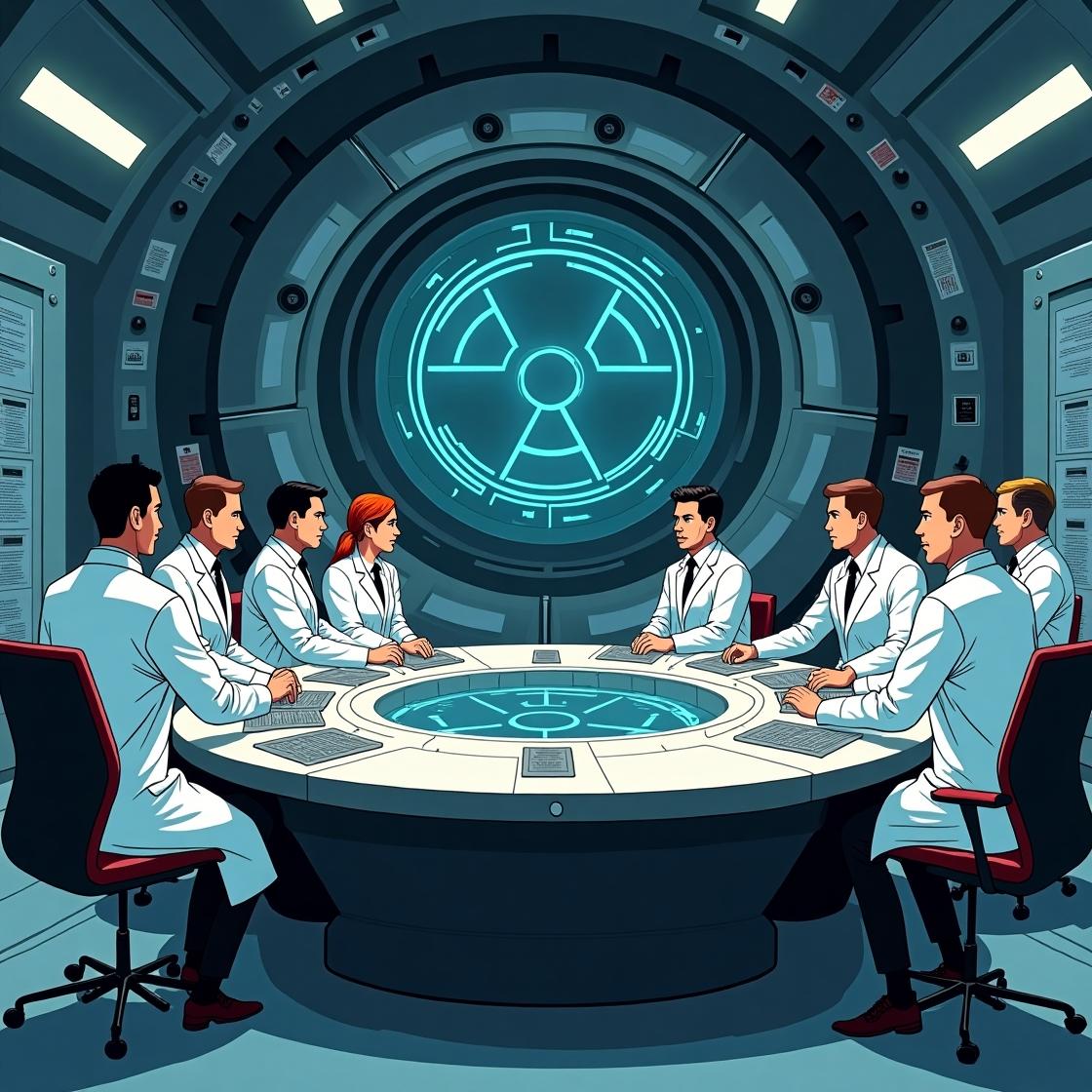
Nuclear Weapons Technology (Generated with Artificial Intelligence)
Fundamental Principle | Fission (Nuclear Fission) and Fusion (Nuclear Fusion) | ||||||||
|---|---|---|---|---|---|---|---|---|---|
Main Type(s) | Atomic Bomb (Fission) Hydrogen Bomb (Fusion) | ||||||||
Initial Use | 6 August 1945, Hiroshima, Japan (by the USA) | ||||||||
Final Use | 9 August 1945, Nagasaki, Japan (by the USA) | ||||||||
Primary Legal Framework | Treaty on the Non-Proliferation of Nuclear Weapons (NPT), 1968 | ||||||||
Strategic Concept | Nuclear Deterrence | ||||||||
Required Materials | Uranium-235, Plutonium-239, Deuterium, Tritium | ||||||||
A nuclear weapon is a weapon of mass destruction that harnesses the energy released by nuclear reactions—either the splitting of atomic nuclei (fission) or the merging of atomic nuclei (fusion)—as a destructive force. Unlike conventional explosives, a single nuclear weapon has the potential to destroy an entire city, kill millions of people, and render vast regions uninhabitable for years through radioactive fallout. These characteristics have elevated nuclear weapons beyond mere military tools, making them one of the foundational elements of strategic deterrence and power balance in international relations.
The military use of nuclear weapon technology began during World War II with the United States’ Manhattan Project. The first atomic bombs developed under this project were dropped on Hiroshima on 6 August 1945 and on Nagasaki on 9 August 1945, becoming the first and only nuclear weapons ever used in warfare. These events brought the war to an end while simultaneously heralding the dawn of the nuclear age and the Cold War.
The United States’ nuclear monopoly did not last long. The Soviet Union, aided by espionage, accelerated its own nuclear program and successfully tested its first atomic bomb, codenamed “RDS-1” (known in the West as Joe-1), on 29 August 1949. This development triggered an arms race between the two superpowers that would last for decades. The nuclear club was later joined by the United Kingdom (1952), France (1960), and China (1964). These five countries are the permanent members of the United Nations Security Council and are recognized under the Treaty on the Non-Proliferation of Nuclear Weapons (NPT) as the official nuclear-weapon states.
The dangerous escalation of the arms race pushed the international community to develop control mechanisms. In 1953, U.S. President Eisenhower’s “Atoms for Peace” proposal led to the establishment of the International Atomic Energy Agency (IAEA) in 1957, aimed at promoting the peaceful use of nuclear technology while ensuring its oversight. The 1962 Cuban Missile Crisis brought the world to the brink of nuclear war and accelerated disarmament efforts. The most significant outcome of this process was the Treaty on the Non-Proliferation of Nuclear Weapons (NPT), opened for signature in 1968 and entered into force in 1970. The NPT established the primary legal framework aimed at preventing the spread of nuclear weapons, promoting disarmament, and regulating the peaceful use of nuclear energy. Throughout the Cold War, various agreements such as the Strategic Arms Limitation Talks (SALT) and the Strategic Arms Reduction Treaty (START) between the United States and the Soviet Union sought to limit arsenals.
Nuclear weapons derive their energy from two fundamental nuclear reactions: fission and fusion.
Fission is the process in which heavy and unstable atomic nuclei, such as uranium-235 or plutonium-239, are bombarded with neutrons and split into smaller atoms. This splitting releases a large amount of energy and frees additional neutrons. These newly released neutrons collide with other nuclei, initiating an uncontrolled chain reaction that results in a massive explosion within a fraction of a second—on the order of one millionth of a second. For uranium found in nature to be usable in nuclear weapons, it must be enriched to increase the concentration of uranium-235 to around 90%. Plutonium-239, by contrast, is produced artificially in nuclear reactors.
Atomic Bomb: Weapons based entirely on the fission principle. The bomb dropped on Hiroshima, “Little Boy,” was a uranium-235 fission bomb, while the one dropped on Nagasaki, “Fat Man,” was a plutonium-239 fission bomb.

Nuclear Weapon Technology (Generated by Artificial Intelligence)
Fusion is the process in which light hydrogen isotopes, such as deuterium and tritium, combine under extreme temperature and pressure to form a heavier nucleus, such as helium. This process is the mechanism by which the Sun and other stars generate energy and releases far more energy than fission. To initiate a fusion reaction, temperatures of millions of degrees are required, typically achieved by detonating a fission bomb. For this reason, fusion bombs contain a fission bomb as a trigger.
Hydrogen Bomb (Thermonuclear Weapon): Weapons that operate on the principle of fusion. Their destructive power is orders of magnitude greater than that of fission bombs and is typically measured in megatons.
The effects of a nuclear explosion are multidimensional, encompassing both immediate and long-term consequences.
The immense blast wave, shock effect, and extreme heat generated at the moment of detonation can destroy buildings, infrastructure, and life forms kilometers away from the epicenter. For example, if a single modern nuclear weapon were detonated over a major metropolis, it is estimated that hundreds of thousands of people could be killed instantly.
The ionizing radiation released into the environment after the explosion damages the cellular structure of living organisms, causing acute radiation syndrome, cancer, genetic disorders, and other serious health problems that can persist for generations. Radioactive fallout can be carried by wind to areas far removed from the blast zone.
In a large-scale war scenario involving multiple nuclear weapons, the dust and smoke clouds ejected into the atmosphere by the explosions could block sunlight from reaching the Earth’s surface. This could lead to a sudden global temperature drop, the collapse of agricultural production, and a “nuclear winter” catastrophe that triggers mass famine and ecosystem collapse.
The existence of nuclear weapons has transformed traditional concepts of warfare and given rise to new strategic ideas.
This is a strategy in which a state prevents an attack against itself by threatening an adversary with an unacceptable level of nuclear retaliation. During the Cold War, the primary factor preventing total war between the superpowers was widely regarded as the “mutually assured destruction” (MAD) balance.
This refers to the deployment of a country’s nuclear forces across three distinct platforms: land-based intercontinental ballistic missiles (ICBMs), submarine-launched ballistic missiles (SLBMs), and strategic bombers. The purpose of this structure is to ensure the survivability of a second-strike capability under any circumstances, thereby preventing an adversary from eliminating the entire nuclear arsenal in a first strike.
Strategic nuclear weapons are high-yield weapons designed to target enemy cities or military centers with the aim of altering the overall course of a war. Tactical nuclear weapons, by contrast, have lower yields and are designed for use against specific battlefield targets such as military units, bases, or naval fleets. Examples include the U.S. B61 bomb and Russia’s approximately 2,000 tactical warheads.
The distribution of nuclear weapons is one of the most important factors shaping global power balances. According to the NPT, five countries are recognized as official nuclear-weapon states: Russia (approximately 5,889 warheads), the United States (approximately 5,224 warheads), China (approximately 410 warheads), France (approximately 290 warheads), and the United Kingdom (approximately 225 warheads). Countries not party to the NPT but known to possess nuclear weapons include Pakistan (approximately 170 warheads), India (approximately 164 warheads), Israel (approximately 90 warheads), and North Korea (approximately 30 warheads).
In addition, under NATO’s nuclear sharing program, several countries host U.S.-owned nuclear weapons on their territory. These countries are Italy, Türkiye, Belgium, Germany, and the Netherlands. Although Türkiye does not possess its own developed nuclear weapon, it is known that U.S.-owned B61 tactical nuclear bombs are stationed at İncirlik Air Base. This situation integrates Türkiye into the nuclear deterrence chain.
The legitimacy of nuclear weapons is one of the most contentious issues in international law. Although there is no binding international treaty that comprehensively bans the use of nuclear weapons, agreements such as the NPT focus on preventing their proliferation. In its 1996 advisory opinion, the International Court of Justice stated that the use of nuclear weapons would generally violate the rules of international humanitarian law, but it could not reach a definitive conclusion on whether their use would be lawful or unlawful in an extreme circumstance of self-defense where the very survival of a state was at stake. Debates continue between those who argue that these weapons are illegitimate due to their inability to distinguish between civilians and combatants, the unnecessary suffering they cause, and their environmental impact, and those who maintain that they preserve peace through deterrence and are necessary for national security.
Cochran, Thomas B., William M. Arkin, Robert S. Norris, and Milton M. Hoenig. Nuclear Weapons Databook: Volume I, U.S. Nuclear Forces and Capabilities. Cambridge, MA: Ballinger Publishing Company, 1984.
Eurasian Research Institute. “Rusya’nın Nükleer Silah Programına Kısa Bir Bakış.” ERI. Accessed July 16, 2025. https://www.eurasian-research.org/publication/rusyanin-nukleer-silah-programina-kisa-bir-bakis/?lang=tr.
Hansen, Chuck. U.S. Nuclear Weapons: The Secret History. Arlington, TX: AeroFax, 1988.
Hansen, Chuck. “Nuclear Weapons Frequently Asked Questions: Section 8.” *Nuclear Weapon Archive*. Accessed July 16, 2025. https://nuclearweaponarchive.org/Nwfaq/Nfaq8.html.
Keskin, Yunus. “Uluslararası Hukukta Nükleer Silahların Meşruluğu Sorunu.” *Bahçeşehir Üniversitesi Hukuk Fakültesi Dergisi*, no. 183–184 (November–December 2019). Accessed July 16, 2025. https://jurix.com.tr/article/20277.
Kibaroğlu, Mustafa. “Kuzey Kore'nin Nükleer Silah Programı: Sebepler ve Sonuçlar.” *Uluslararası İlişkiler Dergisi*, Spring 2004. Accessed July 16, 2025. http://mustafakibaroglu.com/sitebuildercontent/sitebuilderfiles/kibaroglu-ui-dergisi-kuzeykorenukleersilahprogrami-bahar2004.pdf.
Söğüt, Koray. “Nükleer Silah Nedir?” *Tabya Dijital*, May 4, 2025. Accessed July 16, 2025. https://tabyadijital.com/nukleer-silah-nedir/.
Söğüt, İrem Pelin Dinç. “Pakistan Nasıl Nükleer Silah Sahibi Oldu?” *Tabya Dijital*, April 30, 2025. Accessed July 16, 2025. https://tabyadijital.com/pakistan-nasil-nukleer-silah-sahibi-oldu/.

Nuclear Weapons Technology (Generated with Artificial Intelligence)
Fundamental Principle | Fission (Nuclear Fission) and Fusion (Nuclear Fusion) | ||||||||
|---|---|---|---|---|---|---|---|---|---|
Main Type(s) | Atomic Bomb (Fission) Hydrogen Bomb (Fusion) | ||||||||
Initial Use | 6 August 1945, Hiroshima, Japan (by the USA) | ||||||||
Final Use | 9 August 1945, Nagasaki, Japan (by the USA) | ||||||||
Primary Legal Framework | Treaty on the Non-Proliferation of Nuclear Weapons (NPT), 1968 | ||||||||
Strategic Concept | Nuclear Deterrence | ||||||||
Required Materials | Uranium-235, Plutonium-239, Deuterium, Tritium | ||||||||
No Discussion Added Yet
Start discussion for "Nuclear Weapons Technology" article
Historical Development and Arms Race
Working Principles and Types
Fission (Nuclear Splitting)
Fusion (Nuclear Fusion)
Effects of Nuclear Weapons
Physical Destruction
Radiation Dispersion
Nuclear Winter Effect
Strategic Concepts and Doctrines
Nuclear Deterrence
Strategic Triad
Tactical and Strategic Weapons
Nuclear-Armed States and Proliferation
International Law and Control Regimes