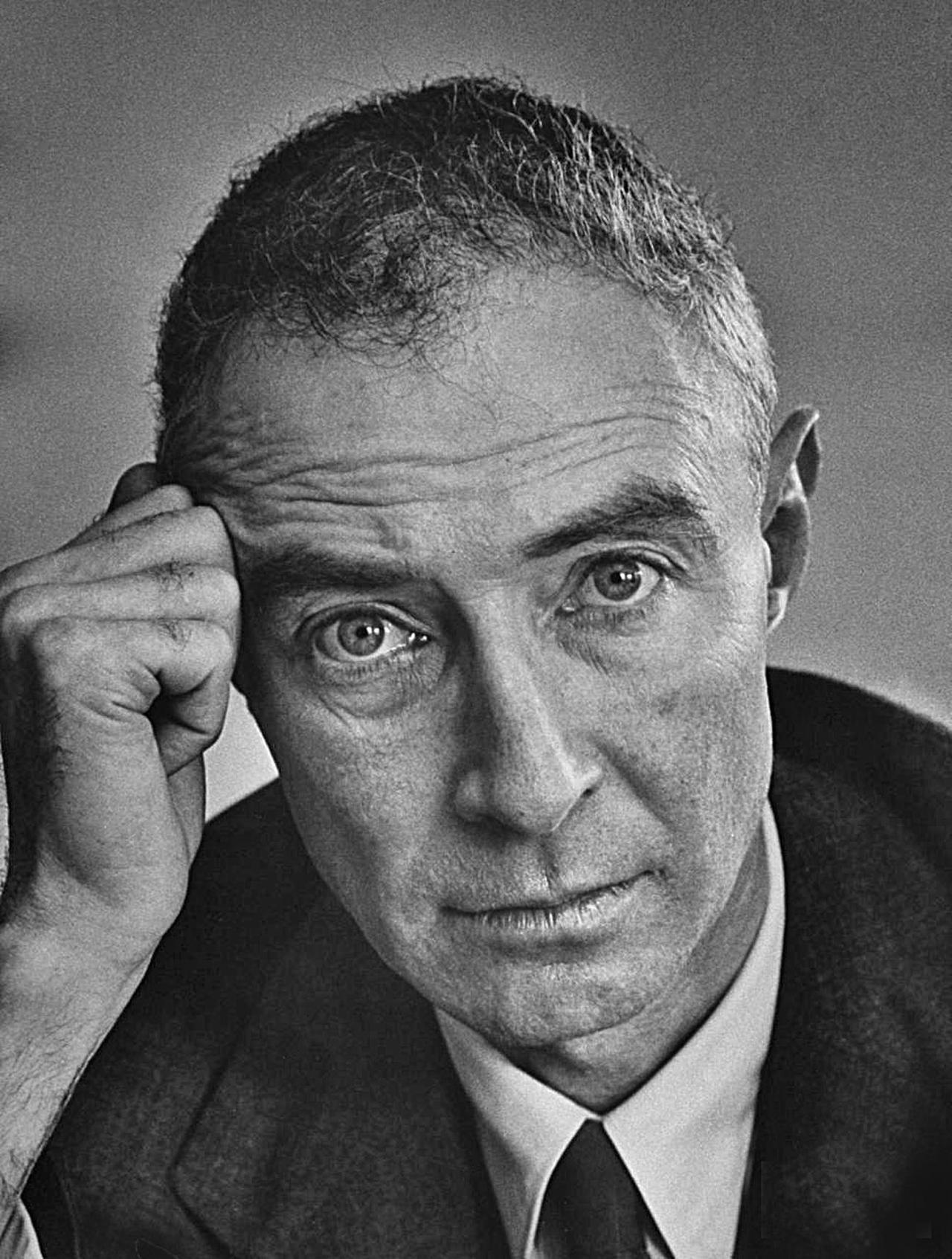
Doğum tarihi | 1904-04-22 | ||||||||
|---|---|---|---|---|---|---|---|---|---|
Eş | Katherine "Kitty" Puening Oppenheimer | ||||||||
Ölüm tarihi | 1967-02-18 | ||||||||
Duties | 1947–1966: Director of the Institute for Advanced Study 1942–1945: Scientific Director of the Los Alamos Laboratory | ||||||||
Çocuk | Katherine (Toni) Oppenheimer Peter Oppenheimer | ||||||||
Full Name | Julius Robert Oppenheimer | ||||||||
Profession(s) | Theoretical physicist | ||||||||
Scientific Contributions | management of the research and design process of the atomic bomb under the Manhattan Project research on black holes and neutron stars in the 1930s Born–Oppenheimer approximation with Max Born | ||||||||
Areas of Expertise | Nuclear weapons research Neutron physics Molecular theory Quantum mechanics | ||||||||
Robert Oppenheimer, born on 22 April 1904 in New York and died on 18 February 1967 in Princeton, New Jersey, was an American theoretical physicist of German Jewish descent. He is known for his contributions to quantum mechanics and for developing the Born–Oppenheimer Approximation with Max Born.
Robert Oppenheimer was born on 22 April 1904 in New York. His full name was Julius Robert Oppenheimer. His family was of German origin. His father, Julius Oppenheimer, had emigrated from Germany to the United States. When he arrived in America, he did not speak English and had limited financial means. He quickly achieved economic success through work in textile imports. Within about ten years he accumulated considerable wealth and moved his family to a luxurious apartment on Riverside Drive in Manhattan. It is reported that the home contained artworks of European origin, including paintings by van Gogh, Cézanne and Gauguin.【1】 His mother, Ella Friedman Oppenheimer, was a painter. Oppenheimer had a brother named Frank; Frank Oppenheimer later worked in the field of physics.
It is known that during his childhood Oppenheimer developed interests in mineralogy, poetry writing and scientific subjects.【2】 He displayed academic talent from an early age and could read and write in Greek, Latin, French and German.
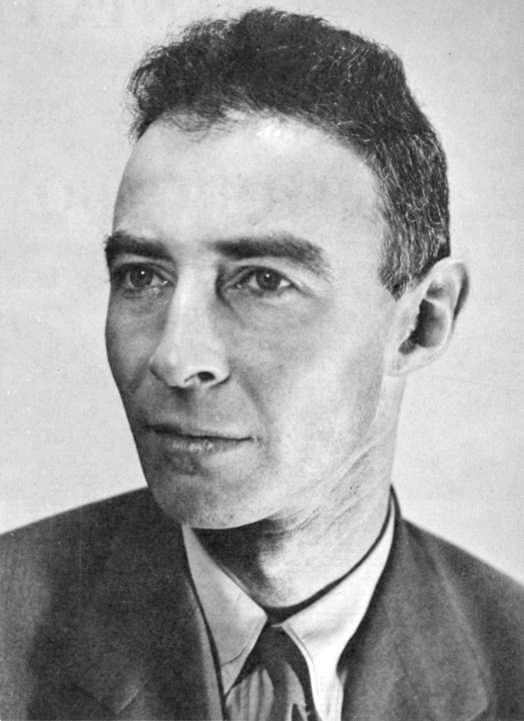
Robert Oppenheimer, 1944 (Lille norske leksikon)
Robert Oppenheimer enrolled at the Ethical Culture School in New York in 1911. This school was founded by the Ethical Culture Society based on principles of rationalism and secular humanism. He graduated first in his class in 1921.
After graduation, he contracted dysentery during a trip to Germany. Due to his illness, he could not immediately begin university studies. In spring 1922, at his father’s urging, he traveled to New Mexico to recover his health. During this time he learned to ride horses and developed an interest in the mountainous regions of New Mexico, an interest that continued in later years.
In autumn 1922 he enrolled at Harvard University. He initially studied chemistry but soon shifted his focus to physics. During his time at Harvard he took courses in mathematics, physics, philosophy, Eastern religions, and French and English literature. He followed an intensive curriculum and completed his undergraduate studies in three years, graduating summa cum laude in 1925.【3】
In 1925 he traveled to England and began working at the Cavendish Laboratory of Cambridge University under J. J. Thomson. He struggled to adapt to experimental work and was more drawn to theoretical physics. In 1926 he moved to Göttingen University in Germany to work with Max Born. During this period he established contact with leading physicists of the era, including Niels Bohr.
He completed his doctorate in 1927. After earning his doctorate he held positions at institutions including Harvard, the California Institute of Technology (Caltech), Leiden and Zurich.
In 1929 he received faculty offers from both Caltech and the University of California, Berkeley campus. He accepted both positions and divided his time between Pasadena and Berkeley. At Berkeley he established a research environment in theoretical physics.
Robert Oppenheimer played a role in the development of quantum mechanics during the second half of the 1920s. While at Göttingen University working with Max Born, he conducted research on the theoretical framework of quantum physics.
In 1927 he published a paper with Max Born on the quantum mechanical analysis of molecular structures. This work later became known as the Born–Oppenheimer Approximation and became a fundamental method for explaining molecules within quantum theory.
During the 1930s he conducted original research on black holes and neutron stars. He taught and researched fundamental problems in quantum mechanics. During this period Berkeley became a major center for both theoretical and experimental physics.【4】
In 1941 he began working on questions related to the development of the atomic bomb alongside Ernest Lawrence. He participated in research connected to Lawrence’s cyclotron-based efforts to separate uranium isotopes.
In early 1942 he organized a program at the University of California, Berkeley on the theoretical physics of fast neutrons. Later that year he participated in fast neutron physics research at the Chicago Met Lab and helped develop the general framework for the neutron physics program. In the summer of 1942 he assembled a theoretical research group at Berkeley to examine the fundamental principles of atomic bomb design. These efforts contributed to the establishment of the early theoretical framework for the atomic bomb.
During the 1930s Oppenheimer’s political interests became more pronounced. In the United States at the time, communism was viewed by some circles not as a threat but as a trend.【5】 The 1929 economic crisis and political developments in Europe, particularly the Spanish Civil War, influenced the ideological atmosphere of the era. Although Oppenheimer had previously led a life largely detached from daily politics, during these years he began engaging with leftist circles.【6】
In 1936 he began a relationship with Jean Tatlock, a medical student and member of the Communist Party. Through Tatlock he became acquainted with leftist circles on the West Coast, some of whom later became subjects of investigations concerning anti-American activities.
His relationship with Tatlock ended in early 1939. Tatlock died by suicide in 1944. Oppenheimer’s relationship with Tatlock and his associations with these circles later became subjects of security investigations.【7】
Oppenheimer occupied a politically controversial position due to his associations with individuals and circles sympathetic to communism. His brother Frank Oppenheimer had joined the Communist Party.【8】
World War II brought his past associations into focus during security evaluations for the Manhattan Project. During security investigations in the 1950s, his political connections from the 1930s were examined.
In 1942 atomic bomb development efforts in the United States were placed under an institutional framework. These efforts initially operated under the S-1 Committee. On 18 September 1942, with the assumption of military responsibility by General Leslie Groves, activities were reorganized under the name Manhattan Engineer District.【9】 This structure later became known as the Manhattan Project (Manhattan Project). The Manhattan Project was a large-scale military-scientific program encompassing research, production and engineering activities across various regions of the country.
Oppenheimer served on the S-1 Committee due to his work on fast neutron research. With Groves’s support, he was appointed scientific director of the secret laboratory to be established in New Mexico under the Manhattan Project. This laboratory was planned as the project’s central research and design facility and was organized as the Los Alamos Laboratory.
Groves and Oppenheimer examined various locations in New Mexico. The area around Jemez Springs was deemed unsuitable. Oppenheimer then proposed the mesa region where the Los Alamos Ranch School was located. Due to its geographic isolation and security conditions, this site was selected. The military soon purchased the land and constructed temporary barracks and laboratory buildings under military control.
Different production facilities and research centers of the Manhattan Project operated under separate security arrangements. The Los Alamos Laboratory, however, served as the center for theoretical design and final assembly of the atomic bomb. Oppenheimer brought together theoretical and experimental physicists there and coordinated scientific activities. Scientists and their families working at the laboratory lived and worked in the area under strict security conditions. Experimental and theoretical teams focused intensively on the design of the atomic bomb.
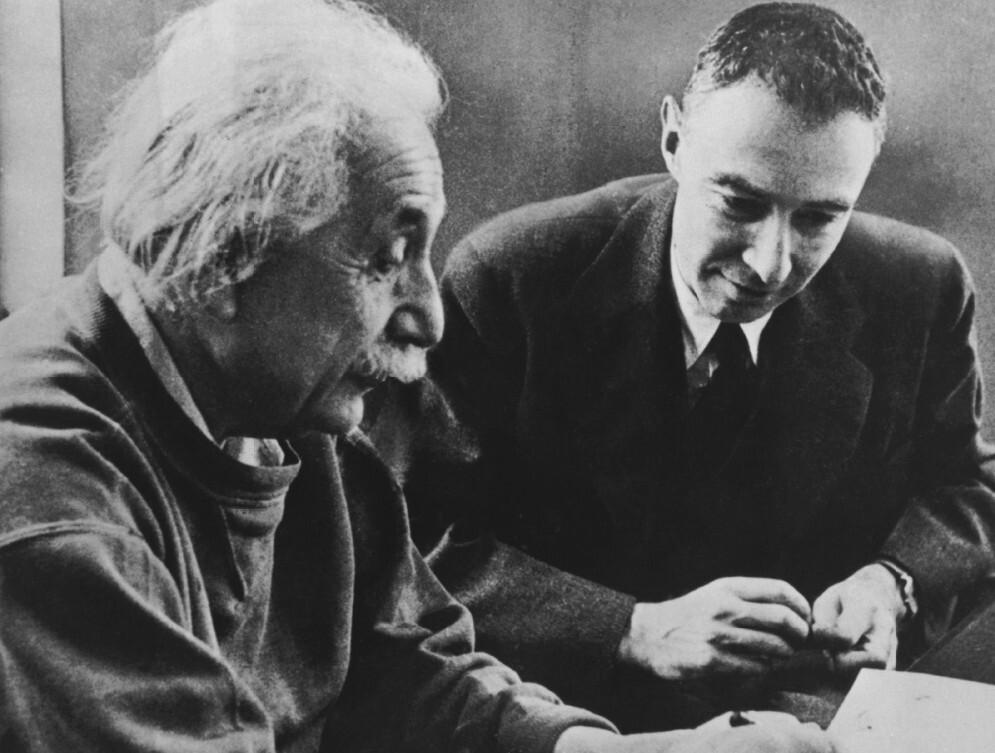
Robert Oppenheimer and Albert Einstein, 1947 (Lille norske leksikon)
Two distinct bomb designs were developed at Los Alamos. The design code-named “Little Boy” relied on combining uranium masses using a method similar to a gun-type mechanism. One uranium piece was fired toward another; when a critical mass was reached, a chain reaction began. The explosive yield was approximately 15,000 tons of TNT.【10】
The design code-named “Fat Man” relied on the simultaneous compression of a plutonium core using spherical arrangements of conventional explosives. The detonation of these explosives compressed the plutonium to a critical mass, triggering a chain reaction. This design had an explosive yield of approximately 20,000 tons of TNT.【11】 Due to its greater complexity, the first test conducted on U.S. soil was based on this model.
On 16 July 1945, the first atomic bomb test, code-named Trinity, was conducted in New Mexico. The explosion produced a mushroom-shaped cloud. A crater approximately 800 meters in diameter formed at ground zero, and the surrounding sand layer was fused into glass.
Oppenheimer was among those who witnessed the test. Years later he described the moment with a quote from the Bhagavad Gita: “Now I am become Death, the destroyer of worlds.”【12】
On 6 August 1945 the uranium bomb code-named “Little Boy” was dropped on Hiroshima. Tens of thousands of buildings in the city were destroyed and numerous civilians and military personnel lost their lives. Three days later the plutonium bomb code-named “Fat Man” was dropped on Nagasaki.
These attacks occurred during the final phase of World War II. After Germany’s unconditional surrender on 6 May 1945, it was decided to use atomic bombs against Japan. Japan surrendered following the bombings.
After World War II, Oppenheimer became one of the most prominent figures in public and political discourse regarding the consequences of the atomic bomb. In October 1945 he met with President Harry S. Truman at the White House. During the meeting he expressed moral discomfort about the use of atomic bombs and emphasized the responsibility of scientists.【13】
It is reported that President Truman did not welcome this approach. Truman emphasized that responsibility for the use of the bomb rested with political authorities and reportedly referred to Oppenheimer as a “crybaby scientist.”【14】
After the war, Oppenheimer advocated for international control of atomic energy. He served as Chairman of the General Advisory Committee of the Atomic Energy Commission.
Robert Oppenheimer's 1965 Interview (CBS News)
The emphasis on open dissemination of scientific knowledge and international cooperation formed key elements of his views during this period. He argued that scientific advancements should be addressed within frameworks of international dialogue and oversight rather than military competition.【15】
While serving on the Atomic Energy Commission, Oppenheimer opposed the development of the hydrogen bomb. He highlighted its military and ethical consequences. This stance was controversial during the Cold War. His objections to the hydrogen bomb were later interpreted unfavorably during security investigations.
In 1949 the Soviet Union’s successful test of its first atomic bomb generated serious security concerns in the United States. Suspicion arose that information from wartime work at Los Alamos might have been transferred to the Soviet Union. Oppenheimer’s associations with leftist circles in the 1930s, his connection to Jean Tatlock, and his links to communism were re-examined.
Within the rising anti-communist atmosphere of the Cold War, investigations led by Senator Joseph McCarthy gained influence in Washington. The Atomic Energy Commission assessed whether Oppenheimer posed a security risk. AEC Chairman Lewis Strauss, who had disagreements with Oppenheimer and particularly opposed his stance on the hydrogen bomb, became his adversary.【16】
In 1954 a formal security hearing was held against Oppenheimer. During the hearings his past associations with communist circles, his connection to Haakon Chevalier, and his political leanings were thoroughly scrutinized. Edward Teller and several other individuals testified. Teller expressed the view that Oppenheimer should not be granted security clearance.【17】
During this process, his past associations with communist circles were judged as a security risk and his security clearance was revoked. Although the decision stated that no clear evidence of disloyalty was found, it concluded that he was deemed a security liability. The revocation of his clearance effectively ended Oppenheimer’s official ties with the government and affected his standing in public opinion.【18】
After the revocation of his security clearance in 1954, Robert Oppenheimer withdrew from official federal roles. He continued serving as director of the Institute for Advanced Study and maintained his academic activities. This period marked a phase in which his influence on public policy diminished, but his intellectual work continued.
In 1963 he was awarded the Enrico Fermi Award, the highest honor of the Atomic Energy Commission.【19】 The award was presented by President Lyndon B. Johnson. This development was widely interpreted as a symbolic restoration of his standing following the 1950s security investigation.
In 1966 he was diagnosed with throat cancer. He died on 18 February 1967 in Princeton, New Jersey. His ashes were scattered at sea off the coast of the United States Virgin Islands.
The life of J. Robert Oppenheimer and the development of the atomic bomb were the subject of the 2023 biographical film Oppenheimer, directed by Christopher Nolan. The film centered on Oppenheimer’s life and his work within the Manhattan Project. Cillian Murphy starred in the lead role; Robert Downey Jr. drew attention in a supporting male role.
The film earned $954 million worldwide.【20】 It received 13 nominations at the Academy Awards and won seven Oscars, including Best Picture.【21】 Christopher Nolan won Best Director, Cillian Murphy won Best Actor, and Robert Downey Jr. won Best Supporting Actor.【22】
The film premiered in many countries in July 2023 but was released later in Japan. The delay was attributed to debates surrounding the film’s content and promotion. The film was criticized for allegedly ignoring the human cost of the atomic bomb.【23】
In Japanese public opinion, the awarding of honors to a production depicting the development of the atomic bomb became a subject of debate. More than 78 years after the atomic bombings of Hiroshima and Nagasaki, some Japanese citizens expressed disapproval of the film’s recognition.
Some Japanese citizens stated they did not wish to watch the film. Public opinion reflected views that the destruction caused by the atomic bomb was insufficiently understood and that younger generations needed to reflect on the realities of war.
Charles Oppenheimer, Robert Oppenheimer’s grandson, declared at a press conference in Tokyo that he opposed nuclear weapons. He stated that the world had entered “a new era more dangerous than ever before.”【24】 He emphasized the need for increased dialogue among nuclear-armed states. He warned that tensions between the United States, China and Russia, if unaddressed by communication, could pose global threats.
Charles Oppenheimer stated that nuclear energy could be used to save the world rather than destroy it. He is the founder of a civil society organization called the “Oppenheimer Project,” which advocates for peaceful uses of nuclear technology.
[1]
IAS, “J. Robert Oppenheimer: Life, Work, and Legacy,” Institute For Advanced Study, Last accessed: 17 February 2026, https://www.ias.edu/oppenheimer-legacy
[2]
National Park Service, “The Life of J. Robert Oppenheimer: Life Before the Manhattan Project,” nps.gov, Last accessed: 17 February 2026, https://www.nps.gov/articles/000/the-life-of-j-robert-oppenheimer-life-before-the-manhattan-project.htm
[3]
IAS, “J. Robert Oppenheimer: Life, Work, and Legacy,” Institute For Advanced Study, Last accessed: 17 February 2026, https://www.ias.edu/oppenheimer-legacy
[4]
IAS, “J. Robert Oppenheimer: Life, Work, and Legacy,” Institute For Advanced Study, Last accessed: 17 February 2026,
[5]
TRT Belgesel, “Robert Oppenheimer | Dünya Tarihinin Dönüm Noktaları | TRT Belgesel,” YouTube, 7:59-8:05, https://www.youtube.com/watch?v=i_RZzk_ac5M&t=292s
[6]
TRT Belgesel, “Robert Oppenheimer | Dünya Tarihinin Dönüm Noktaları | TRT Belgesel,” YouTube, 8:09-8:27
[7]
National Park Service, “The Life of J. Robert Oppenheimer: Life Before the Manhattan Project,” nps.gov. Last accessed: 17 February 2026, https://www.nps.gov/articles/000/the-life-of-j-robert-oppenheimer-life-before-the-manhattan-project.htm
[8]
National Park Service, “The Life of J. Robert Oppenheimer: After the Manhattan Project,” nps.gov, Last accessed: 17 February 2026, https://www.nps.gov/articles/000/the-life-of-j-robert-oppenheimer-after-the-manhattan-project.htm
[9]
National Park Service, “The Life of J. Robert Oppenheimer: The Manhattan Project Years (1941 to 1946),” nps.gov, Last accessed: 17 February 2026, https://www.nps.gov/articles/000/the-life-of-j-robert-oppenheimer-the-manhattan-project-years-1941-to-1946.htm
[10]
TRT Belgesel, “Robert Oppenheimer | Dünya Tarihinin Dönüm Noktaları | TRT Belgesel,” YouTube, 15:02, https://www.youtube.com/watch?v=i_RZzk_ac5M&t=292s
[11]
TRT Belgesel, “Robert Oppenheimer | Dünya Tarihinin Dönüm Noktaları | TRT Belgesel,” YouTube, 15:21
[12]
Lindsey Michael Banco, “THE BIOGRAPHIES OF J. ROBERT OPPENHEIMER: DESERT SAINT OR DESTROYER OF WORLDS,” Biography 35, no. 3 (2012): p. 500, http://www.jstor.org/stable/23541147
[13]
National Park Service, “The Life of J. Robert Oppenheimer: The Manhattan Project Years (1941 to 1946),” nps.gov, Last accessed: 17 February 2026, https://www.nps.gov/articles/000/the-life-of-j-robert-oppenheimer-the-manhattan-project-years-1941-to-1946.htm
[14]
National Park Service, “The Life of J. Robert Oppenheimer: The Manhattan Project Years (1941 to 1946),” nps.gov, Last accessed: 17 February 2026,
[15]
Atomic Heritage Foundation, “J. Robert Oppenheimer,” ahf.nuclearmuseum.org, Last accessed: 17 February 2026, https://ahf.nuclearmuseum.org/ahf/profile/j-robert-oppenheimer/
[16]
National Park Service, “The Life of J. Robert Oppenheimer: After the Manhattan Project,” nps.gov, Last accessed: 17 February 2026, https://www.nps.gov/articles/000/the-life-of-j-robert-oppenheimer-after-the-manhattan-project.htm
[17]
National Park Service, “The Life of J. Robert Oppenheimer: After the Manhattan Project,” nps.gov, Last accessed: 17 February 2026,
[18]
National Park Service, “The Life of J. Robert Oppenheimer: After the Manhattan Project,” nps.gov, Last accessed: 17 February 2026,
[19]
IAS, “J. Robert Oppenheimer: Life, Work, and Legacy,” Institute For Advanced Study, Last accessed: 17 February 2026, https://www.ias.edu/oppenheimer-legacy
[20]
Anadolu Ajansı, “Japonlar "Oppenheimer" filminin Oscar almasına tepkili,” Ayrımcılık/hattı, Last accessed: 17 February 2026, https://www.aa.com.tr/tr/ayrimcilikhatti/ayrimcilik/japonlar-oppenheimer-filminin-oscar-almasina-tepkili/1819389
[21]
Anadolu Ajansı, “Japonlar "Oppenheimer" filminin Oscar almasına tepkili,” Ayrımcılık/hattı, Last accessed: 17 February 2026,
[22]
Anadolu Ajansı, “Japonlar "Oppenheimer" filminin Oscar almasına tepkili,” Ayrımcılık/hattı, Last accessed: 17 February 2026,
[23]
Anadolu Ajansı, “Oppenheimer'ın torunundan nükleer güce sahip ülkelere mesaj,” Anadolu Ajansı, Last accessed: 17 February 2026, https://www.aa.com.tr/tr/dunya/oppenheimerin-torunundan-nukleer-guce-sahip-ulkelere-mesaj/3240493
[24]
Anadolu Ajansı, “Oppenheimer'ın torunundan nükleer güce sahip ülkelere mesaj,” Anadolu Ajansı, Last accessed: 17 February 2026,

Doğum tarihi | 1904-04-22 | ||||||||
|---|---|---|---|---|---|---|---|---|---|
Eş | Katherine "Kitty" Puening Oppenheimer | ||||||||
Ölüm tarihi | 1967-02-18 | ||||||||
Duties | 1947–1966: Director of the Institute for Advanced Study 1942–1945: Scientific Director of the Los Alamos Laboratory | ||||||||
Çocuk | Katherine (Toni) Oppenheimer Peter Oppenheimer | ||||||||
Full Name | Julius Robert Oppenheimer | ||||||||
Profession(s) | Theoretical physicist | ||||||||
Scientific Contributions | management of the research and design process of the atomic bomb under the Manhattan Project research on black holes and neutron stars in the 1930s Born–Oppenheimer approximation with Max Born | ||||||||
Areas of Expertise | Nuclear weapons research Neutron physics Molecular theory Quantum mechanics | ||||||||
No Discussion Added Yet
Start discussion for "Julius Robert Oppenheimer" article
Birth and Family Origins
Education and Academic Development
Scientific Work
Political Orientation and Social Environment
Relationship with Jean Tatlock
The Manhattan Project and Establishment of the Los Alamos Laboratory
“Little Boy” and “Fat Man” Designs
The Bombing of Hiroshima and Nagasaki
Attitude After the Atomic Bomb
Security Investigation and Clearance Revocation
Final Years and Death
Cultural Representation and Biographical Interpretations
Controversies Over Screening in Japan
Charles Oppenheimer’s Statements