This article was automatically translated from the original Turkish version.
+2 More
Origin(s) | Safranbolu-Karabük/Türkiye | ||||||||
|---|---|---|---|---|---|---|---|---|---|
Product / Product Group(s) | Chocolate confectionery and related products | ||||||||
Registration Type | Trademark | ||||||||
Registration Number | 183 | ||||||||
Registration Date | 15 July 2014 | ||||||||
Basic Components | Sugar, corn starch, citric acid, drinking water | ||||||||
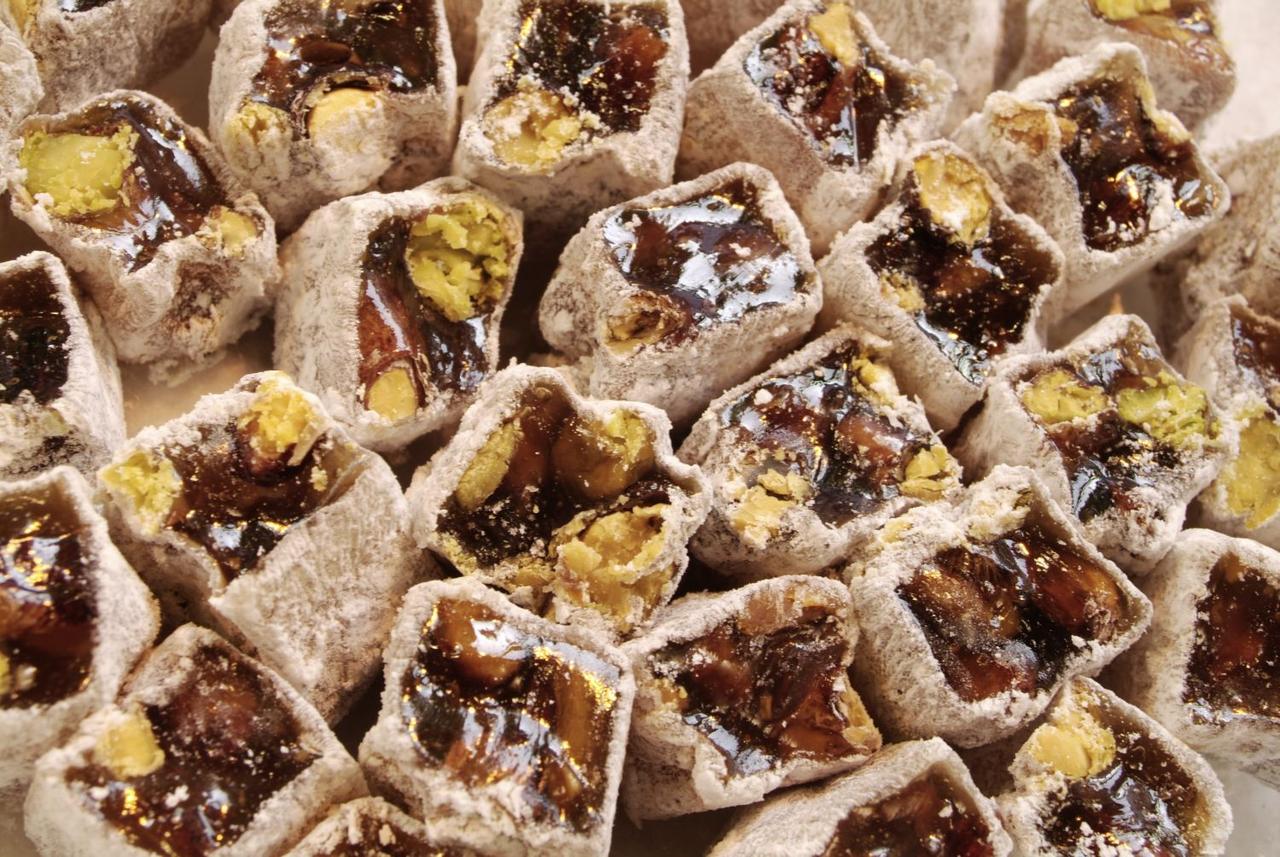
Safranbolu Lokumu is a traditional type of Turkish delight uniquely associated with the district of Safranbolu in Karabük Province. It is produced using sugar (sucrose), water, corn starch, and citric acid, with no additives. The product distinguishes itself from other lokums by its glossy cross-section, elastic texture, non-stickiness to the palate when chewed, and absence of a raw starch taste. This product must be produced entirely within the administrative boundaries of Safranbolu district and was officially registered with a geographical indication in 2014.

Safranbolu Lokumu (T.C. Karabük Governorship)
Safranbolu Lokumu is a product requiring traditional knowledge, and therefore its production must involve masters with at least five years of experience. The manufacturing process is carried out in copper cauldrons, whose ability to conduct heat evenly and slowly positively influences the product’s structure and flavour.
Water, powdered sugar, corn starch, and citric acid are added sequentially into the copper cauldron and mixed. Then, an additional 50 litres of water are added, and the mixture is continuously stirred and boiled for 3 to 3.5 hours. The boiling temperature is maintained at 110–115 °C during summer months and 105–110 °C during winter months to achieve the desired consistency.
The thickened mixture is poured in portions of 4 to 5.35 kg into smooth wooden moulds lined with food-grade greased parchment paper. The lokum in the moulds is left to rest for at least 16 hours. After this stage, the product is transferred onto a marble surface dusted with coconut. The surface of the lokum is moistened, turned over, and both sides are coated with coconut.
The product is then shaped into cylindrical form (minimum diameter of 3 cm, thickness of 1.9–2.1 cm), sliced, and packaged for sale.
Safranbolu Lokumu can be produced plain or with various flavouring agents:
No additives such as aroma, essence, or food colouring are used in its production.
Safranbolu Lokumu has been registered for protection under Law No. 6769 on Industrial Property by the Karabük Provincial Directorate. The geographical indication was registered on 15 July 2014 with registration number 183. All stages of production must be carried out within the administrative boundaries of Safranbolu district.
The use of water sourced from the local geographical area is essential to preserve the product’s elastic texture and achieve its traditional consistency. Inspections are conducted by a commission composed of expert representatives from relevant professional chambers, coordinated by Safranbolu Lati Food Industry and Trade Limited Company.
T.C. Karabük Valiliği. “Safranbolu Lokumu.” T.C. Karabük Valiliği Resmî Web Sitesi. Accessed July 9, 2025. http://www.karabuk.gov.tr/safranbolu-lokumu
T.C.Safranbolu Kaymakamlığı Governorship. "Safranbolu Lokumu." T.C. Safranbolu District Governorship Official Website. Accessed July 9, 2025. http://www.safranbolu.gov.tr/safranbolu-lokumu
Turk Patent and Trademark Office. "Safranbolu Lokumu – Tescil Belgesi ve Üretim Metodu." *Coğrafi İşaretler Portalı.* Accessed July 9, 2025. https://ci.turkpatent.gov.tr/Files/GeographicalSigns/6f5acc56-4f78-46aa-be94-16e2e520f669.pdf.
Turkish Patent and Trademark Office. "Safranbolu Lokumu." *Geographical Indications Portal.* Accessed July 9, 2025. https://ci.turkpatent.gov.tr/cografi-isaretler/detay/37970.


Origin(s) | Safranbolu-Karabük/Türkiye | ||||||||
|---|---|---|---|---|---|---|---|---|---|
Product / Product Group(s) | Chocolate confectionery and related products | ||||||||
Registration Type | Trademark | ||||||||
Registration Number | 183 | ||||||||
Registration Date | 15 July 2014 | ||||||||
Basic Components | Sugar, corn starch, citric acid, drinking water | ||||||||
Production Method
Ingredients
Production Process
Varieties
Geographical Indication Information
Inspection