


This article was automatically translated from the original Turkish version.
+1 More
Location | Ağlasun Türkiye Burdur | ||||||||
|---|---|---|---|---|---|---|---|---|---|
Coordinate(s) | 37°40′27″N 30°30′00″E | ||||||||
Region(s) | Pisidia | ||||||||
Elevation(s) | 1 500 metres | ||||||||
Foundation | It is believed to extend as far back as the 3rd millennium BCE | ||||||||
Golden Age | Roman Empire Period (1st–3rd centuries CE) | ||||||||
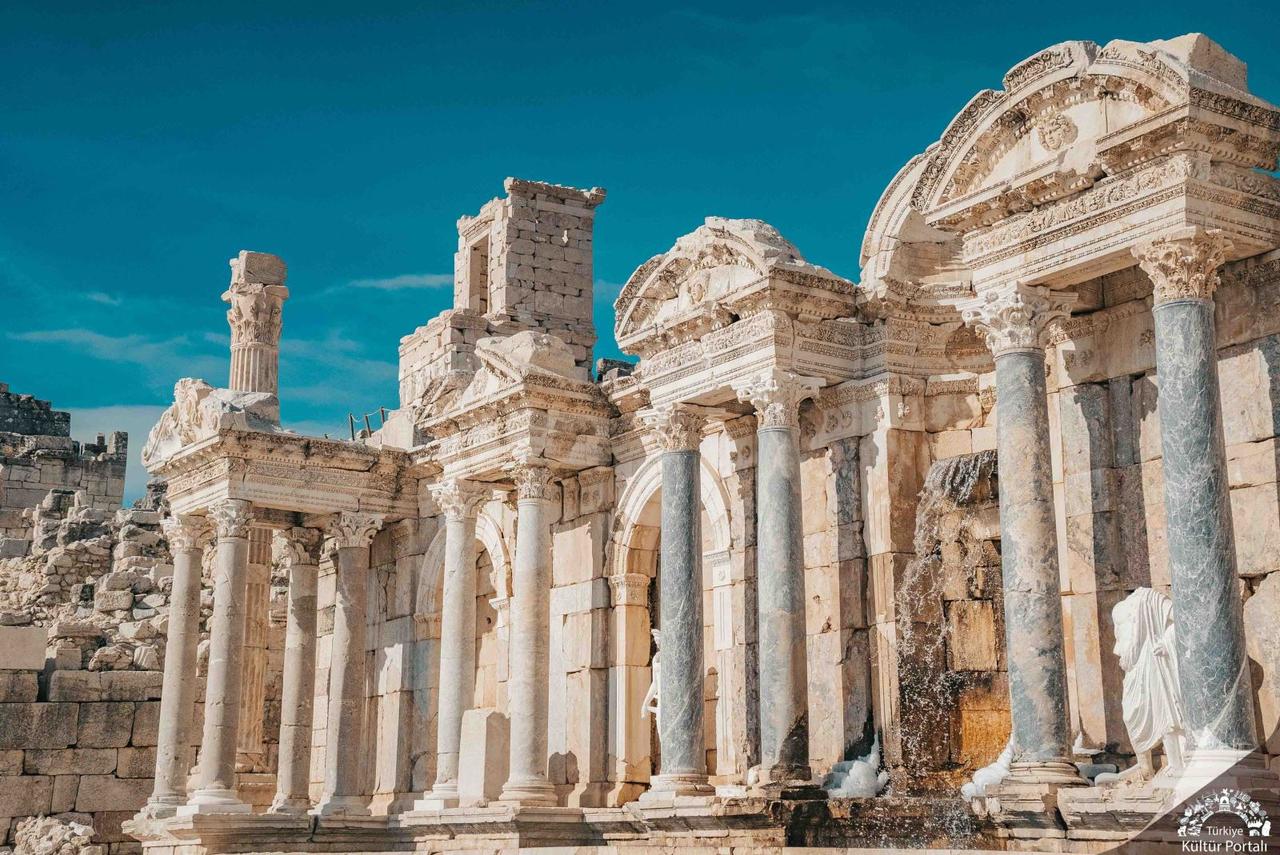
Notable Structures | Antoninler Çeşmesi, Tiberius Kapısı, Roma Hamamı, Heroon, Bouleuterion | ||||||||
Sagalassos is an ancient city of Pisidia located within the boundaries of Ağlasun district in Burdur province, in the Mediterranean Region of present-day Türkiye. Situated at an elevation of approximately 1500 meters above sea level at the foot of the Taurus Mountains, the city is recognized as one of Anatolia’s most important ancient settlements due to its natural defensive advantages, advanced water infrastructure, rich architecture, and abundant archaeological findings.

Sagalassos Ancient City - Sagalossos Foundation
The settlement history of Sagalassos extends as far back as the 3rd millennium BCE, but the city gained its principal significance after Alexander the Great conquered the region in 334 BCE. It subsequently came under the rule of the Seleucids, the Kingdom of Pergamon, and finally the Roman Empire. During the Roman period, particularly under Emperor Augustus (27 BCE – 14 CE), it acquired the title “Metropolis of Pisidia” and became a regional center. This era witnessed intensive construction activity, with the city enriched by theaters, agoras, baths, fountains, monuments, and temples.
Settlement continued during the Byzantine period, but from the 7th century CE onward, the city lost its importance due to Arab raids, earthquakes, and the destruction of its water sources. Although small settlements are believed to have persisted until the 13th century, the city was eventually abandoned entirely.
Sagalassos is situated on a high plateau dominating the Ağlasun Valley. This location provided the city with natural defensive advantages, while its proximity to abundant water sources enabled a sustainable living environment. Moreover, its position along major trade routes connecting Pamphylia (modern Antalya) with Central Anatolia enhanced its economic and strategic value in antiquity.
Sagalassos houses some of the best-preserved examples of Roman architecture in Anatolia. Since 1990, excavations led by the Catholic University of Leuven in Belgium have uncovered numerous structures, establishing the site as a major reference in archaeological literature. The city’s most notable structures include:

Antonine Fountain (Nymphaeum) - Turkish Museums
Sagalassos is notable for its rich water resources and sophisticated engineering systems. Aqueducts, storage facilities, channels, and monumental fountains ensured the population’s water supply. Research has demonstrated that the city’s water systems were technologically advanced for their time.
During the Roman period, the presence of a wealthy aristocratic class is evident from surviving luxury residences and private baths. The economy was based on agriculture, animal husbandry, and ceramic production. In particular, the high-quality ceramics produced in Sagalassos demonstrate the city’s integration into the Mediterranean trade network. It is known that goods manufactured in its workshops were exported to various regions of the Roman Empire.
Environmental factors are believed to have played a major role in the abandonment of Sagalassos. Major earthquakes in the 6th century CE, epidemics (likely the Plague of Justinian), climate change, and damage to the water infrastructure collectively led to the end of urban life in the city.
Sagalassos Vakfı. "Sagalassos Antik Kenti." Sagalassos Foundation Official Website. Accessed May 14, 2025. http://www.sagalassosvakfi.org/sagalassos/.
Turkish Ministry of Culture and Tourism. "Sagalassos."Burdur İl Directorate of Culture and Tourism. Accessed May 14, 2025. https://burdur.ktb.gov.tr/TR-155349/sagalassos.html.
Turkish Museums. “Sagalassos’ta Mutlaka Görmeniz Gereken 4 Eser.” Turkish Museums Blog. Accessed May 14, 2025. https://turkishmuseums.com/blog/detail/sagalassos-ta-mutlaka-gormeniz-gereken-4-eser/10056/1.
Türkiye Kültür Portalı. “Sagalassos Antik Kenti - Burdur.” Türkiye Kültür Portalı. Accessed May 14, 2025. https://kulturportali.gov.tr/turkiye/burdur/gezilecekyer/sagalassos-antik-kenti.

Location | Ağlasun Türkiye Burdur | ||||||||
|---|---|---|---|---|---|---|---|---|---|
Coordinate(s) | 37°40′27″N 30°30′00″E | ||||||||
Region(s) | Pisidia | ||||||||
Elevation(s) | 1 500 metres | ||||||||
Foundation | It is believed to extend as far back as the 3rd millennium BCE | ||||||||
Golden Age | Roman Empire Period (1st–3rd centuries CE) | ||||||||
Notable Structures | Antoninler Çeşmesi, Tiberius Kapısı, Roma Hamamı, Heroon, Bouleuterion | ||||||||
No Discussion Added Yet
Start discussion for "Sagalassos Ancient City" article
History
Geographical Location and Strategic Importance
Architectural and Archaeological Features
Water Systems and Infrastructure
Society and Economy