


This article was automatically translated from the original Turkish version.
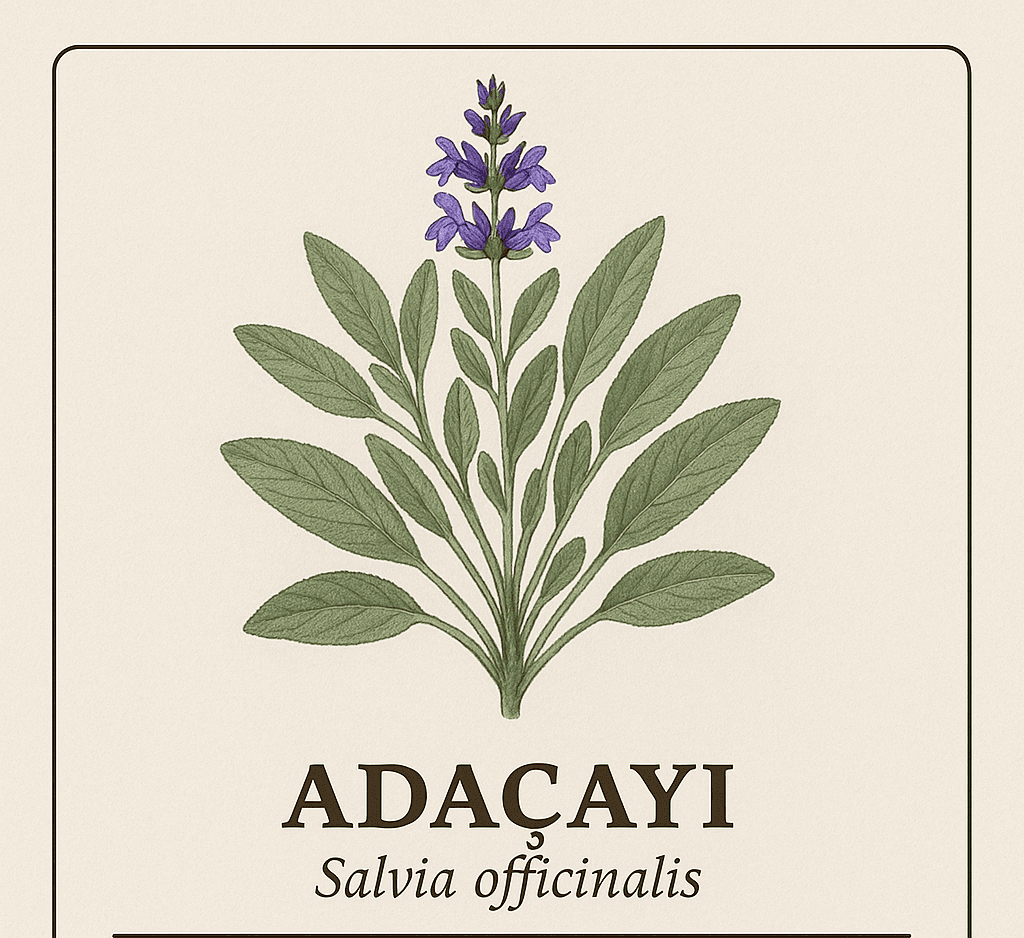
Sage (Salvia officinalis)
Scientific Name(s) | Salvia officinalis L. | ||||||||
|---|---|---|---|---|---|---|---|---|---|
Family | Lamiaceae (Lamiaceae) | ||||||||
Genus | Salvia | ||||||||
Number of Species (Worldwide) | Approximately 900 | ||||||||
Salvia in Türkiye’s Flora | 97 species, 4 subspecies, 8 varieties | ||||||||
Endemism Rate (Türkiye) | 51% | ||||||||
Sage (Salvia officinalis L.) is a perennial medicinal herb belonging to the Lamiaceae (mint) family, distinguished by its woody stem and aromatic properties. Worldwide, approximately 900 species are known within the genus Salvia, with the highest diversity found in the Americas and Southwest Asia. In Türkiye’s flora, 97 species, four subspecies, and eight varieties of Salvia are represented, of which 51% are endemic. Although Salvia officinalis does not occur naturally in Anatolia, it is widely cultivated in the Aegean, Mediterranean, and Marmara regions, particularly in the Inner Aegean, after being introduced for cultivation.
Sage is a semi-shrub that can grow up to 50–100 cm in height. Its stem is woody and branched. Oppositely arranged, long-petioled, hairy, gray-green leaves are borne on the branches. The leaves constitute the most pharmacologically utilized part of the plant and contain 0.5–2.5% essential oil. The main components of this essential oil include thujone, cineol, and borneol, which confer antimicrobial and antiseptic properties to sage. Harvesting is typically carried out at the end of bud formation or the beginning of flowering, as leaves collected during this period contain the highest concentration of active compounds.

Sage (generated by artificial intelligence)
The physico-mechanical properties of sage, important for agricultural production and processing, have been studied at different moisture levels (8.4%, 11.5%, and 16.2% on a dry weight basis). Leaf length ranged from 32.8 to 65.6 mm, leaf thickness from 0.517 to 0.541 mm, and the force required for leaf-stem detachment measured between 4.3 and 6.5 N. The leaf-to-stem ratio varied between 2.3 and 2.6, factors that enhance the economic value of the plant. As moisture content increased, the essential oil content decreased slightly, from 2.7% to 2.67%. These data provide key agronomic parameters to consider during harvesting and processing.
The leaves of Salvia officinalis have been analyzed for trace elements including Zn, Cu, Mn, Se, Cr, and Cd. Zinc (Zn) was the most abundant mineral detected in leaf tissue at a concentration of 63.163 µg/kg, followed by copper (Cu: 31.369 µg/kg), manganese (Mn: 24.052 µg/kg), selenium (Se: 7.910 µg/kg), chromium (Cr: 443 µg/kg), and cadmium (Cd: 27 µg/kg).
The transfer rates of these minerals into herbal teas prepared from sage were compared using infusion and decoction methods. Decoction yielded significantly higher mineral extraction rates than infusion. The highest transfer rate was observed for Cd at 22.63%, while the lowest was for Se at 0.02%. The duration of application and the amount of plant material used directly influenced mineral transfer rates. Optimal conditions were determined to be 3 grams of plant material subjected to 5 minutes of decoction.
Due to its antimicrobial, antioxidant, and anti-inflammatory effects, sage has been widely used in traditional medicine throughout history. In folk practice, it is commonly consumed as an herbal tea to alleviate sore throat, digestive disorders, excessive sweating, anxiety, and menopausal symptoms. In countries such as Germany, the United Kingdom, and the United States, sage extracts or essential oils are used in pharmaceutical products including antiseptic mouthwashes, digestive tonics, and cold remedies. There is also significant demand for sage in aromatherapy, cosmetics, and soap manufacturing.
Sage, as a medicinal and aromatic plant, is a valuable agricultural commodity both in domestic markets and for export. Industrial production in Türkiye is steadily increasing, with dried leaves and essential oils utilized across various industries. With high adaptability, it is well suited to organic and traditional farming systems. Its low input requirements and drought tolerance make it a promising species for contributing to rural development.
Elmas, Sinem. 2021. “Salvia officinalis (Tıbbi Adaçayı) Bitkisinin Bazı Abiyotik Stres Faktörlerine Yanıtları.” Iğdır Üniversitesi Fen Bilimleri Enstitüsü Dergisi 11, no. 2: 943–959. Accessed May 25, 2025. https://dergipark.org.tr/tr/download/article-file/1500539
Yaman, Cennet. 2021. “Tıbbi Adaçayı’nın (Salvia officinalis L.) Herbal Çaylarındaki Mineral İçeriği Üzerine Örnek Miktarı ve Uygulama Süresinin Etkisi.” Türk Tarım ve Doğa Bilimleri Dergisi 8, no. 2: 336–343. Accessed May 25, 2025. https://dergipark.org.tr/en/download/article-file/1407221
Yılmaz, Deniz, and Mehmet Emin Gökduman. 2015. “Adaçayı (Salvia officinalis) Bitkisinin Farklı Nem Düzeylerinde Fiziko-Mekanik Özelliklerinin Belirlenmesi.” Süleyman Demirel Üniversitesi Ziraat Fakültesi Dergisi 10, no. 1: 73–82. Accessed May 25, 2025. https://dergipark.org.tr/en/download/article-file/308638
Sage (Salvia officinalis)
Scientific Name(s) | Salvia officinalis L. | ||||||||
|---|---|---|---|---|---|---|---|---|---|
Family | Lamiaceae (Lamiaceae) | ||||||||
Genus | Salvia | ||||||||
Number of Species (Worldwide) | Approximately 900 | ||||||||
Salvia in Türkiye’s Flora | 97 species, 4 subspecies, 8 varieties | ||||||||
Endemism Rate (Türkiye) | 51% | ||||||||
No Discussion Added Yet
Start discussion for "Sage (Salvia officinalis)" article
Botanical Characteristics and Morphology
Physico-Mechanical Properties
Mineral Composition and Herbal Tea Performance
Uses and Traditional Applications
Economic and Agricultural Importance