


This article was automatically translated from the original Turkish version.
+2 More
Salem Witch Trials were a series of hearings and prosecutions that took place in the Massachusetts Bay Colony between February 1692 and May 1693. The events resulted in more than a hundred people being accused of witchcraft, 140 imprisoned, nineteen executed by hanging, and one man pressed to death under interrogation. The process profoundly shaken the social and legal structures of the colony and has since become a symbol of mass hysteria religious extremism and judicial failure in American history.
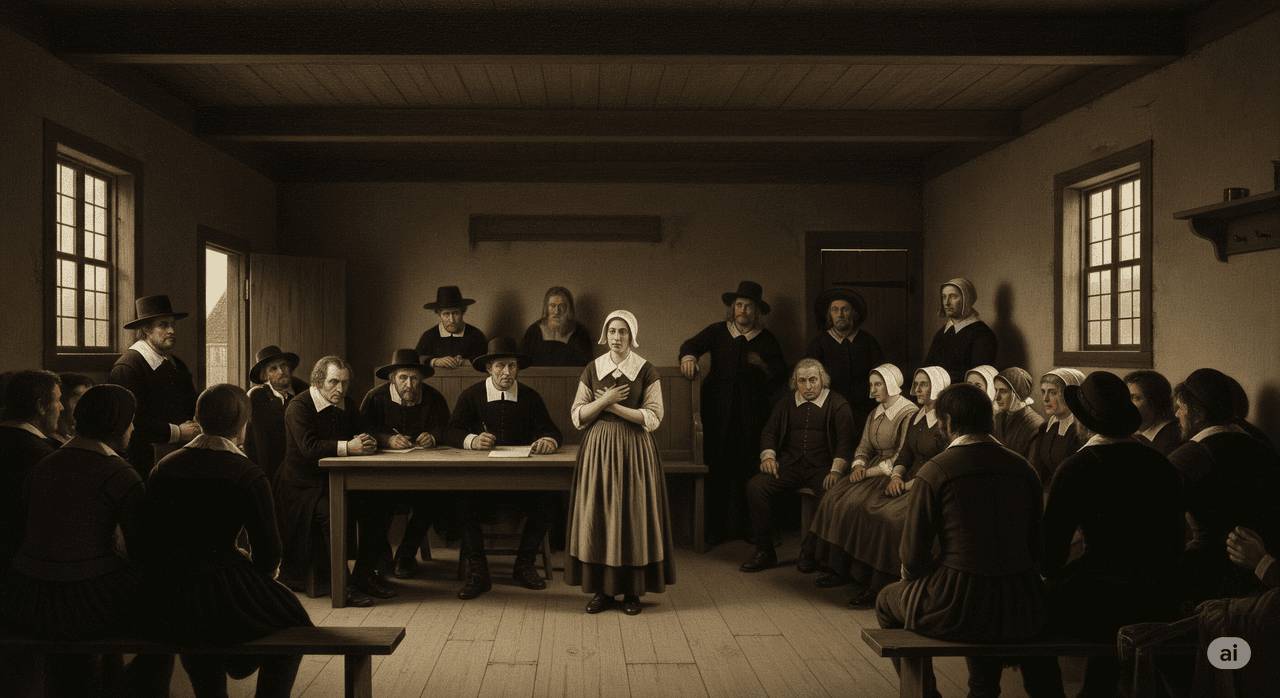
Depiction of a Witch Trial in 17th Century Salem (Generated by Artificial Intelligence)
Belief in witchcraft was an integral part of the worldview of 17th century New England Puritan society. Colonists who migrated from Europe brought with them the conviction in a constant physical struggle between God and Satan and the tradition of witch hunts to the New World. This belief system combined with the colony’s political instability wars with Native American tribes such as King William’s War and the frequent sermons by Puritan leaders warning of moral decline to create a tense social environment.
The events began in January 1692 in the household of Samuel Parris the minister of Salem Village (present-day Danvers). Parris’s nine-year-old daughter Elizabeth Betty Parris and his eleven-year-old niece Abigail Williams began exhibiting strange behaviors and uncontrollable fits. Dr. William Griggs a local physician unable to find a physical explanation for their condition diagnosed them as being under the influence of an evil hand.
Under pressure the girls named three women as the source of their affliction: Tituba a Caribbean-born slave of Parris’s Sarah Good a beggar and Sarah Osborne an elderly woman marginalized by society. These three women were arrested and interrogated. Tituba’s interrogation became a turning point in the course of events. Likely under torture or coercion she confessed to being a witch and more importantly claimed the existence of a coven of other witches in Salem. This testimony triggered the transformation of isolated accusations into a mass hysteria.
Following Tituba’s confession the wave of accusations spread rapidly. Numerous individuals were accused including respected church members such as Martha Corey and Rebecca Nurse. To cope with the growing number of cases Governor William Phips established in May 1692 a special court known as the Court of Oyer and Terminer (to hear and determine). Appointed as chief justice William Stoughton began hearing cases with great speed.
The courts operated intensively from March to September 1692. During this period:
The most controversial aspect of the trials was the type of evidence accepted.
Spectral evidence was central to the proceedings. This form of evidence relied on testimonies that the accused’s spirit or ghost had appeared to the victim and tormented them. Such claims were accepted as valid proof even when the accused was physically elsewhere. Although prominent clergyman Cotton Mather advised caution in its use the court accepted spectral evidence widely and uncritically.
Other forms of evidence included:
By the autumn of 1692 growing public suspicion and the fact that accusations had reached even the highest families including the governor’s own wife led to a backlash against the trials. In October 1692 Governor Phips dissolved the Court of Oyer and Terminer. The newly established Superior Court of Judicature acquitted most of the remaining defendants because it no longer accepted spectral evidence.
In January 1697 the Massachusetts General Court declared a day of fasting and prayer for the events. Judge Samuel Sewall became the only official to publicly apologize for his role in the proceedings. In 1706 leading accuser Ann Putnam Jr. asked for forgiveness in front of her church calling her actions a great mistake by Satan. In subsequent years the reputations of those wrongfully accused were restored and compensation was paid to their families.
Throughout history various theories have been proposed to explain the causes of the Salem Witch Trials:
Historians Paul Boyer and Stephen Nissenbaum interpreted the events as a power struggle between Salem Village’s agrarian and conservative faction led by the Putnam family and Salem Town’s commercial and wealthier faction led by the Porter family. The majority of accusations targeted members of the Porter faction.
Mary Beth Norton argues that the trauma and climate of fear generated by King William’s War fueled the hysteria. The presence of refugees from frontier areas who had witnessed Native American attacks heightened social anxiety and reinforced the idea of Satan’s assault.
It has been suggested that the accusers suffered from a genuine psychological disorder conversion disorder due to the repressive environment of Puritan society and intergenerational tensions.
Proposed by Linnda Caporael in 1976 the theory suggests the girls’ symptoms may have resulted from consuming rye bread contaminated with ergot a fungus with LSD-like hallucinogenic effects. However this theory has been largely rejected by other scientists due to inconsistencies in symptom patterns and Puritan dietary habits.
The trials in Salem were based on English law and biblical injunctions against witchcraft such as Exodus 22:18 “Thou shalt not suffer a witch to live.” However in practice especially through the acceptance of spectral evidence traditional legal standards were stretched and the judicial process was compromised. The courts’ greatest error lay in issuing irreversible verdicts based on evidence that was devoid of concrete proof highly subjective and vulnerable to manipulation. The rejection of spectral evidence became the legal turning point that ended the trials.
The Salem Witch Trials left deep marks on American identity and have become a metaphor for political “witch hunts” through works such as Arthur Miller’s The Crucible. The events serve as a historical lesson on social fear group psychology religious dogmatism and the abuse of legal power.
Gün, Mukadder. "Köle Kadın Avından Cadı Kadın Avına Dönüşen Şifacı Kadına Yönelik Şiddet: Salem Cadı Suçlamaları ve Duruşmaları Örneği." *Türkiye Klinikleri Medical Ethics, Law and History-Special Topics* 5, no. 3 (2019): 13–20. Accessed July 6, 2025. https://www.academia.edu/49337766/Kole_Kad%C4%B1n_Av%C4%B1ndan_Cad%C4%B1_Kad%C4%B1n_Av%C4%B1na_Donusen.
Price, David Wayne. *Cotton Mather's Cosmology and the 1692 Salem Witch Trials.* PhD thesis, University of North London, 2001. Accessed July 6, 2025. https://repository.londonmet.ac.uk/7286/1/369396.pdf.
Purdy, Sean. "Conjuring History: The Many Interpretations of the Salem Witchcraft Trials." *Rivier Academic Journal* 3, no. 1 (2007): 1–18. Accessed July 6, 2025. https://www2.rivier.edu/journal/rcoaj-spring-2007/j90-purdy-salem-trials.pdf.
Yurtseven, Yaprak. *Ataerkil Yargılamalar: Salem Cadı Mahkemeleri.* Master's thesis, Dokuz Eylül University Institute of Social Sciences, Department of Women's Studies, 2022. Accessed July 6, 2025. https://www.proquest.com/openview/57a6ec4087719f01e753b9c66bb98015/1?pq-origsite=gscholar&cbl=2026366&diss=y.


Historical Development
Nature of the Evidence
End and Aftermath of the Trials
Key Figures
Theoretical Approaches and Interpretations
Socioeconomic and Political Interpretations
Factionalism
War Trauma
Psychological and Medical Interpretations
Mass Hysteria
Ergot Poisoning
Feminist Interpretations
Legal Framework