This article was automatically translated from the original Turkish version.
+2 More
Location | Beyköy Village Türkiye Düzce Düzce Central | ||||||||
|---|---|---|---|---|---|---|---|---|---|
Area(s) | 10.8 hectares | ||||||||
Geomorphological Features | Three waterfall drops, large cauldron (Witch's Cauldron), rock blocks, narrow valley system | ||||||||
Vegetation Cover | Broadleaf forest species such as hornbeam, oak, hornbeam, and chestnut; monumental trees | ||||||||
Climate Type | Black Sea Climate | ||||||||
Prominent Natural Features | Witch's Cauldron, Natural Waterfalls, Stream Bed, Rock Formations | ||||||||
Structural Features | Observation platforms, Walking trails, Metal and wooden bridges, viewing terraces | ||||||||
Samandere Waterfall Nature Monument is a natural area located in the boundaries of Beyköy Village, southeast of the city center of Düzce, and was declared a nature monument in 1988. It is one of the first nature monuments declared in Türkiye and is distinguished particularly by its geological structure, waterfall systems, and forest formations. The area, covering 10.8 hectares, is under protection by the General Directorate of Nature Conservation and National Parks.
Samandere Waterfall is approximately 24 kilometers from the city center of Düzce. Access to the area is provided via the Düzce-Beyköy-Samandere route. The site is situated on a sloping topography along the Samandere Creek valley, and its position within the valley, combined with the surrounding river systems and forest cover, makes it a site of significant natural and scientific interest.
The area where Samandere Waterfall is located lies within the influence zone of the Düzce Fault Zone and is characterized geologically by volcanic rocks, particularly basalt and tuff. The waterfall consists of three main cascade structures formed by the creek’s descent over distinct elevation breaks, along with various pot holes.

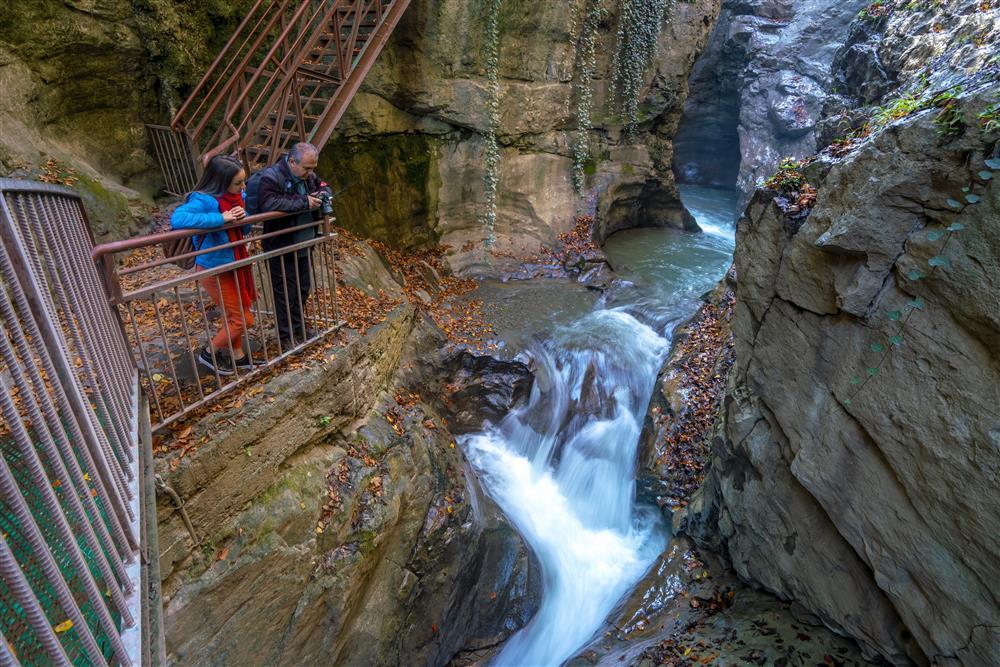
Image of Walking Trails at Samandere Waterfall Nature Monument (Ministry of Agriculture and Forestry of the Republic of Türkiye)
The waterfalls form at three distinct points where the stream flows over vertical fault lines. These drop points have been shaped over time by rock erosion and fluvial abrasion.
The large pothole known as “Cadı Kazanı” (Witch’s Cauldron) was formed by the swirling action of the stream creating a circular depression. Along the stream bed, various sizes of rock blocks and erosional geological features can be observed.
The region is covered by humid forests under the influence of the Black Sea climate. Natural forest formations dominate the area. Particularly broadleaf tree species such as oriental beech (Fagus orientalis), hornbeam (Carpinus betulus), oak (Quercus spp.), and chestnut (Castanea sativa) are widely distributed. Some monumental tree specimens reach heights exceeding 30 meters.
Although detailed information on faunal elements is not provided in available sources, the area’s natural forest structure and water resources suggest it provides habitat for mammals, birds, reptiles, and various invertebrates.

Conservation activities are carried out by the Düzce Branch Directorate of the General Directorate of Nature Conservation and National Parks, under the Ministry of Agriculture and Forestry. Monitoring and regulatory measures for the protection of the site are coordinated by this unit.
Within the designated nature monument area, any intervention that damages the natural structure is prohibited. Construction, unauthorized use of forest products, environmental degradation, and similar activities are restricted under legal regulations.
Samandere Waterfall Nature Monument is open to visitors but is managed with careful attention to the balance between conservation and use. Recreational use of the area is monitored in accordance with the principle of sustainable natural resource management. Entry and exit controls, cleaning services, and site arrangements are conducted under the supervision of relevant public institutions.

Samandere Waterfall Nature Monument holds an important place in the history of Türkiye’s conservation policies as one of the first natural areas to be granted nature monument status. With its natural waterfall system, pothole formations, rock structures, and rich vegetation, it possesses high potential for both scientific research and environmental education.
Ministry of Agriculture and Forestry of the Republic of Türkiye, 9th Regional Directorate of Nature Conservation and National Parks. "Düzce Tabiat Anıtları." *bolge9.tarimorman.gov.tr*. Accessed July 6, 2025. https://bolge9.tarimorman.gov.tr/Menu/169/Duzce-Tabiat-Anitlari
Ministry of Culture and Tourism. "Samandere Şelalesi." *kulturportali.gov.tr*. Accessed July 6, 2025. https://www.kulturportali.gov.tr/turkiye/duzce/gezilecekyer/samandere-selales
T.C. Ministry of Culture and TourismDüzce İl Directorate of Culture and Tourism. "Samandere Şelalesi Tabiat Anıtı." *duzce.ktb.gov.tr*. Accessed July 6, 2025. https://duzce.ktb.gov.tr/TR-209254/samandere-selalesi-tabiat-aniti.html

Location | Beyköy Village Türkiye Düzce Düzce Central | ||||||||
|---|---|---|---|---|---|---|---|---|---|
Area(s) | 10.8 hectares | ||||||||
Geomorphological Features | Three waterfall drops, large cauldron (Witch's Cauldron), rock blocks, narrow valley system | ||||||||
Vegetation Cover | Broadleaf forest species such as hornbeam, oak, hornbeam, and chestnut; monumental trees | ||||||||
Climate Type | Black Sea Climate | ||||||||
Prominent Natural Features | Witch's Cauldron, Natural Waterfalls, Stream Bed, Rock Formations | ||||||||
Structural Features | Observation platforms, Walking trails, Metal and wooden bridges, viewing terraces | ||||||||
No Discussion Added Yet
Start discussion for "Samandere Falls Nature Monument" article
Access and Geographic Location
Geomorphological and Hydrological Features
Waterfall Structures
Potholes and Rock Formations
Ecological and Biological Features
Vegetation
Fauna Potential
Protection Status and Legal Process
Declaration Process
Administrative Responsibility
Prohibitions and Restrictions
Management and Use