
This article was automatically translated from the original Turkish version.
+2 More
Samarium
Periodic Table | 6 | ||||||||
|---|---|---|---|---|---|---|---|---|---|
Chemical Symbol | Sm | ||||||||
Atomic Number | 62 | ||||||||
Group | Lanthanides | ||||||||
Atomic Weight | (150.36) g/mol | ||||||||
Electron Configuration | [Xe] 4f⁶6s² | ||||||||
Density | 7.52 g/cm³ | ||||||||
Melting Point | 1072 °C | ||||||||
Boiling Point | 1794 °C | ||||||||
Atomic Radius | ~236 pm | ||||||||
Electronegativity | 1.17 | ||||||||
Important Isotopes | ¹⁴⁴Sm, ¹⁴⁷Sm, ¹⁴⁸Sm, ¹⁴⁹Sm, ¹⁵⁰Sm, ¹⁵²Sm (%26.75), ¹⁵⁴Sm (natural) | ||||||||
Year of Discovery(ies) | 1879 | ||||||||
Discoverer(s) | Paul-Émile Lecoq de Boisbaudran | ||||||||
Etymology(s) | Samarskite mineral (and Vasili Samarsky-Bykhovets) | ||||||||
Samarium is a metallic element in the lanthanide series, with an atomic number of 62 and a silvery-white appearance. It was discovered in 1879 by French chemist Paul-Émile Lecoq de Boisbaudran, who isolated it from the mineral samarskite. The element is named after this mineral, and indirectly after its discoverer, Russian mining engineer Colonel Vasili Samarsky-Bykhovets. Samarium is particularly used in the production of strong permanent magnets, lasers, and nuclear technology.
Samarium (Sm) is an element located in the sixth period of the periodic table, within the lanthanide group. Its electron configuration is [Xe] 4f⁶6s². As a typical lanthanide, it exhibits metallic properties and exists as a solid at room temperature. It is relatively hard and has a bright silvery luster. Its density is approximately 7.52 g/cm³.
The first indications of samarium’s existence were observed in 1853 by Swiss chemist Jean Charles Galissard de Marignac during the spectroscopic analysis of a rare earth mineral then known as “didymium.” However, the person who successfully isolated and identified the pure element was French chemist Paul-Émile Lecoq de Boisbaudran. In 1879 in Paris, Boisbaudran succeeded in isolating the oxide of a new element—samaria—from the mineral samarskite ((Y,Ce,U,Fe)₃(Nb,Ta,Ti)₅O₁₆). Pure metallic samarium, however, was not obtained until the early 20th century.

Samarskite Mineral (Generated by Artificial Intelligence)
Samarium derives its name from the mineral samarskite, in which it was first discovered. The mineral samarskite, in turn, is named after Russian mining engineer Colonel Vasili Yefgrafovich Samarsky-Bykhovets (1803–1870), who provided samples of the mineral for analysis. This makes samarium one of the first elements to be named after a person, albeit indirectly through a mineral.
Samarium occurs in various minerals alongside other lanthanide elements, particularly in rare earth minerals such as monazite, bastnäsite, and cerite. Samarskite is also an important source. Its abundance in the Earth’s crust is moderate, comparable to that of tin or boron. Commercially, it is separated from other lanthanides through complex processes such as ion exchange and solvent extraction during the processing of these minerals.
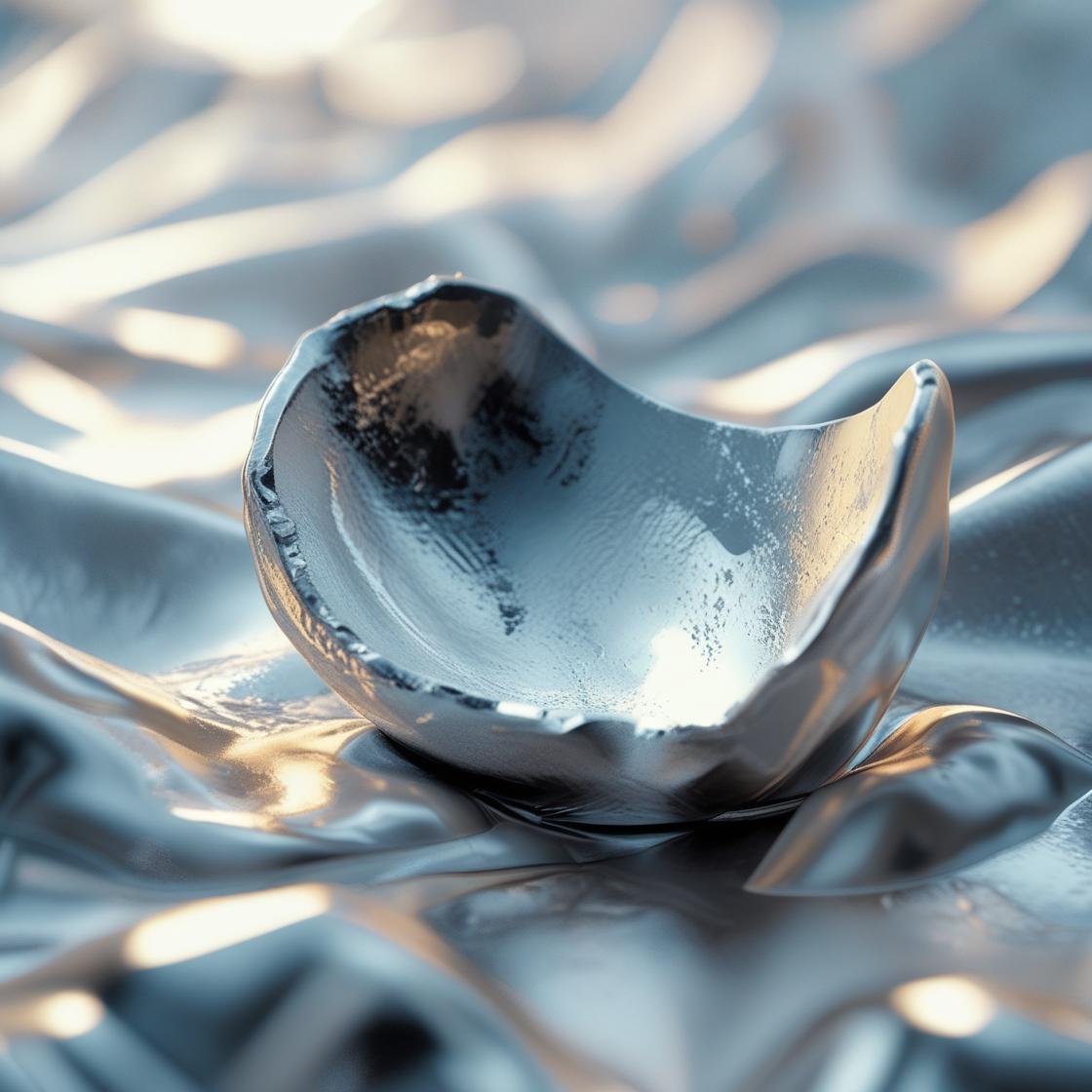
Samarium is a bright silvery-white metal. It is relatively stable in air but can ignite spontaneously when heated above 150 °C. It slowly oxidizes in moist air. Its melting point is 1072 °C and its boiling point is 1794 °C. The atomic radius is approximately 236 pm and its electronegativity is 1.17. It reacts slowly with water and more rapidly with acids, releasing hydrogen gas. In its compounds, samarium typically exhibits a +3 oxidation state, but under certain conditions it can also show a +2 oxidation state (for example, in SmI₂).

Samarium Element (Generated by Artificial Intelligence)
Samarium has seven naturally occurring isotopes. Five of these are stable: ¹⁴⁴Sm, ¹⁴⁹Sm, ¹⁵⁰Sm, ¹⁵²Sm, and ¹⁵⁴Sm. The other two, ¹⁴⁷Sm and ¹⁴⁸Sm, are radioactive but have extremely long half-lives (1.06 × 10¹¹ years for ¹⁴⁷Sm and 7 × 10¹⁵ years for ¹⁴⁸Sm). The isotope ¹⁵²Sm is noted as significant in sources, as it is one of the most abundant naturally occurring isotopes of samarium (approximately 26.75%).
Samarium’s unique magnetic and nuclear properties enable several important applications:
Samarium has no known biological role. It is considered mildly toxic. Ingestion or inhalation of soluble samarium salts may cause mild toxic effects and can stimulate metabolism. Like other reactive metals, samarium powder can pose a fire hazard, especially when finely divided and under certain conditions. Standard laboratory safety precautions are recommended when handling samarium and its compounds.
National Center for Biotechnology Information. "Samarium." PubChem Compound Database. Accessed May 31, 2025. https://pubchem.ncbi.nlm.nih.gov/compound/23951.
TÜBİTAK Bilim Genç. "Samaryum." *Periyodik Tablo - Bilim Genç*. t.y. Accessed May 31, 2025. https://bilimgenc.tubitak.gov.tr/periyodik-tablo/samaryum.

Samarium
Periodic Table | 6 | ||||||||
|---|---|---|---|---|---|---|---|---|---|
Chemical Symbol | Sm | ||||||||
Atomic Number | 62 | ||||||||
Group | Lanthanides | ||||||||
Atomic Weight | (150.36) g/mol | ||||||||
Electron Configuration | [Xe] 4f⁶6s² | ||||||||
Density | 7.52 g/cm³ | ||||||||
Melting Point | 1072 °C | ||||||||
Boiling Point | 1794 °C | ||||||||
Atomic Radius | ~236 pm | ||||||||
Electronegativity | 1.17 | ||||||||
Important Isotopes | ¹⁴⁴Sm, ¹⁴⁷Sm, ¹⁴⁸Sm, ¹⁴⁹Sm, ¹⁵⁰Sm, ¹⁵²Sm (%26.75), ¹⁵⁴Sm (natural) | ||||||||
Year of Discovery(ies) | 1879 | ||||||||
Discoverer(s) | Paul-Émile Lecoq de Boisbaudran | ||||||||
Etymology(s) | Samarskite mineral (and Vasili Samarsky-Bykhovets) | ||||||||
Classification and Basic Properties
Discovery
Origin of the Element’s Name
Natural Occurrence
Physical and Chemical Properties
Isotopes
Applications
Biological Importance/Effects and Precautions