

This article was automatically translated from the original Turkish version.
Type of Geographical Indication | Mahreç Sign | ||||||||
|---|---|---|---|---|---|---|---|---|---|
Registration Number | 1242 | ||||||||
Registration Date | 20.10.2022 | ||||||||
Product / Product Group(s) | Processed and unprocessed fruits vegetables and mushrooms | ||||||||
Province(s) | Afyonkarahisar | ||||||||
Applicant/Registrant(s) | Sandıklı Municipality | ||||||||
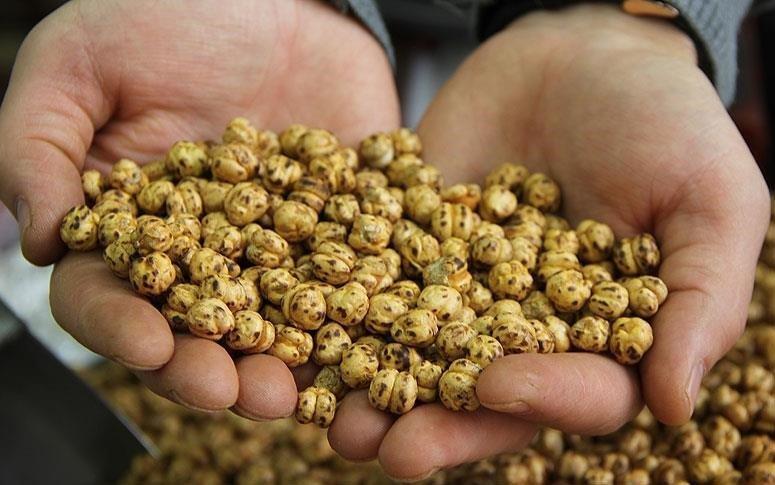
Sandıklı leblebisi is a double-roasted chickpea snack unique to the Sandıklı district of Afyonkarahisar province, produced using Sarı 98 variety chickpeas and subjected to a four-stage roasting process. It was officially registered as a geographical indication on 20.10.2022. Due to the skilled craftsmanship required in the peeling stage, the product has a geographical indication linkage, meaning all production stages must be carried out within the defined geographical boundaries.
Sandıklı leblebisi is produced using copper equipment during the roasting process. Its distinguishing features are as follows:
Sandıklı leblebisi is produced using Sarı 98 variety chickpeas and copper equipment. The production process consists of the following stages:
The geographical boundary for Sandıklı leblebisi is the Sandıklı district of Afyonkarahisar province. Due to the product’s long-standing historical roots, its significance in Sandıklı’s culinary culture and economy, and the specialized skill required for chickpea skin removal, all production stages must be carried out within this defined geographical boundary.
Monitoring of the product is conducted by a supervisory body established under the coordination of the Sandıklı Municipality. This body includes one expert representative each from the Sandıklı Municipality, the Sandıklı District Governor’s Office, the Sandıklı Vegetable and Fruit Traders’ Guild, and the Sandıklı District Directorate of Agriculture and Forestry, totaling four experts.
Inspections are carried out at least once annually; additional inspections may be conducted upon complaint or if deemed necessary. Key criteria for inspection include the use of the correct chickpea variety and equipment, compliance with the production method, adherence to product characteristics (verified by analysis where required), and the proper use of the Sandıklı leblebisi name, logo, and geographical indication emblem.
Turk Patent and Trademark Office. "Sandıklı Leblebisi." *Geographical Indications Portal.* Accessed October 24, 2025. https://ci.turkpatent.gov.tr/cografi-isaretler/detay/3635
Turk Patent and Trademark Office. *Sandıklı Leblebisi: Coğrafi İşaret Sicil Belgesi.* Accessed October 24, 2025. https://ci.turkpatent.gov.tr/Files/GeographicalSigns/6c5371d5-ea64-4972-b6ac-d2890d74e90b.pdf

Type of Geographical Indication | Mahreç Sign | ||||||||
|---|---|---|---|---|---|---|---|---|---|
Registration Number | 1242 | ||||||||
Registration Date | 20.10.2022 | ||||||||
Product / Product Group(s) | Processed and unprocessed fruits vegetables and mushrooms | ||||||||
Province(s) | Afyonkarahisar | ||||||||
Applicant/Registrant(s) | Sandıklı Municipality | ||||||||
Product Characteristics
Production Method
Geographical Boundary
Monitoring