



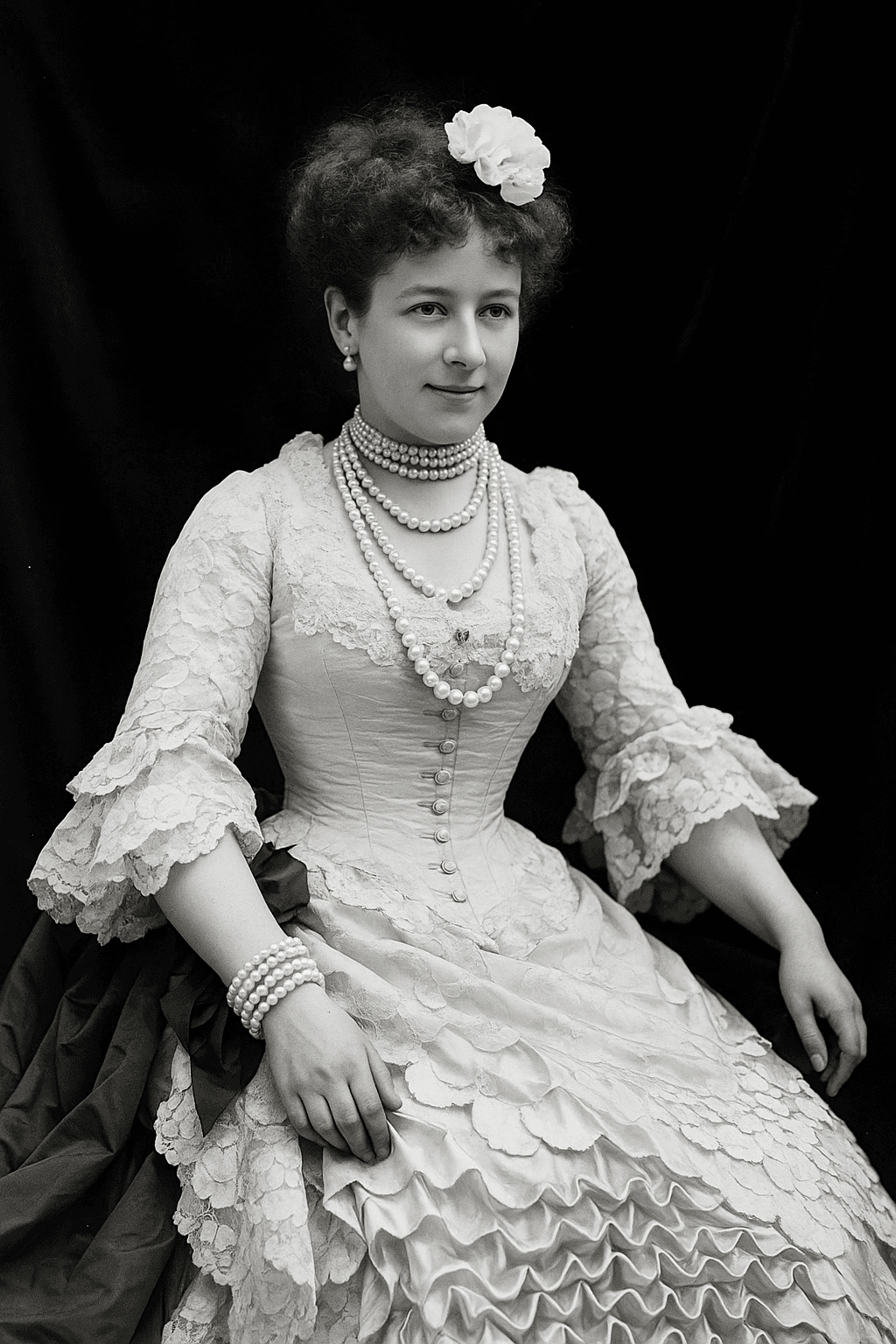
Sarah Bernhardt (generated by artificial intelligence)
Real Name | Henriette Rosine Bernhardt | ||||||||
|---|---|---|---|---|---|---|---|---|---|
Birth | 23 October 1844, Paris, France | ||||||||
Death | 26 March 1923, Paris, France | ||||||||
Profession(s) | theatre director sculptor writer Theatre actress | ||||||||
Annesi | Julie Bernhardt | ||||||||
Çocuk | Maurice Bernhardt | ||||||||
Notable Roles | Théodora Ruy Blas Hamlet La Tosca La Dame aux Camélias Phèdre | ||||||||
Henriette Rosine Bernhardt, known as Sarah Bernhardt (23 October 1844, Paris – 26 March 1923, Paris), was a French stage actress, writer, sculptor and theatre manager. She is renowned for her international tours, roles in the classical theatre repertoire and diverse artistic productions beyond the stage. Throughout her life she toured across Europe, America, Africa, the Middle East and Australia; she challenged traditional gender roles in theatre by taking on male parts. She was among the first performers to appear before the camera in early silent cinema and operated a theatre in Paris bearing her own name.
Sarah Bernhardt was born in Paris in 1844. Her mother, Julie Bernard (Bernhardt), was of Dutch Jewish descent; her father’s identity remains uncertain. During her childhood, her mother was often absent, so she was raised for a time under the care of nannies and later educated at the Grandchamp Augustine convent school near Versailles. The religious instruction she received there led her at one point to consider becoming a nun.
Charles Duc de Morny, the illegitimate half-brother of Napoleon III, played a key role in guiding Sarah Bernhardt toward a theatrical career through his close relationship with her mother. With Morny’s support, she turned to the performing arts at a young age.
In 1859, she was admitted to the Conservatoire de Musique et Déclamation on a scholarship provided by Morny. She received acting training there for two years. During this period, the acting style of the renowned 19th-century actress Rachel was presented to students as a model; Bernhardt later cited Rachel as a major influence in her own career.
In 1862, she made her professional stage debut in the play Iphigénie at the Comédie-Française. Although a dispute in 1866 led to her departure from the institution, this period was instrumental in shaping her early career.
From the mid-1860s, Bernhardt performed at the Odéon Theatre. She gained attention for her roles as Anna Damby in Alexandre Dumas’s Kean and as Cordelia in Shakespeare’s King Lear. In 1869, she portrayed the young poet Zanetto in François Coppée’s play Le Passant; this male role is regarded as an early precursor to the male characters she would later assume.
During the war years, she converted part of the Odéon Theatre into a facility for wounded soldiers. After the war, following Victor Hugo’s return to Paris, she performed as Queen Maria in his play Ruy Blas.
In the mid-1870s, she rejoined the Comédie-Française company. She took the lead role in Racine’s Phèdre (1874). In 1877, she portrayed Doña Sol in Victor Hugo’s Hernani. In 1880, she left the company to pursue an independent career.
After 1880, she undertook extensive tours covering Europe, the United States, Canada, Latin America, Australia, the Middle East and the Ottoman Empire. She performed in Istanbul in 1888, 1893, 1904 and 1908, appearing on various stages of the time, including the Naum Theatre.
Bernhardt portrayed several male characters throughout her career. In 1899, she took the lead role in Shakespeare’s Hamlet. She also played other male roles such as Pelléas.
1899 Hamlet, Duel Scene with Laertes (Duellist 1956)
In 1899, she long-term leased the Théâtre des Nations and renamed it Théâtre Sarah Bernhardt. She served both as actress and manager in its productions. The opening play was Sardou’s La Tosca.
After a 1905 accident, her right leg was amputated; nevertheless, she continued stage performances with various adaptations. During World War I, she performed for soldiers at the front. She remained active in theatre and cinema throughout the 1910s and 1920s.
Bernhardt appeared in some of the earliest examples of cinema. In 1900, a short scene from her performance in Hamlet was filmed. In 1911, she starred in Camille (La Dame aux Camélias) and in 1912 in Queen Elizabeth. Queen Elizabeth was one of the first feature-length films to receive wide distribution in the United States. She also appeared in the 1917 war-themed film Les Mères françaises.
Bernhardt received sculpture training from Mathieu Meusnier and Emilio Franchesci in the 1870s. Between 1874 and 1886, she regularly submitted works to the Paris Salon. Among her notable sculptures is Après la tempête (After the Storm), exhibited at the Paris Salon in 1876 and attracting attention from the artistic circles of the time. In her paintings, landscapes and portraits were prominent themes. She maintained close artistic relationships with painters Georges Clairin and Louise Abbéma, engaging in mutual model-artist collaborations.
Bernhardt produced various works in theatre and literature. Her major publications include:
Bernhardt collaborated with various writers and artists of her time. The posters designed by Alphonse Mucha for her plays, such as Gismonda, La Dame aux Camélias and Hamlet, are considered key examples of the Art Nouveau movement.
She had literary and artistic connections with figures such as Victor Hugo, Oscar Wilde, Edmond Rostand and Marcel Proust.
Bernhardt continued her sculpture and painting work outside of her stage activities. She had a keen interest in travel and collected various objects during her tours. It is known that at certain times she kept different types of animals at home.
In 1864, she gave birth to a son, Maurice Bernhardt, from her relationship with Prince Henri de Ligne of Belgium. Maurice became interested in literature as an adult and took on various roles in his mother’s artistic projects. Throughout her life, she maintained long- or short-term relationships with numerous writers and artists.
Bernhardt is remembered in contemporary sources for her disciplined work ethic, rigorous preparation for roles and independent approach to role selection. Her inclination toward male roles, her stage practices and her international tours are frequently discussed in scholarly research on the representation of theatre history.
Despite health problems from the 1910s onward, Sarah Bernhardt continued her artistic and stage activities. The physical limitations resulting from her 1905 amputation became more pronounced over time. Nevertheless, she undertook tours across France and Europe, using modified stage sets and special seating arrangements to facilitate her performances. As silent cinema rose in prominence, she continued appearing in films and maintained an active presence in both theatre and film worlds.
During World War I, she participated in various morale-boosting events to support soldiers at the front and performed in military hospitals. In the 1920s, she limited her theatrical work and focused more on educational activities and administrative duties at her own theatre.
Bernhardt’s health deteriorated significantly by 1922. In early 1923, she endured a prolonged illness at her home in Paris. She died on 26 March 1923 in Paris. Her funeral, attended by a large crowd, was followed by burial at Père Lachaise Cemetery. Her death provoked widespread反响 in France and internationally within theatre circles; numerous newspapers and cultural institutions published articles evaluating her career and contributions to the stage.
Sarah Bernhardt played a pivotal role in shaping late 19th- and early 20th-century theatre history through her international tours, repertoire choices and stage practices. Her tours across Europe, America, North Africa and the Far East helped establish the recognition of French theatre in diverse regions and contributed to the development of cross-border performance practices of the era.
In acting, her approaches to staging classical and modern texts provided a significant reference for documenting the vocal, physical and gestural conventions of her time. Her performances in male roles are frequently examined in studies on the historical evolution of gender-based casting in theatre.
Her appearances in early cinema are regarded as among the first examples of stage actors engaging with the film industry. These films contributed to documenting the adaptation of theatrical acting for cinema and are frequently cited in research on the transition between the two disciplines.
Bernhardt’s work in sculpture and painting is significant for illustrating the breadth of her engagement with the artistic milieu of her time. Her exhibited sculptures and published writings offer valuable insights into the multidisciplinary creative practices of artists at the end of the 19th and beginning of the 20th centuries. The visual representation of Bernhardt in posters by Alphonse Mucha is a frequently studied phenomenon in analyses of theatrical promotion strategies during the Art Nouveau period.
The Théâtre Sarah Bernhardt, bearing her name, remained one of Paris’s major cultural institutions throughout the 20th century. Research on Bernhardt’s stage practices continues today through contemporary critiques, tour records and visual materials. Today, her career is regarded as a fundamental subject of study in theatre history, performance studies and early cinema research, offering essential insights into the conditions of artistic production in her era.
"1899 Hamlet, the Fencing Scene with Laertes." YouTube video, July 15, 2007. Accessed September 10, 2025. https://youtu.be/Mp_v_dP8s-8.
Almelek, Ester. “Sahnelerin İmparatoriçesi Sarah Bernhardt.” *Şalom Dergi*, no. 109. Accessed September 10, 2025. https://dergi.salom.com.tr/haber-604-sahnelerin_Imparatoricesi_sarah_bernhardt.html
Bernhardt, Sarah. Après la tempête (After the Storm), ca. 1876. National Museum of Women in the Arts, gift of Wallace and Wilhelmina Holladay. Accessed September 10, 2025. https://nmwa.org/art/collection/apres-la-tempete-after-storm/.
Bozcalı, S. “BERNHARDT (Sarah).” *İstanbul Ansiklopedisi*, Volume 5, pp. 2550–2554. İstanbul: Kadir Has Üniversitesi ve SALT işbirliği, Accessed September 10, 2025. https://istanbulansiklopedisi.org/handle/rek/6591.
Duckett, Victoria. “Celebrating Transgressive Celebrity: Sarah Bernhardt.” *The Dangerous Women Project* (The University of Edinburgh, The Institute for Advanced Studies in the Humanities), June 9, 2016. Accessed September 10, 2025. https://dangerouswomenproject.org/2016/06/09/sarah-bernhardt/.
Duckett, Victoria. “Sarah Bernhardt.” In Women Film Pioneers Project, edited by Jane Gaines, Radha Vatsal, and Monica Dall’Asta. New York: Columbia University Libraries, 2015. Accessed September 10, 2025. https://wfpp.columbia.edu/pioneer/sarah-bernhardt.
Dunn-Ruiz, Elizabeth. “The Life, Legends, and Legacy of Sarah Bernhardt.” Roundabout Theatre Company, September 4, 2018. Accessed September 10, 2025. https://www.roundabouttheatre.org/about/our-blog/the-life-legends-and-legacy-of-sarah-bernhardt.
IMDb. "Sarah Bernhardt – Biography." IMDb. Accessed September 10, 2025. https://www.imdb.com/name/nm0076800/bio/.
Jewish Women’s Archive. “Sarah Bernhardt.” The Shalvi/Hyman Encyclopedia of Jewish Women. Accessed September 10, 2025. https://jwa.org/encyclopedia/article/bernhardt-sarah/.
Look and Learn Historical Picture Archive. "Sarah Bernhardt’ın Portresi." Accessed October 13, 2025. https://www.lookandlearn.com/history-images/YNK1031337/Portrait-of-Sarah-Bernhardt.
Mucha Foundation. Poster for *Gismonda* (Sarah Bernhardt theme), colour lithograph, 1894–95. *The Mucha Trust Collection*. Accessed September 10, 2025. https://www.muchafoundation.org/en/gallery/themes/theme/sarah-bernhardt/object/346.
Shakespeare Theatre Company. “Highlighting Sarah Bernhardt.” Shakespeare Theatre Company, 2019. Accessed September 10, 2025. https://www.shakespearetheatre.org/watch-listen/highlighting-sarah-bernhardt/.
Sarah Bernhardt (generated by artificial intelligence)
Real Name | Henriette Rosine Bernhardt | ||||||||
|---|---|---|---|---|---|---|---|---|---|
Birth | 23 October 1844, Paris, France | ||||||||
Death | 26 March 1923, Paris, France | ||||||||
Profession(s) | theatre director sculptor writer Theatre actress | ||||||||
Annesi | Julie Bernhardt | ||||||||
Çocuk | Maurice Bernhardt | ||||||||
Notable Roles | Théodora Ruy Blas Hamlet La Tosca La Dame aux Camélias Phèdre | ||||||||
Early Life and Education
Childhood and Youth
Educational Years
Career and Works
Early Years and the Odéon Period
The Franco-Prussian War (1870–1871)
Return to Comédie-Française and Major Roles
International Tours
Male Roles
Founding Her Own Theatre
Late Career Works
Activities in Cinema
Sculpture and Painting
Writing Activities
Collaborations with Artists
Personal Life
Hobbies and Interests
Private Life
Character and Representation
Final Years and Death
Final Years
Death
Legacy and Influence