


This article was automatically translated from the original Turkish version.
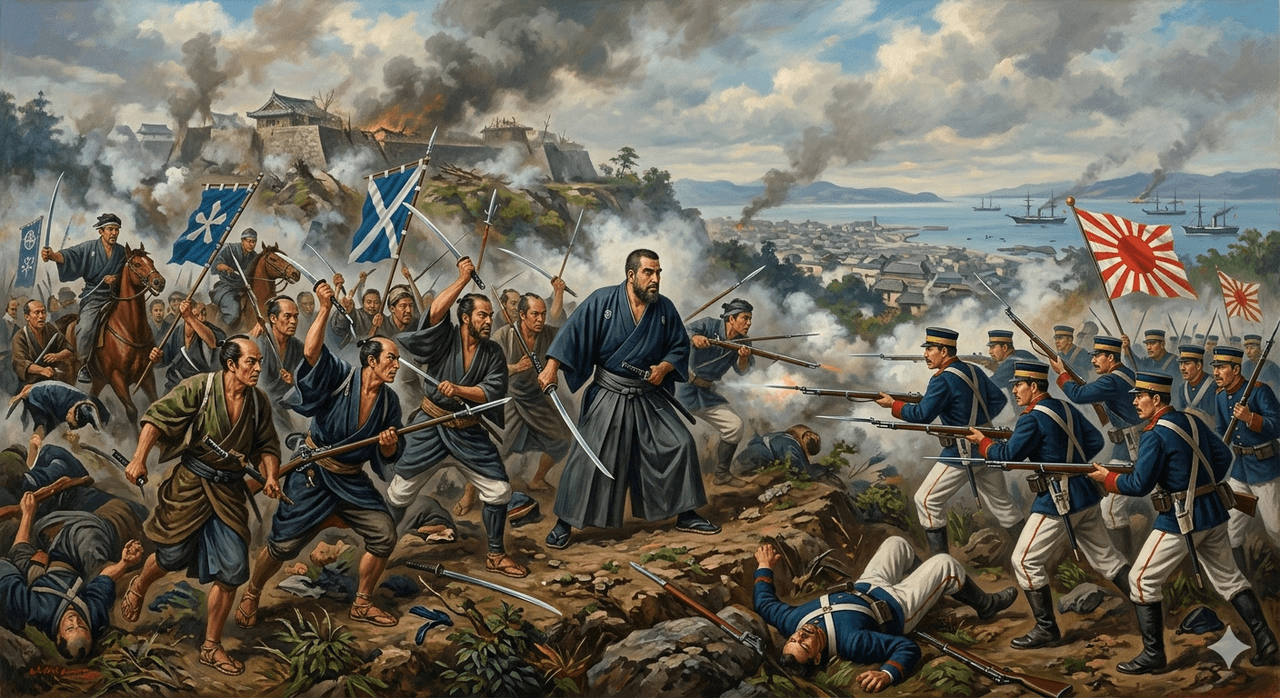
Satsuma İsyanı (Yapay Zeka İle Oluşturulmuştur.)
The Satsuma Rebellion, is an armed uprising that occurred in 1877 in the Satsuma region of Japan under the leadership of Saigō Takamori. It is regarded as a consequence of opposition to the Meiji government’s political, military and social reforms, which eliminated the privileges of the samurai class. This event took place during the process of dismantling the feudal order in Japan and strengthening the centralized state structure, and is considered one of the last major resistances of the samurai class.【1】
The Tokugawa shogunate established a system of governance in Japan from the early 17th century, in which political authority was centered around a military administration (bakufu) while the emperor held a symbolic position. Under this system, the country was divided into domains ruled by daimyō, who maintained administrative authority based on their loyalty to the shogunate.【2】

Samurai Image (Generated by Artificial Intelligence)
The Tokugawa regime created a structure that maintained internal stability for a long period; however, by the mid-19th century it began to unravel under the influence of both internal and external dynamics. In particular, pressure from Western states and their demands for trade rendered the shogunate’s isolationist foreign policy unsustainable.【3】
The arrival of an American naval fleet in 1853 and the subsequent treaties weakened the shogunate’s control over foreign policy. These developments created fertile ground for the strengthening of internal opposition that questioned the legitimacy of central authority.【4】
During this period, certain domains, particularly Satsuma and Chōshū, adopted a more independent political and military stance toward the shogunate. These domains became central to movements advocating the restoration of imperial authority and sought an alternative political order to challenge the existing regime.
With the Meiji Restoration of 1868, the Tokugawa shogunate was formally abolished and political authority was transferred to the imperial court. This transition was not merely a change in power but also signified the dismantling of the feudal administrative structure. The new government initiated comprehensive reforms aimed at eliminating the old administrative framework to strengthen central authority.【5】
With the fall of the shogunate, the political and military powers of the daimyō were gradually abolished, and local administrations were brought directly under the control of the central government. This process acquired institutional character with the abolition of the domain system and laid the foundation for Japan’s transition to a modern state structure.
This transformation also led to the dissolution of the feudal order to which the samurai class was tied, resulting in significant changes in traditional power balances. The collapse of the Tokugawa system was one of the key developments that established the fundamental conditions for the social and military conflicts that would emerge in the following years.
The Meiji government implemented comprehensive administrative reforms to centralize political authority. Local administrative units were reorganized and the tax system was restructured. In particular, the shift from a tax system based on agricultural production to one based on cash payments ensured more regular and predictable state revenues.【6】
This financial transformation had direct effects on the rural population and triggered changes in production relations. The standardization of the taxation system strengthened central control by reducing regional disparities.
A major dimension of the Meiji reforms was the transformation in the military sphere. The introduction of conscription in 1873 removed military service from the exclusive domain of a particular class and extended it to broad segments of the population.【7】
This reform led to the creation of a modern army composed of soldiers trained through standardized education and loyal to the central authority. Western models were adopted for military organization, and education, discipline, and command structures were restructured accordingly.
Social reforms aimed at eliminating class-based privileges. The old hierarchical status system was gradually abolished and a new order based on the principle of legal equality was established.
During this process, individuals gained broader opportunities to choose professions, relocate, and engage in economic activities. As a result, social mobility, previously constrained by class boundaries, expanded and paved the way for the emergence of new economic actors.
The Meiji government also implemented educational reforms to ensure the sustainability of social transformation. The establishment of modern educational institutions aimed to cultivate a workforce aligned with the new administrative philosophy.
The expansion of the education system ensured the dissemination of knowledge and skills required not only for administrative and military personnel but also for economic activities across society. This factor strengthened the institutional foundations of the modernization process.
Economic reforms during the Meiji period triggered transformations in production and trade structures. Steps toward industrialization and infrastructure investments diversified economic activities.
During this period, the state assumed a direct role in certain sectors and encouraged the adoption of modern production techniques. The transformation of the economic structure contributed to the reshaping of relationships between social classes.
In the final years of the Tokugawa period, the Satsuma region emerged as one of the domains with the highest military and administrative capacity. Its geographic location and semi-autonomous structure enabled its local administration to maintain a strong internal organization.
With the implementation of centralization policies during the Meiji period, this local power structure came directly under the control of the central government. This change shifted decision-making processes from the local level to the center, resulting in a loss of authority for local elites.
The new financial arrangements imposed by the central government reshaped economic relations in the Satsuma region. Economic activities previously conducted through local structures evolved into a new framework under the centralized tax system and cash-based regulations.【8】
During this period, individuals belonging to the former military class struggled to adapt to new economic conditions following the loss of their traditional income sources. This situation created an environment of economic dissatisfaction at the regional level.
With the establishment of the modern army system, the traditional military organization in Satsuma lost its function. The presence of units loyal to the central authority in the region limited the military role of local power elements.
These developments led to the transfer of control over armed capacity from the local level to the central government, narrowing opportunities for independent action at the regional level. This situation generated tension among groups with military backgrounds.
Military training institutions and local organizations established in Satsuma became structures that enabled individuals in the region to unite. These institutions operated within defined frameworks of discipline and organization.
The networks formed through these institutions contributed to the rapid spread of developments in the region and facilitated the emergence of collective action capacity. Thus, coordination at the local level improved.
The direct impact of central government policies at the local level led to a redefinition of relations between the center and the periphery. In Satsuma, this process became more pronounced as administrative, economic, and military changes converged.【9】
The perception that central decisions were incompatible with local conditions created a distance between the regional governance model and central authority. This situation gradually laid the groundwork for a more organized and visible opposition at the regional level.
In early 1877, developments concerning state armories in Kagoshima marked the initial phase of the conflict. The heightened activity surrounding control of weapons and ammunition stored in official depots quickly led local elements to target these sites. The seizure of weapons from the depots effectively weakened the central authority’s military control in the region and triggered the transition of tensions into open conflict.【10】
This development was not merely an attempt to acquire military supplies; it also demonstrated the capacity of local forces to act independently of the central government. This intervention against the armories was regarded as one of the first concrete steps indicating a shift in the regional power balance.
Following these events, the central government began military preparations to intervene in the situation in Kagoshima. In response, local groups, armed with seized weapons and ammunition, enhanced their defensive and operational capabilities, creating the groundwork for larger-scale military confrontations in the near future.
The initial clashes emerged as sporadic encounters occurring at multiple locations rather than along a defined front line. These confrontations tested the military capacities of both sides and served as precursors to the larger battles that would follow.
The confrontations during this phase took the form of rapidly developing, localized skirmishes rather than a coordinated war plan. This process was viewed as a precursor to the more organized military operations that would follow.
Following the outbreak of the rebellion, forces under the leadership of Saigō Takamori moved strategically across various regions of Kyūshū island. This advance was not only aimed at direct combat but also at securing logistical and supply lines.【11】

Statue of Saigō Takamori (Flickr)
Rebel units exploited local terrain and conditions to move swiftly and launched surprise attacks on imperial army positions. This tactic included sudden assaults by small units and defensive maneuvers in temporary positions.
During their advance, the rebels seized key intersections and passes to expand their operational areas and sought to limit the rapid deployment of reinforcements sent by the central government.
Saigō’s leadership was decisive in planning operations and coordinating units. Although numerically inferior, the rebel forces demonstrated effectiveness against the central army through their skill in utilizing terrain and executing sudden maneuvers.
Another dimension of their advance involved efforts to secure logistical support and supplies through temporary alliances with local populations and regional forces. This helped sustain the movement’s continuity and prevented its confinement to a single location.
In March 1877, Satsuma rebels laid siege to Kumamoto Castle, a strategically vital target. The castle was a critical defensive point through which the central government maintained control over Kyūshū. The rebels aimed to capture the castle to expand their operational area and gain a strategic advantage over the central army.【12】

Kumamoto Castle Today (Flickr)
The siege unfolded not as a conventional front-line battle but as a series of surprise attacks, surveillance operations, and infiltration attempts around the castle. The rebels aimed not only to assault the castle directly but also to cut its supply lines and prevent the garrison from receiving provisions.

Siege of Kumamoto Castle (Generated by Artificial Intelligence)
The imperial army units defending the castle effectively utilized modern weapons and fortifications, strengthened their positions during the siege, and launched small-scale counterattacks. This prolonged the siege and prevented the rebels from capturing the castle directly.
The rebels’ logistical capacity proved insufficient during the siege. Limited ammunition and food supplies in their depots forced them to establish temporary defensive lines when resources became inadequate.
The rebel forces attempted to exploit the surrounding terrain, particularly natural obstacles, to restrict the movement of central army units. Nevertheless, the imperial army’s continuous supply lines and reinforcement units remained effective throughout the siege.
The Siege of Kumamoto Castle marked a turning point in the military course of the Satsuma Rebellion. Its failure halted the rebels’ advance and forced them to retreat toward Shiroyama. This process defined a critical phase of the rebellion’s military trajectory.
The failure of the Siege of Kumamoto prompted the Satsuma rebels to reassess their strategic positions. Due to shortages in supplies and ammunition, the rebels could not sustain the siege and were forced to retreat. This withdrawal was not merely a loss of position but also an acknowledgment of the central army’s superiority and an effort to preserve military resources.【13】
During the retreat, rebel forces moved in small units, employing constantly shifting positions to avoid pursuit by the central army. This tactic minimized losses and enabled future reorganization.
The Satsuma forces utilized regional transit points and terrain advantages during their retreat. Mountainous and forested areas facilitated rapid movement and slowed the advance of the central army. This strategy preserved the rebels’ capacity for short-term operations.【14】
During this phase, logistical support and temporary supply points provided by the local population played a critical role in meeting the basic needs of the retreating forces. The rebels established temporary bases and shelters to make their movements flexible and unpredictable.
The retreat process was not merely a tactical maneuver but also viewed by the rebels as part of a broader strategic plan. This phase prepared for the upcoming Battle of Shiroyama, enabling the reorganization of forces and reinforcement of positions.【15】
During the Satsuma Rebellion, the balance of forces was defined by the contrast between traditional samurai units and the modern army. The rebel forces consisted primarily of samurai warriors from Satsuma and surrounding areas, organized into disciplined but numerically limited groups.【16】
In contrast, the imperial army of the central government was equipped with Western-style training and modern weapons, exhibiting a larger numerical strength and robust logistical capacity. Regular units could coordinate artillery, infantry, and cavalry effectively.
The rebels’ armament consisted largely of traditional swords, bows, and limited numbers of firearms, with very few modern weapons. The central army, however, possessed rifles, artillery, and supply lines supported by railways.
There were also significant differences in command structures. Saigō Takamori emerged as an experienced leader skilled in coordinating local units and exploiting terrain. The central army, by contrast, employed a hierarchical and disciplined command structure and applied standardized tactics to counter rebel attacks.【17】
Military structural differences also influenced tactics. Rebel forces attempted agile and flexible maneuvers to launch surprise attacks, while the central army responded with artillery fire and organized infantry lines. This dynamic continually shifted the balance of combat and ultimately ensured the imperial army’s strategic superiority.
The rebels’ limited numbers and logistical deficiencies reduced their endurance in prolonged operations. When combined with the central army’s superior supply and reinforcement capabilities, these factors determined the outcome of the war. In this context, the balance of forces must be evaluated not only in terms of numerical strength but also in terms of weaponry, logistical capacity, command structure, and tactical diversity.【18】
The conflicts during the Satsuma Rebellion varied spatially and in intensity. Engagements between rebel and central forces occurred not only along fixed front lines but across a wide area, often shaped by terrain advantages.
In the early stages, clashes occurred primarily between smaller units, with sudden and surprise attacks dominating. This allowed both sides to test each other’s positions and mobility.

Satsuma Rebellion Engagement (Generated by Artificial Intelligence)
As time progressed, the intensity of clashes increased both in scale and violence. The central army’s ability to maintain supply lines and deploy reinforcements intensified pressure on the rebels, escalating the duration and severity of confrontations.
Terrain structure was another critical factor influencing the intensity of clashes. Mountainous regions and forested areas enabled frequent short engagements and sustained maneuvering by military units.【19】
In addition to large-scale sieges, intense clashes occurred at regional transit points and strategic intersections. These locations were critical for controlling logistical flows and securing regional dominance.
The intensity of the clashes significantly affected the psychological and physical resilience of both rebels and the central army. Continuous small-scale engagements tested the tactical flexibility of both sides and influenced the strategic course of the final battles.【20】
The final phase of the Satsuma Rebellion took place in September 1877 at Shiroyama near Kagoshima. After the failed Siege of Kumamoto and the subsequent retreat, rebel forces regrouped and established defensive positions at Shiroyama. The region offered terrain advantages including natural barriers and narrow passes, which played a central role in the defensive planning.【21】

Site of Shiroyama (Flickr)
The central government’s army, equipped with modern weapons and numerically superior, advanced toward Shiroyama. Artillery units, infantry, and cavalry were coordinated effectively in planning the siege. This structure aimed to restrict rebel mobility and encircle them.
The rebels established positions on ridges and forested areas, exploiting the terrain to defend in small groups and preserve mobility. This defensive arrangement provided brief resistance against the central army’s artillery fire and organized infantry assaults.
The battle unfolded as intense close-range combat. Rebel forces, struggling with limited ammunition and food supplies, faced heavy casualties in every attack and counterattack.
Strategically, the central army’s siege and advance tactics gradually narrowed the rebel defensive line. This process placed severe psychological and physical pressure on the Satsuma units, making prolonged defense increasingly difficult.
At the end of the Battle of Shiroyama, Saigō Takamori and his remaining forces were unable to resist the central troops and suffered massive losses. Saigō’s death eliminated the rebel leadership and effectively ended the Satsuma Rebellion.
The suppression of the battle firmly reinforced the central government’s military authority and marked the end of the samurai class’s last major resistance in Japanese history.【22】
The suppression of the Satsuma Rebellion strengthened the military authority of the central government in Japan. Although the rebels, numerically limited and logistically constrained, resisted for an extended period, the superiority of the imperial army—equipped with modern weapons and disciplined units—became unmistakably clear.【23】
Among the military consequences was the end of the samurai class’s traditional combat capability and the impossibility of organized groups operating independently. This established the imperial army system as permanent and eliminated the possibility of future internal conflicts.
Politically, the suppression of the rebellion reinforced the feasibility of the Meiji government’s reform policies. The central government established absolute control over local administration and completely curtailed the military and political influence of daimyō and the old feudal structure.【24】
The reforms implemented after the Satsuma Rebellion facilitated the central government’s consolidation of military power within the modern army, strengthening military discipline, logistical capacity, and the command chain. This contributed to the consolidation of Japan’s centralized state model and the continuity of its modern national army structure.
Moreover, the suppression of the rebellion solidified the central government’s dominance in central–regional relations. The control and monitoring mechanisms applied in Satsuma completely eliminated the political and military autonomy of local power centers. This accelerated the recognition and acceptance of imperial authority throughout the country.【25】
The Satsuma Rebellion was a pivotal moment in the modernization process of the central government, marking the end of the political and military influence of the traditional samurai class and the definitive establishment of central military and state authority.【26】
The social dimension of the Satsuma Rebellion became evident with the complete disappearance of the traditional samurai class’s social role. The suppression of the rebellion revealed the end of the samurai’s economic and social privileges.【27】
This change affected not only the samurai themselves but also the local networks and service relationships tied to them. With the loss of economic income and the end of military duties, former samurai lost their social status and many were compelled to seek new economic opportunities.
Additionally, the destruction and effects of the conflict disrupted daily life in both rural and urban communities. Agricultural, commercial, and transportation activities experienced temporary disruptions, creating pressure on the economic and social security of the local population.
In terms of social mobility, the suppression of the rebellion led to the restructuring of the social hierarchy. The elimination of traditional class privileges and the reforms implemented by the central government enabled individuals to pursue professions and economic participation in areas previously inaccessible to them.
Culturally, the samurai identity began to assume only symbolic and cultural roles. Samurai traditions continued in fields such as education, literature, and art, but the class no longer possessed political or military power. This development was regarded as a significant factor in the consolidation of modernization in Japanese society.【28】
The social impacts also strengthened the feasibility of implementing central government reform policies at the local level. The dissolution of feudal loyalty relationships enabled the central government to implement new social arrangements encompassing the entire population.
The Satsuma Rebellion is regarded as a pivotal turning point in Japan’s Meiji-era modernization process. Its suppression demonstrated the central government’s capacity to implement its modern state structure and the practicality of its modernization policies.
Militarily, the suppression of the rebellion tested and confirmed the effectiveness and discipline of the modern army, proving its superiority on the battlefield. This demonstrated that military modernization in Japan was not merely a technical reform but a comprehensive transformation encompassing logistics, command structures, and education.
Politically, the end of the Satsuma Rebellion reinforced the acceptance of central authority throughout the country. The dismantling of the feudal structure and the abolition of the domain system enhanced the applicability of imperial authority at the local level and facilitated the continuation of central government reforms.【29】
In social and cultural spheres, the suppression of the rebellion led to the disappearance of traditional class structures. The end of the samurai class’s political and military functions opened new avenues for social mobility, and economic and social relations were reshaped according to the norms of the modern state.
The Satsuma Rebellion revealed the limits and feasibility of reform during the modernization process and served as a test of the central government’s ability to strengthen and sustain its reforms. In this context, the suppression of the rebellion was a critical event that accelerated the establishment of the modern state and social order in Japan.【30】
Ankur Panchbudhe, “Shiroyama Viewpoint near Shirakawago Ogimachi.” Flickr. Accessed March 26, 2026. https://www.flickr.com/photos/ankurp/36137080550
Anteplioğlu, Dilara. "Japonya’da Meiji Dönemi Toplumsal Sınıflarda Değişim." Journal of Turkic Civilization Studies 3, no. 1 (2022): 52–63.
Gilpivert. “Kumamoto Castle.” Flickr. Accessed March 26, 2026. https://www.flickr.com/photos/109536074@N05/16787356601
JREF. "Satsuma Rebellion." Japan Reference. Accessed March 25, 2026.
Maveri4201. "Last Samurai, Takamori Saigo" Flickr. Accessed March 26, 2026.
National Diet Library. “The Meiji Restoration and Modernization.” Accessed March 25, 2026. https://www.ndl.go.jp/modern/e/cha1/description11.html
Sabaton. "Satsuma Rebellion Begins." Accessed March 25, 2026.
Szczepanski, Kallie. "How the Samurai Ended During the Satsuma Rebellion." ThoughtCo. Accessed March 25, 2026.
The Collector. "The Incredible Story of the (Real) Last Samurai and the Satsuma Rebellion." Accessed March 25, 2026. https://www.thecollector.com/real-last-samurai-satsuma-rebellion/
The provided text contains only HTML markup and placeholder tokens (`https://www.touken-world.jp/tips/7792/`, `https://www.touken-world.jp/tips/7792/`) with no actual Turkish content to translate. There are no author names, titles, dates, or access phrases present that require translation under the specified rules. Therefore, no translation is needed or possible from the given input. If you have the actual citation text (e.g., with a URL, access date, or title), please provide it for accurate translation.
The provided text contains only HTML markup and placeholder variables (`https://www.sabaton.net/historical-facts/satsuma-rebellion-begins/`, `https://www.sabaton.net/historical-facts/satsuma-rebellion-begins/`) with no actual Turkish content to translate. There are no structural elements, dates, author names, titles, or access phrases requiring translation. Therefore, the output remains as-is, preserving the HTML structure and placeholders: ```html
https://www.sabaton.net/historical-facts/satsuma-rebellion-begins/
```
Touken World. "明治時代「西南戦争」." Accessed March 25, 2026.
Unseen Japan. "The Satsuma Rebellion: Last Gasp of the Samurai." Accessed March 25, 2026. https://unseen-japan.com/the-satsuma-rebellion-last-gasp-of-the-samurai/
War History Online. "The Satsuma Rebellion Begins." Accessed March 25, 2026. https://warhistory.org/@msw/article/the-satsuma-rebellion-begins
https://dergipark.org.tr/tr/download/article-file/3789399
https://jref.com/articles/satsuma-rebellion.759/
https://www.flickr.com/photos/maveri4201/34297805471
https://www.thoughtco.com/the-satsuma-rebellion-195570
[1]
Kallie Szczepanski, “The Satsuma Rebellion,” ThoughtCo, accessed 25 March 2026, https://www.thoughtco.com/the-satsuma-rebellion-195570
[2]
Dilara Anteplioğlu, “Social Class Changes During the Meiji Period in Japan,” Journal of Turkic Civilization Studies 3, no. 1 (2022): 54–55.
[3]
National Diet Library, “The Meiji Restoration and Modernization,” accessed 25 March 2026, https://www.ndl.go.jp/modern/e/cha1/description11.html
[4]
National Diet Library, “The Meiji Restoration and Modernization,” accessed 25 March 2026, https://www.ndl.go.jp/modern/e/cha1/description11.html
[5]
Dilara Anteplioğlu, “Social Class Changes During the Meiji Period in Japan,” Journal of Turkic Civilization Studies 3, no. 1 (2022): 54–56.
[6]
Dilara Anteplioğlu, “Social Class Changes During the Meiji Period in Japan,” Journal of Turkic Civilization Studies 3, no. 1 (2022): 55–56.
[7]
Dilara Anteplioğlu, “Social Class Changes During the Meiji Period in Japan,” Journal of Turkic Civilization Studies 3, no. 1 (2022): 57–58.
[8]
Dilara Anteplioğlu, “Social Class Changes During the Meiji Period in Japan,” Journal of Turkic Civilization Studies 3, no. 1 (2022): 55–56.
[9]
National Diet Library, “The Meiji Restoration and Modernization,” accessed 25 March 2026, https://www.ndl.go.jp/modern/e/cha1/description11.html
[10]
“Satsuma Rebellion,” JREF – Japan Reference, accessed 25 March 2026, https://jref.com/articles/satsuma-rebellion.759/
[11]
JREF, “Satsuma Rebellion,” Japan Reference, accessed 25 March 2026, https://jref.com/articles/satsuma-rebellion.759/
[12]
Dilara Anteplioğlu, Social Class Changes During the Meiji Period in Japan, Journal of Turkic Civilization Studies 3, no. 1 (2022): 57–58.
[13]
Dilara Anteplioğlu, Social Class Changes During the Meiji Period in Japan, Journal of Turkic Civilization Studies 3, no. 1 (2022): 58–59.
[14]
The Collector, “The Real Last Samurai: The Satsuma Rebellion,” accessed 25 March 2026, https://www.thecollector.com/real-last-samurai-satsuma-rebellion/
[15]
War History Online, “The Satsuma Rebellion Begins,” accessed 25 March 2026, https://warhistory.org/@msw/article/the-satsuma-rebellion-begins
[16]
Dilara Anteplioğlu, Social Class Changes During the Meiji Period in Japan, Journal of Turkic Civilization Studies 3, no. 1 (2022): 57–58.
[17]
JREF, “Satsuma Rebellion,” Japan Reference, accessed 25 March 2026, https://jref.com/articles/satsuma-rebellion.759/
[18]
Touken World, “Satsuma Rebellion,” accessed 25 March 2026, https://www.touken-world.jp/tips/7792/
[19]
War History Online, “The Satsuma Rebellion Begins,” accessed 25 March 2026, https://warhistory.org/@msw/article/the-satsuma-rebellion-begins
[20]
Szczepanski, Kallie. “The Satsuma Rebellion.” ThoughtCo. Last updated 28 August 2019. Accessed 25 March 2026. https://www.thoughtco.com/the-satsuma-rebellion-195570
[21]
Dilara Anteplioğlu, Social Class Changes During the Meiji Period in Japan, Journal of Turkic Civilization Studies 3, no. 1 (2022): 58–59.
[22]
Szczepanski, Kallie. “The Satsuma Rebellion.” ThoughtCo. Last updated 28 August 2019. Accessed 25 March 2026. https://www.thoughtco.com/the-satsuma-rebellion-195570
[23]
Dilara Anteplioğlu, Social Class Changes During the Meiji Period in Japan, Journal of Turkic Civilization Studies 3, no. 1 (2022): 57–59.
[24]
National Diet Library, “The Meiji Restoration and Modernization,” accessed 25 March 2026, https://www.ndl.go.jp/modern/e/cha1/description11.html
[25]
War History Online, “The Satsuma Rebellion Begins,” accessed 25 March 2026, https://warhistory.org/@msw/article/the-satsuma-rebellion-begins
[26]
Szczepanski, Kallie. “The Satsuma Rebellion.” ThoughtCo. Last updated 28 August 2019. Accessed 25 March 2026. https://www.thoughtco.com/the-satsuma-rebellion-195570
[27]
Dilara Anteplioğlu, Social Class Changes During the Meiji Period in Japan, Journal of Turkic Civilization Studies 3, no. 1 (2022): 58–59
[28]
Szczepanski, Kallie. “The Satsuma Rebellion.” ThoughtCo. Last updated 28 August 2019. Accessed 25 March 2026. https://www.thoughtco.com/the-satsuma-rebellion-195570
[29]
JREF, “Satsuma Rebellion,” Japan Reference, accessed 25 March 2026, https://jref.com/articles/satsuma-rebellion.759/
[30]
Szczepanski, Kallie. “The Satsuma Rebellion.” ThoughtCo. Last updated 28 August 2019. Accessed 25 March 2026. https://www.thoughtco.com/the-satsuma-rebellion-195570


Satsuma İsyanı (Yapay Zeka İle Oluşturulmuştur.)
Historical Background
The End of the Tokugawa Order
Reforms and Social Transformation
Administrative and Financial Reforms
Reorganization of the Military Structure
Social Status and Legal Equality
Education and Institutional Modernization
Transformation of the Economic Structure
Tensions in the Satsuma Region
Regional Power Structure and Local Dynamics
Local Effects of Economic Transformation
Transformation of the Military Structure and Local Reactions
Institutional Structures and Organizational Processes
Tensions in Central–Regional Relations
Development of the Rebellion
Arsenal Incident and Initial Clashes
Advance of the Rebel Forces
Siege of Kumamoto Castle
Retreat Process
Course of the Battles
Balance of Forces and Military Structure
Intensity of the Conflicts
Battle of Shiroyama
Consequences and Impacts
Military and Political Consequences
Social Impacts
Impact on the Modernization Process