

This article was automatically translated from the original Turkish version.
+2 More
Scientific Name(s) | Salicornia europaea | ||||||||
|---|---|---|---|---|---|---|---|---|---|
Family | Spinach family (Amaranthaceae) | ||||||||
Common Names | Leadwort, Saltwort | ||||||||
Plant Type | Annual, fleshy (succulent) plant | ||||||||
Natural Habitat | Seashores, highly saline wetlands | ||||||||
Key Characteristic | Halophyte (salt-tolerant) | ||||||||
Cuisine Where Commonly Used | Aegean Cuisine (Particularly İzmir and the Aegean coast) | ||||||||
Consumption Method | Usually served as a cold appetizer or salad | ||||||||
Gastronomic Companion | Fish and seafood dishes | ||||||||
Sea asparagus, scientifically known as Salicornia europaea, is an annual plant species that grows in saline and brackish environments. In Türkiye, it is widely recognized and used particularly along the Aegean coast.
Sea asparagus has been reported to offer numerous health benefits against oxidative stress, inflammation, diabetes, asthma, hepatitis, cancer, and gastroenteritis.【1】 Sea asparagus seeds contain approximately 26–33% crude oil and 30–33% crude protein by composition.【2】 The oil extracted from these seeds is of high quality, with 87–88% of its fatty acid composition consisting of unsaturated fatty acids and 12–13% saturated fatty acids.【3】
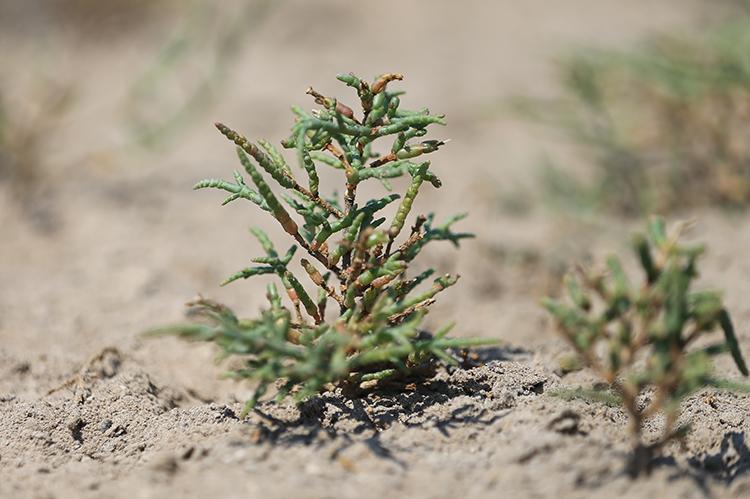
Sea asparagus is a low-growing, annual plant with a succulent structure. Its stem exhibits a cylindrical, jointed, and segmented morphology. The stem segments contribute to the plant’s distinctive appearance, and most of its photosynthetic activity occurs through this stem tissue. Leaves have not developed into prominent blade structures; instead, they are scale-like and fused with the stem.
During the vegetative growth phase, the shoots are typically green, but color changes become noticeable as the plant matures. The succulent stem tissue is a key morphological adaptation that enables the plant to retain water. This structure is one of the primary adaptations allowing the plant to survive in environments characterized by high salinity and water stress.
Sea asparagus naturally occurs in coastal marshes, salt marshes, and areas influenced by tidal action. These habitats are characterized by high salinity levels and variable water regimes. Salicornia europaea is among the limited number of plant species capable of thriving under such harsh environmental conditions.
The plant’s natural distribution is associated with soils directly or indirectly affected by seawater. In these environments, sea asparagus typically occurs as part of natural plant communities and is considered a characteristic species of saline ecosystems.
Cultivation studies have demonstrated that sea asparagus can be successfully grown under saline water or saline soil conditions. The plant’s growth process continues only in the presence of a specific salinity level, a key feature distinguishing it from conventional crop plants.
For successful cultivation, environmental conditions similar to its natural habitats must be provided. Saline soils, coastal areas, and controlled growing environments are among the primary settings used for its production. Research on cultivation has thoroughly examined the plant’s growth dynamics and its responses to environmental factors.
Sea asparagus is particularly associated with coastal cuisines. Due to its growth in saline environments, it possesses a distinctive flavor and is used in various ways in both traditional and modern culinary practices.
In gastronomic literature, sea asparagus is regarded as a plant component often paired with seafood. Various gastronomic studies have analyzed its use as an ingredient, evaluating its taste, texture, and presentation properties.
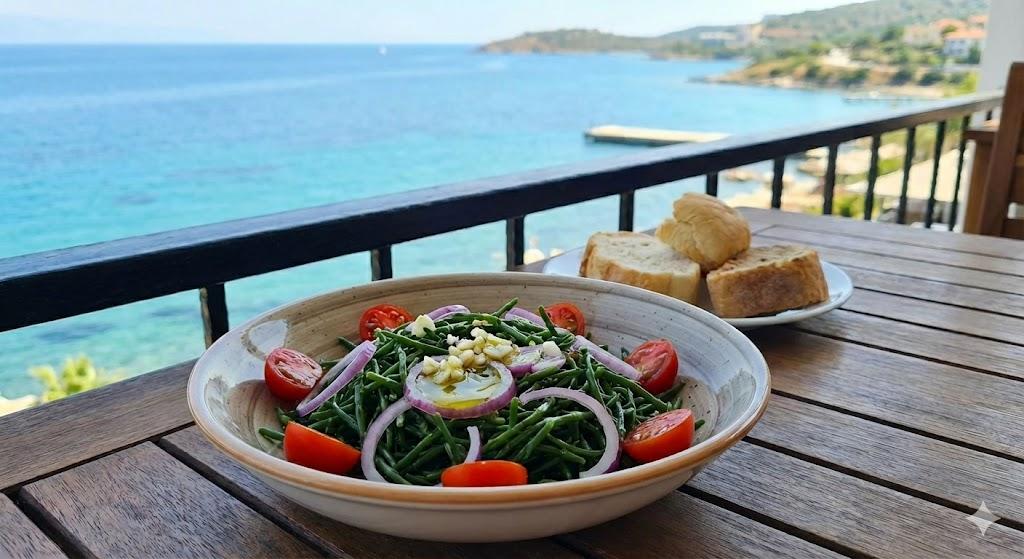
Sea Asparagus Salad (Generated by Artificial Intelligence.)
In Turkish cuisine, sea asparagus is widely known and consumed, especially in the coastal culinary traditions of the Aegean Region. The most well-known preparation method is serving it as a salad after boiling. This method has been defined and popularized within regional culinary culture.
In Turkish cuisine, sea asparagus is typically prepared using simple methods and served with basic ingredients such as olive oil and lemon. Within the context of regional cuisine, sea asparagus is recognized as a traditional food prepared and presented according to specific local practices.
Anadolu Ajansı. "Bekçiliğini yaptığı araziyi değerlendirip yılda 3 ton deniz börülcesi üretimine ulaştı." Accessed December 28, 2025. https://www.aa.com.tr/tr/ekonomi/bekciligini-yaptigi-araziyi-degerlendirip-yilda-3-ton-deniz-borulcesi-uretimine-ulasti/3332304
Irish Sea Fisheries Board (BIM). *Cultivating Salicornia europaea (Marsh Samphire).* Dublin: Bord Iascaigh Mhara, Accessed December 21, 2025. https://bim.ie/wp-content/uploads/2021/02/BIM,Cultivating,,Salicornia,europaea,-,Marsh,Samphire.pdf
Kök, Alperen, Kurnaz, Alper, Kurnaz, Hande Akyurt, and Selda Karahan. "Ege Otlarının Yöresel Mutfaklarda Kullanımı." *Journal of Tourism Intelligence and Smartness* 3, no. 2 (2020): 152-168. Accessed December 21, 2025. https://dergipark.org.tr/en/download/article-file/1326267
Ministry of Culture and Tourism of the Republic of Turkey. "Deniz Börülcesi Salatası - İzmir." *Türkiye Kültür Portalı*. Accessed December 21, 2025. https://www.kulturportali.gov.tr/turkiye/izmir/neyenir/denz-borulces-salatasi
Orcen, Nesrin. "Deniz Börülcesi (Salicornia europaea’nın) Beslenmedeki Yeri ve Önemi." Beslenme, Obezite ve Toplum Sağlığı Kongresi Bildirileri. Accessed December 21, 2025.
[1]
Nesrin Orcen, “Deniz Börülcesi (Salicornia europaea’nın) Beslenmedeki Yeri ve Önemi,” Beslenme, Obezite ve Toplum Sağlığı Kongresi Bildirileri, Erişim tarihi 21 Aralık 2025, https://www.beslenmeobezitevetoplumsagligikongresi.org/bildiriayrinti/deniz-borulcesi-salicornia-europaeanin-beslenmedeki-yeri-ve-onemi_314
[2]
Nesrin Orcen, “Deniz Börülcesi (Salicornia europaea’nın) Beslenmedeki Yeri ve Önemi,” Beslenme, Obezite ve Toplum Sağlığı Kongresi Bildirileri, Erişim tarihi 21 Aralık 2025, https://www.beslenmeobezitevetoplumsagligikongresi.org/bildiriayrinti/deniz-borulcesi-salicornia-europaeanin-beslenmedeki-yeri-ve-onemi_314
[3]
Nesrin Orcen, “Deniz Börülcesi (Salicornia europaea’nın) Beslenmedeki Yeri ve Önemi,” Beslenme, Obezite ve Toplum Sağlığı Kongresi Bildirileri, Erişim tarihi 21 Aralık 2025, https://www.beslenmeobezitevetoplumsagligikongresi.org/bildiriayrinti/deniz-borulcesi-salicornia-europaeanin-beslenmedeki-yeri-ve-onemi_314

Scientific Name(s) | Salicornia europaea | ||||||||
|---|---|---|---|---|---|---|---|---|---|
Family | Spinach family (Amaranthaceae) | ||||||||
Common Names | Leadwort, Saltwort | ||||||||
Plant Type | Annual, fleshy (succulent) plant | ||||||||
Natural Habitat | Seashores, highly saline wetlands | ||||||||
Key Characteristic | Halophyte (salt-tolerant) | ||||||||
Cuisine Where Commonly Used | Aegean Cuisine (Particularly İzmir and the Aegean coast) | ||||||||
Consumption Method | Usually served as a cold appetizer or salad | ||||||||
Gastronomic Companion | Fish and seafood dishes | ||||||||
No Discussion Added Yet
Start discussion for "Sea Asparagus (Salicornia europaea)" article
Botanical and Morphological Characteristics
Habitat and Natural Distribution
Cultivation Conditions and Agricultural Properties
Role in Gastronomy