


This article was automatically translated from the original Turkish version.
+1 More
Deniz Örümcekleri (Nymphonidae)
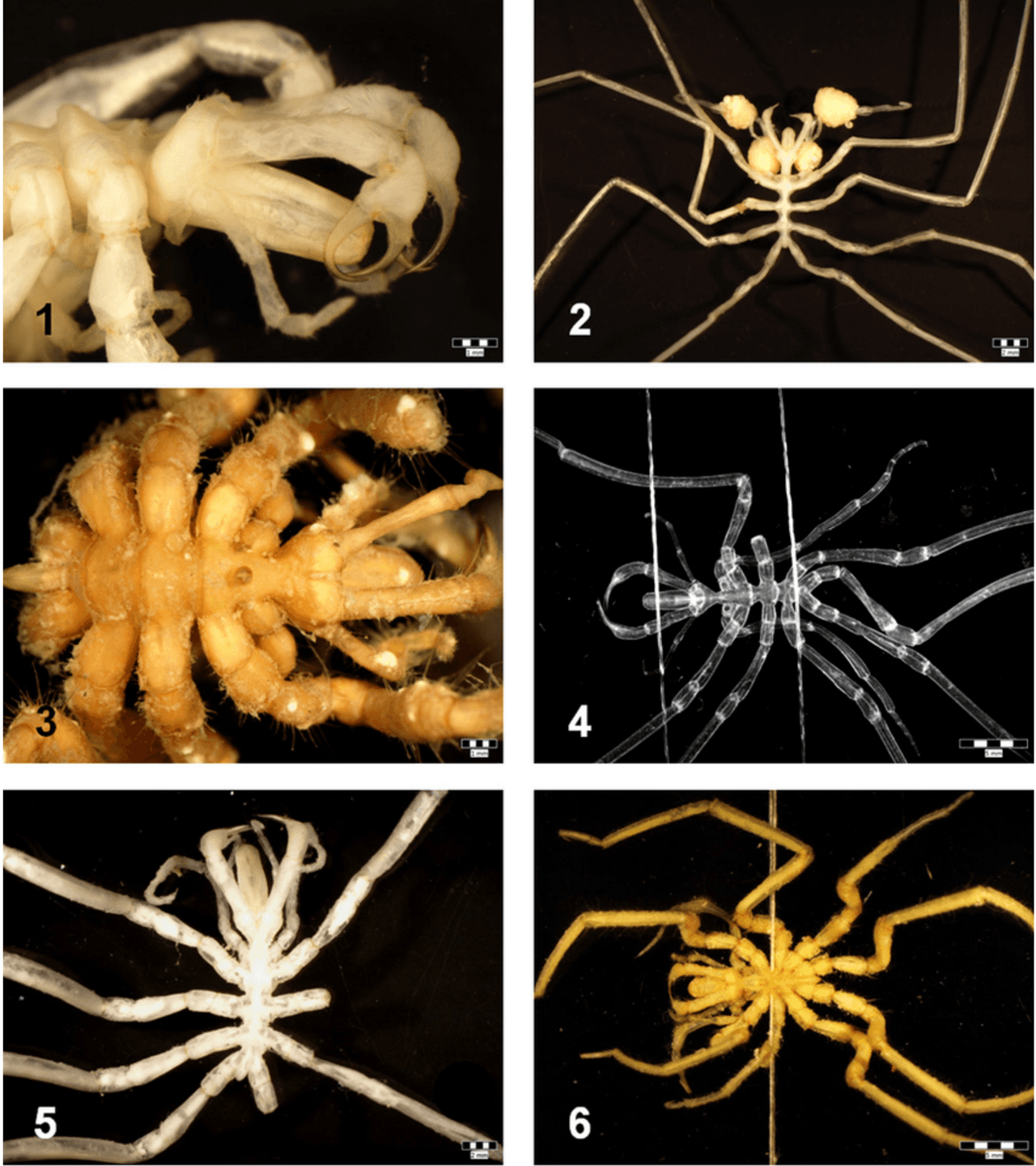
Sea Spider (Pycnogonida) is a group of marine organisms belonging to the phylum Arthropoda, commonly called sea spiders due to their morphological resemblance to terrestrial spiders of the class Arachnida.
They are generally small-bodied organisms; most species measure 1–10 mm in length, although some deep-sea species can have a leg span of up to 6 cm. They possess exceptionally long legs relative to their body size (typically four to six pairs). Their bodies are so small that their digestive systems and other organs extend into their legs.

Sea Spider (Pycnogonida) (Researchgate)
Reproductive behavior in sea spiders is highly distinctive. After the female lays eggs, the male fertilizes them and carries them on specialized legs called ovigers. Male individuals may carry the eggs for weeks until they develop into the larval stage known as protonymphon, and sometimes even longer until the young are somewhat more developed.
They are carnivorous or parasitic feeders and can be found in a wide variety of marine ecosystems, from shallow waters to the deep sea. For example, studies conducted in the Gulf of Antalya have identified the species Pennaria disticha living on hydroids.
Scientific research conducted in Turkish waters has revealed the diversity of this group.
Sampling in the region has identified two species belonging to the genus Tanystylum: Tanystylum orbiculare and Tanystylum conirostre. The presence of T. conirostre represents the first record for the Gulf of Antalya and the second for the Mediterranean coast of Türkiye and the Levantine Sea.
Research in the shallow waters of Güllük Gulf led to the description of a new species for science, Anoplodactylus gullukensis. This species is distinguished from similar species such as Anoplodactylus angulatus and other close relatives by the number and structure of cement gland pores on the femur region (two pores per femur). Additionally, this species lacks genital protrusions on the coxa-2 segments of the third and fourth legs.
Sea spiders have a wide geographic distribution ranging from the North Atlantic to the Indian Ocean.
Comprehensive studies on the fauna of the southwestern Indian Ocean have provided new insights into the diversity of sea spiders in the region.
The National Museum in Prague (Czech Republic) holds specimens of sea spiders collected from the Mediterranean and North Atlantic. These include Anoplodactylus lentus, Endeis spinosa, and various Nymphon species (N. grossipes, N. stroemi). Some specimens in the collection are historically significant and originate from the Sars collection in Bergen.
Dolejs, Petr. "A collection of sea spiders (Pycnogonida, Pantopoda) in the National Museum, Prague, Czech Republic." Journal of the National Museum (Prague), Natural History Series 174 (2005): 93-98. Accessed February 2, 2026. https://www.researchgate.net/publication/287302405_A_collection_of_sea_spiders_Pycnogonida_Pantopoda_in_the_National_Museum_Prague_Czech_Republic.
Koçak, Cengiz, and Furkan Durucan. "Sea Spiders (Arthropoda: Pycnogonida) from the Antalya Bay (Turkey, Eastern Mediterranean Sea)." *Acta Aquatica Turcica* 17, no. 2 (2021): 159–163. Accessed February 2, 2026. https://doi.org/10.22392/actaquatr.772216
Koçak, Cengiz. "A New Pycnogonid Species from Türkiye: Anoplodactylus gullukensis n. sp. (Pycnogonida, Phoxichilidiidae), with an Identification Key to the Turkish Species of the Genus." Turkish Journal of Zoology 48, no. 7 (2024): 640-647. Accessed February 2, 2026. https://doi.org/10.55730/1300-0179.3201
Sabroux, Romain,Alexandre Hassanın, andLaure Corbarı. "New Insights into the Sea Spider Fauna (Arthropoda, Pycnogonida) of the Southwest Indian Ocean." *European Journal of Taxonomy* 851, no. 1 (2022): 1–141. Accessed February 2, 2026. https://doi.org/10.5852/ejt.2022.851.1999
Türkiye Yaban Hayatı. "Deniz Örümcekleri." Accessed February 2, 2026. https://turkiyeyabanhayati.org/blog/detail/deniz-orumcekleri

Deniz Örümcekleri (Nymphonidae)
No Discussion Added Yet
Start discussion for "Sea Spider (Pycnogonida)" article
General Characteristics and Morphology
Life Cycle and Reproduction
Feeding and Ecology
Research and Species in Turkish Seas
Gulf of Antalya
Güllük Gulf (Aegean Sea)
Global Distribution and Museum Collections
Indian Ocean
Museum Collections