


This article was automatically translated from the original Turkish version.
+2 More
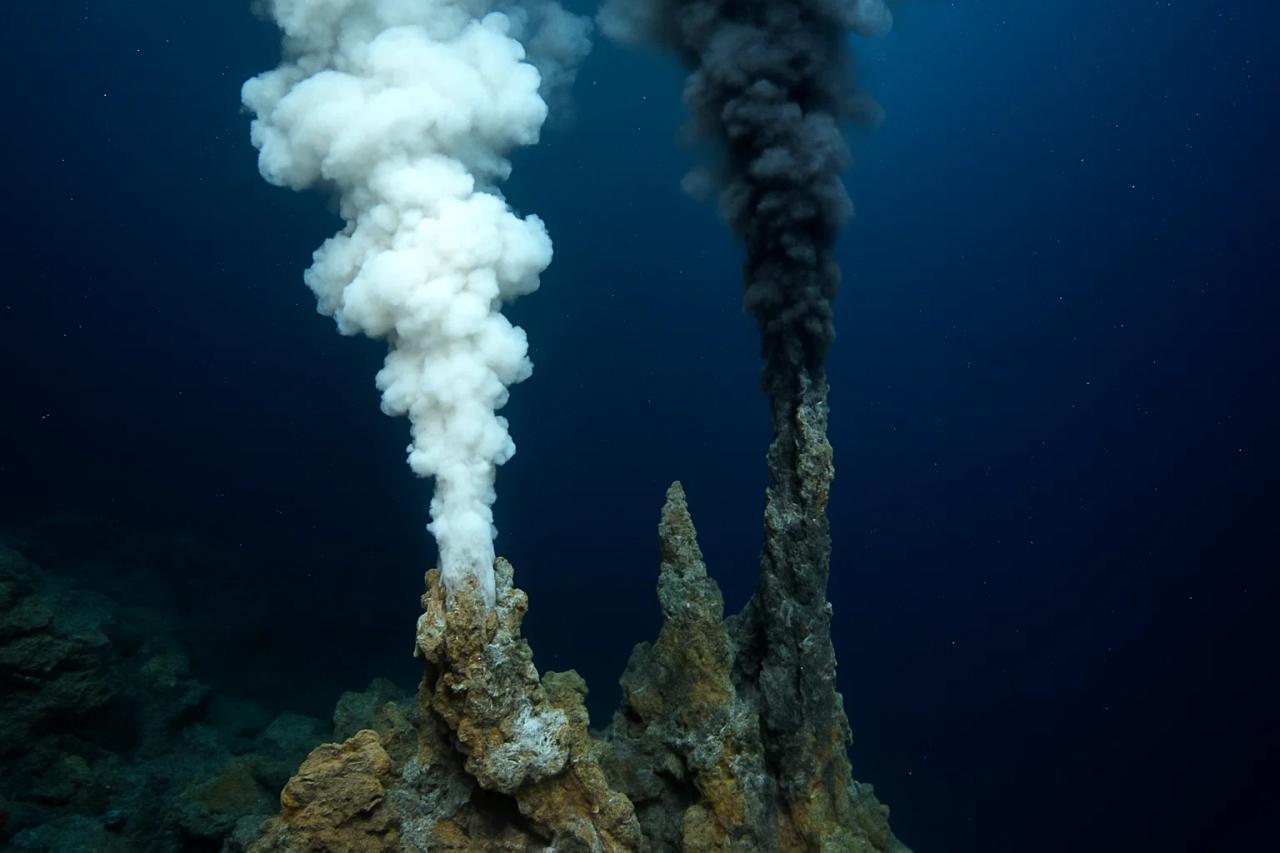
Generated with Visual Artificial Intelligence
Hydrothermal Vent
Discovery(ies) | 1977 | ||||||||
|---|---|---|---|---|---|---|---|---|---|
Region(s) | Galápagos Islands | ||||||||
Temperature | 2°C - 400°C | ||||||||
Living Species | Riftia pachyptila, Mussel, Shrimp, Yeti Crab, Symbiotic Fish | ||||||||
Flue Types | Black Smoker, White Smoker, Gray, Yellow | ||||||||
Chemical Process | Chemosynthesis, Sulfur, Methane, Hydrogen Oxidation | ||||||||
Hydrothermal vents are geological formations where mineral-rich fluids, heated geothermally, emerge from the ocean floor. Discovered during deep-sea research in the 1970s, these structures have demonstrated that life can persist in environments devoid of sunlight by utilizing chemical energy.

Hydrothermal Vents (Generated by Artificial Intelligence)
The formation of hydrothermal vents is directly linked to volcanic activity beneath the oceanic crust. Cold seawater seeps through fractures and cracks along tectonic plate boundaries and is heated to temperatures of up to 400°C upon contact with magma. This superheated water dissolves various minerals from surrounding rocks, acquiring a high concentration of metals. The heated, less dense fluid rises back toward the surface and erupts through the seafloor. As this hot, mineral-rich fluid meets the cold seawater, the dissolved metals begin to precipitate, gradually building up chimney-like structures layer by layer. The chemical composition and temperature profile of the vents determine their structure and appearance.
For example:
According to NOAA data, these vents can be observed in both focal and diffuse discharge forms. In focal flows, fluid exits through a narrow vent with high intensity, leading to rapid structure growth, while in diffuse flows, fluid spreads over a broader area with lower temperatures.
The ecosystems surrounding hydrothermal vents have revealed the existence of life forms entirely dependent on chemical energy, without any need for sunlight. Since photosynthesis is impossible in the deep sea, the primary producers are microorganisms that convert chemical compounds into energy. These organisms oxidize inorganic substances such as hydrogen sulfide, methane, and hydrogen to generate energy, a process known as chemosynthesis.
Chemosynthetic bacteria form symbiotic relationships with certain animals. In particular, bacteria living within the bodies of giant tube worms provide these animals with essential energy. These bacteria not only sustain life but also form the foundation of the food chain observed in these regions.
Hydrothermal vent ecosystems host some of the most extreme environmental conditions on Earth. These areas are completely dark, with temperatures ranging from a few degrees to 400°C, pressures reaching hundreds of atmospheres, and high concentrations of toxic compounds such as dissolved sulfide. Despite these harsh conditions, the organisms that thrive here exhibit extraordinary adaptive mechanisms.

Representative Image of Giant Tube Worms (Generated by Artificial Intelligence)
First discovered near the Galápagos, this organism forms dense colonies around vents. Unlike other worms, it lacks a digestive system; it obtains nutrition through chemosynthetic bacteria living within a specialized organ called the trophosome. These symbiotic bacteria convert substances such as hydrogen sulfide into energy, producing nutrients for both themselves and their host. The worm’s capillary network is specialized to optimize the transport of both oxygen and sulfide.
These bivalve mollusks live in clusters near vents. Some species host chemosynthetic bacteria in their gills, forming symbiotic relationships. They feed both by filter feeding and through symbiosis to obtain energy. The shells of these mussels are thick and mineral-rich to withstand high pressure.
Among shrimp species, one notable feature is the development of light-sensitive pigments on their body surfaces. This adaptation may help them detect environmental changes in complete darkness. Crab species occupy higher trophic levels in the food chain and feed on zooplankton or other small organisms.
These crabs, known for their hairy claws, are fascinating organisms that rely on bacterial symbiosis for nutrition. Chemosynthetic bacteria live on the hair-like structures of their claws. The crabs regularly scrape off and consume these bacteria. This represents one of the rare feeding strategies involving symbiosis on the external body surface.
Among deep-sea fish, species that live around vents are typically small and adapted to low-light conditions. These fish either feed on symbiotic bacteria or prey on smaller organisms. They often form the uppermost level of the biological network developing around vents.
These organisms are not only adapted to extreme physical conditions but also maintain constant interaction with their chemical environment. To survive in environments rich in toxic compounds such as concentrated sulfide, methane, and iron, these organisms have:
For these reasons, hydrothermal vent environments are of great significance not only in terms of biological diversity but also for evolutionary biology and molecular adaptation research. The unique communities found in these regions are frequently described in scientific literature as "undersea oases," because they create localized areas of rich life within the generally biologically impoverished deep-sea environment.

Representative Image of Yeti Crabs (Generated by Artificial Intelligence)
Hydrothermal vents are studied not only for their biological diversity but also for their geological and potential economic resources. The metal-rich fluids emitted by these vents precipitate over time to form massive sulfide deposits on the seafloor. These deposits contain metals such as copper, zinc, lead, silver, and gold.
This formation process occurs as seawater interacts with hot magma, and the metal content varies depending on the chemical composition of the seafloor rocks. Hydrothermal vents are classified into three main sulfide types—sulfite, sulfate, and native sulfur—based on differing temperature and chemical conditions. These regions are considered potential mining targets for deep-sea mining. However, because they also harbor unique marine ecosystems, their environmental impacts are under active investigation.
In addition, hydrothermal vents are studied in the context of scientific hypotheses regarding the origin of life. Some research proposes that primitive life forms may have originated in these environments, where chemical energy sources were abundant. These structures are also being used as models in the search for extraterrestrial life. Observational evidence suggesting similar hydrothermal systems on Jupiter’s moon Europa and Saturn’s moon Enceladus holds significant importance for astrobiological research.
Karapınar, Nuray. “Hidrotermal Bacalar.” *Bilim ve Teknik*, no. 1199 (April 2024): 70–77. Accessed August 6, 2025. https://e-dergi.tubitak.gov.tr/edergi/yazi.pdf?yaziid=49018
NOAA Pacific Marine Environmental Laboratory (PMEL). "Hydrothermal Vent Concepts." Accessed August 6, 2025. https://www.pmel.noaa.gov/eoi/nemo/explorer/concepts/hydrothermal.html
Oceana. "Deep Hydrothermal Vent." Accessed August 6, 2025. https://oceana.org/marine-life/deep-hydrothermal-vent/
ScienceDirect. "Hydrothermal Vent | Earth and Planetary Sciences." Accessed August 6, 2025. https://www.sciencedirect.com/topics/earth-and-planetary-sciences/hydrothermal-vent


Generated with Visual Artificial Intelligence
Hydrothermal Vent
Discovery(ies) | 1977 | ||||||||
|---|---|---|---|---|---|---|---|---|---|
Region(s) | Galápagos Islands | ||||||||
Temperature | 2°C - 400°C | ||||||||
Living Species | Riftia pachyptila, Mussel, Shrimp, Yeti Crab, Symbiotic Fish | ||||||||
Flue Types | Black Smoker, White Smoker, Gray, Yellow | ||||||||
Chemical Process | Chemosynthesis, Sulfur, Methane, Hydrogen Oxidation | ||||||||
No Discussion Added Yet
Start discussion for "Hydrothermal Vents " article
Geological Formation Process
Chemosynthesis
Species and Adaptation Features in Hydrothermal Fields
Riftia pachyptila (Giant Tube Worm)
Deep-Sea Mussels and Clams
Shrimps, Crabs, and Other Crustaceans
Yeti Crabs
Symbiotic Fish and Other Vertebrates
Geoeconomic Importance