


This article was automatically translated from the original Turkish version.
+2 More
II. Evkâf Apartmanı is one of the early Republican-era buildings located in the Ulus neighborhood within the Altındağ district of Ankara. It derives its name from the Directorate of Foundations, which undertook its construction. The reason it is referred to as the “Second Evkâf Apartment” is that it was built immediately after the first apartment complex owned by the same directorate. Its central urban location has enabled it to be regarded as an architectural example that supported the administrative and commercial functions of the period.

II. Evkâf Apartmanı (AA)
The architectural design of II. Evkâf Apartmanı was prepared by Mimar Kemalettin Bey, one of the leading representatives of the National Architecture movement in Turkey. The project development phase spanned 1926 to 1927, and construction was completed between 1928 and 1930. The building was planned as part of the urbanization policies pursued in the capital Ankara following the proclamation of the Republic, with the aim of generating income as an investment. Within the economic conditions of the time, rental income from foundation properties was intended to support public services. In this context, the apartment was designed as a structure combining residential and commercial functions.
II. Evkaf Apartmanı - Architectural Works of the Republic. (TRT 2)
II. Evkâf Apartmanı was constructed according to the formal principles of the First National Architecture Movement. This movement was based on integrating elements of Ottoman classical architecture with modern construction techniques. The overall massing of the building follows a symmetrical composition. Facades feature balanced window openings, cornice moldings, stepped stone sills, and limited decorative details.
The building employs a reinforced concrete structural system, distinguishing it from traditional masonry constructions.
Stone and plaster are used together on the facades, creating a visual rhythm through pilaster-like vertical divisions. Corner sections feature a broken-plan design known as fasche. The roof is designed with wide eaves, which provide both aesthetic balance to the facade and protection from rainfall.
The building is arranged over seven levels, including a basement. The ground floor was planned for commercial use and contains shops and a café. Residential functions dominate the upper floors. A theater hall was additionally located on the first floor, supporting the building’s social function.
The residential units are organized around a central courtyard, ensuring natural light and ventilation for interior spaces. Each floor contains eight apartments. Rooms face the exterior façade, while service areas are oriented toward the courtyard. Access is provided through four entrances, four staircases, and four elevators. The plan layout represents an innovative apartment typology for its time.
II. Evkâf Apartmanı was designed by the Directorate of Foundations to generate income. Commercial units on the lower levels and rental apartments on the upper levels served this purpose. Additionally, the theater hall introduced a cultural dimension to the building and contributed to the social life of the period. In this regard, the apartment exemplifies the multi-functional urban structure sought to be established in the capital during the early years of the Republic.
The building’s structural system is a reinforced concrete frame, one of the modern construction techniques newly introduced in Turkey during the 1920s. Floors and staircases were constructed using reinforced concrete. Interior spaces feature minimal decoration, with wooden joinery and iron railings used functionally. Geometric cast-iron elements are visible on the courtyard-side railings.
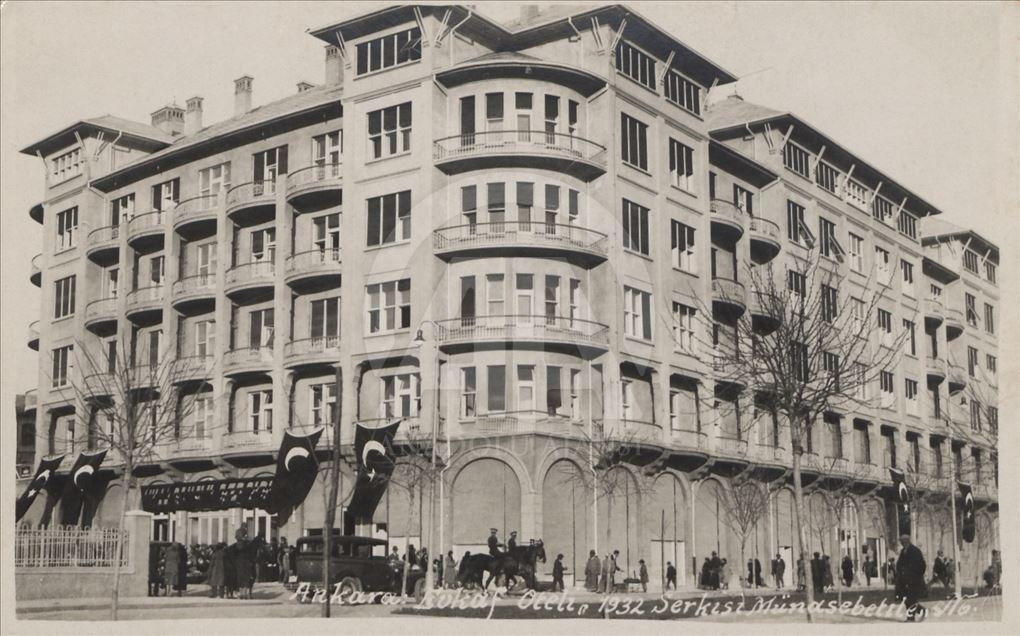
II. Evkâf Apartmanı (AA)
II. Evkâf Apartmanı is among the significant examples of early Republican-era architectural heritage. It continues to exist while preserving its original architectural identity within Ankara’s contemporary urban fabric. Due to its largely intact architectural integrity, it is recognized as one of the surviving examples of early Republican architecture.
The building is referred to as “Tescilli Evkaf II Apartmanı” in the agendas of the Ankara Regional Council for the Protection of Cultural Heritage dated 30 May 2024 (meeting no. 155) and 31 October 2024 (meeting no. 170). Accordingly, the building is protected under the category of registered cultural heritage.
Ankara Cultural Heritage Protection Regional Board. "155. Meeting Agenda (May 30, 2024)." Ministry of Culture and Tourism Ankara Cultural Heritage Protection Regional Board. Accessed October 27, 2025. https://korumakurullari.ktb.gov.tr/Eklenti/123774%2C155-toplanti-gundemi-30-mayis-2024pdf.pdf?0=
Ankara Kültür Varlıklarını Koruma Bölge Kurulu. “170. Toplantı Gündemi (31 Ekim 2024).” *Kültür ve Turizm Bakanlığı Ankara Kültür Varlıklarını Koruma Bölge Kurulu.* Accessed October 27, 2025. https://korumakurullari.ktb.gov.tr/Eklenti/127882%2C170-toplanti-gundemi-31-ekim-2024pdf.pdf?0=
Koç University VEKAM Archive. "VEKAM Arşivi'nden Az Bilinen Ankara Fotoğrafları." Anadolu Ajansı. Accessed October 25, 2025. https://www.aa.com.tr/tr/pg/foto-galeri/vekam-arsivinden-az-bilinen-ankara-fotograflari
Koç, Nisanur. "Ankara'nın Başkent Oluşunun Yıl Dönümünde Tarih Eski ve Yeni Fotoğraflarla Canlanıyor." Faruk Küçük Arşvi, Anadolu Ajansı. Accessed October 25, 2025. https://www.aa.com.tr/tr/pg/foto-galeri/ankaranin-baskent-olusunun-yil-donumunde-tarih-eski-ve-yeni-fotograflarla-canlaniyor
Mimarlar Odası Ankara Şubesi. "İkinci Vakıf Apartmanı." Accessed October 25, 2025. http://www.mimarlarodasiankara.org/?id=1490
TRT 2. "II. Evkâf Apartmanı." TRT 2 Youtube Kanalı. Accessed October 25, 2025. https://www.youtube.com/watch?v=UQ_HmxAQITcTRT 2. "II. Evkâf Apartmanı." TRT 2 Youtube Kanalı. Accessed October 25, 2025. https://www.youtube.com/watch?v=UQ_HmxAQITc
Yalçın, Ahsennur, and Seda Kula. “An Innovative Residential Building of the Early Turkish Republican Period: İkinci Evkâf Apartmanı.” *GU Journal of Science, Part B: Art, Humanities, Design and Planning* 12, no. 3 (2024): 431-445. https://dergipark.org.tr/tr/download/article-file/3831192

No Discussion Added Yet
Start discussion for "Second Evkaf Building" article
Historical Background
Architectural Style and Period Characteristics
Plan Composition and Spatial Organization
Purpose and Functional Features
Structural Details
Conservation Status and Current Use