


This article was automatically translated from the original Turkish version.
Sensor
Description | A sensor is a device that detects a specific quantity from the physical environment and converts it into an electrical signal. It detects changes in the surroundings and provides data to electronic systems to enable control mechanisms to function. | ||||||||
|---|---|---|---|---|---|---|---|---|---|
Working Principle | It detects physical or chemical changes and converts them into digital or analog signals. | ||||||||
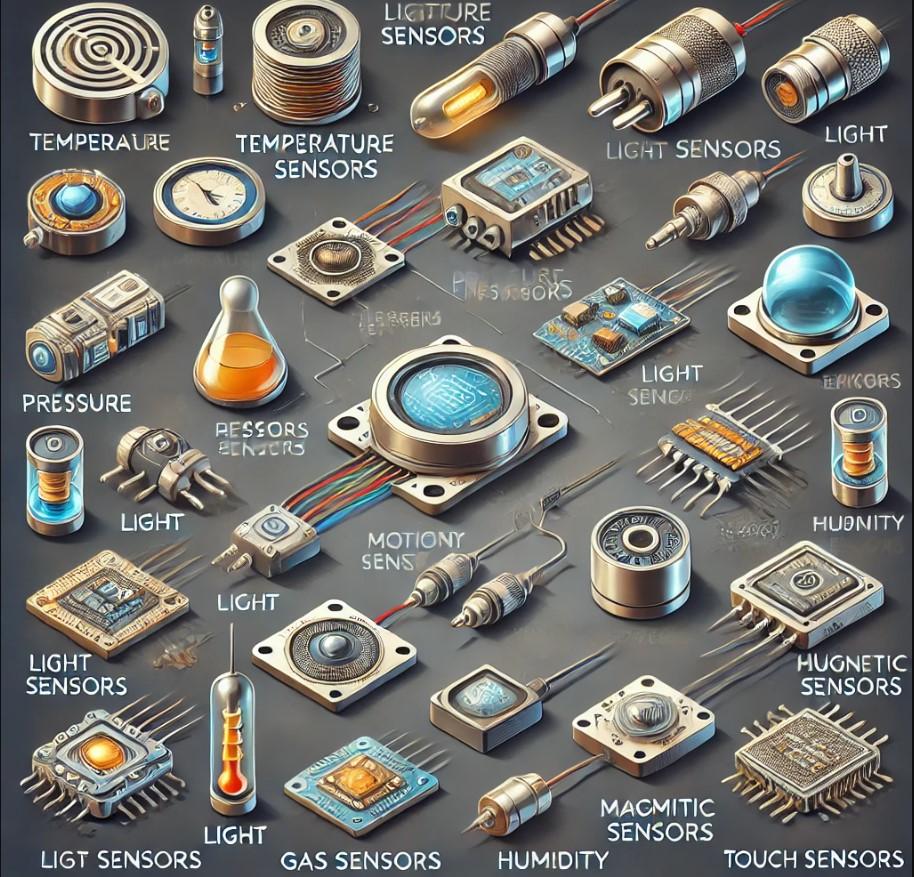
Sensor Types | Touch Sensors Magnetic Sensors Humidity Sensors Gas Sensors Motion Sensors Light Sensors Pressure Sensors Temperature Sensors | ||||||||
A sensor is a device that detects a specific physical quantity from the environment and converts it into an electrical signal. In other words, it is a measuring instrument that detects changes in the surroundings and transmits this information to an electronic system.
Sensors detect physical or chemical changes and convert them into digital or analog signals. These signals are processed by control systems to perform specific actions.
Sensors can be categorized based on the physical quantity they detect:
Sensor technologies are becoming smarter through integration with artificial intelligence, the Internet of Things (IoT), and automation systems. For example, in the concept of smart cities, sensors are used to manage traffic, monitor air quality, and conserve energy. In the future, biosensors and nanotechnology-enabled sensors may become significantly more common in the fields of medicine and industry.
Sensors are an indispensable part of modern technology and play a vital role in various fields. They are widely used and continuously evolving across a broad spectrum, from industry to healthcare and from smart devices to robotic systems. The advancement of sensor technologies will enable the development of more precise and efficient systems in the future.
K. D. Wise, "Microelectromechanical Systems and Sensors," *Proceedings of the IEEE*, vol. 86, no. 8, pp. 1516-1523, 1998. J. Fraden, *Handbook of Modern Sensors: Physics, Designs, and Applications*, Springer, 2016. M. J. Madou, *Fundamentals of Microfabrication and Nanotechnology*, CRC Press, 2011. G. Kovacs, *Micromachined Transducers Sourcebook*, McGraw-Hill, 1998. D. G. Webster, "Sensor Technologies and Their Applications in IoT," *IEEE Internet of Things Journal*, vol. 7, no. 5, pp. 4321-4335, 2020.

Sensor
Description | A sensor is a device that detects a specific quantity from the physical environment and converts it into an electrical signal. It detects changes in the surroundings and provides data to electronic systems to enable control mechanisms to function. | ||||||||
|---|---|---|---|---|---|---|---|---|---|
Working Principle | It detects physical or chemical changes and converts them into digital or analog signals. | ||||||||
Sensor Types | Touch Sensors Magnetic Sensors Humidity Sensors Gas Sensors Motion Sensors Light Sensors Pressure Sensors Temperature Sensors | ||||||||
Definition and Working Principle of Sensors
Types of Sensors and Their Applications
Development and Future of Sensors