

This article was automatically translated from the original Turkish version.
+2 More
Location | Akçaabat Trabzon | ||||||||
|---|---|---|---|---|---|---|---|---|---|
Formation Cause | Landslide | ||||||||
Formation Date | 21 February 1950 | ||||||||
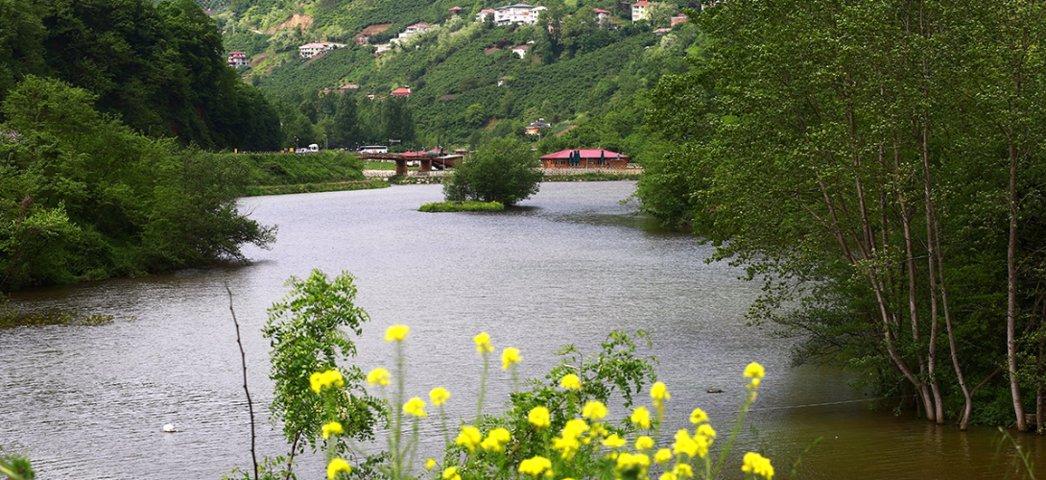
Sera Lake is a small landslide-dammed lake located within the boundaries of Akçaabat District, Trabzon Province, in Türkiye’s Black Sea Region. Situated approximately 8 km south of the Akçaabat district center, atop the Sera Creek Valley, the lake extends from northeast to southwest and lies at an elevation of about 85 meters above sea level. Noted for its natural origin and environmental characteristics, the lake holds significance both geologically and in terms of ecological diversity.

Sera Lake ( Eastern Black Sea Cultural Inventory Project )
The formation of Sera Lake resulted from a major landslide that occurred on 21 February 1950. A soil mass of approximately 15 million cubic meters detached from a slope in the western part of Yıldızlı Village due to heavy rainfall, blocking the flow of Sera Creek and causing water to accumulate in the valley floor. This natural process was completed within just a few days, resulting in the spontaneous formation of the lake. The lake is about 4 kilometers long and up to 150 meters wide, with an average depth of around 25 meters.
Sera Lake, together with the surrounding forested areas and wetland habitats, provides a home to various plant and animal species. The lake and its vicinity support diverse freshwater fish, including trout, as well as bird species such as ducks and coots. Seasonal fluctuations in water level are observed in the lake. The natural vegetation around the lake consists of humid forest formations shaped by the Black Sea climate.

Sera Lake (DSİ)
In 2010, Sera Lake was declared the “Sera Lake Nature Park” and placed under protection by the Ministry of Environment, Urbanization and Climate Change. In 2011, it was officially registered as a “Natural Heritage Site.” The Nature Park status aims to preserve the region’s biological diversity and landscape values. The lake serves as a limited, controlled area for recreation, nature walking, and day visits. Walking trails, observation decks, and informational panels have been established around the lake.
In recent years, road construction and building activities around the lake, along with pollution from domestic waste, have emerged as the primary threats to the lake’s natural structure. The lake water occasionally becomes turbid, and shallowing has been observed in certain areas due to alluvial deposition. Additionally, the impact of tourism-related interventions on the lake’s ecosystem remains a subject of academic debate.
Akçaabat Belediyesi. "Sera Gölü Tabiat Parkı Hakkında Bilgi." Accessed July 15, 2025. https://www.akcaabat.bel.tr/turizm-rehberi-detay.aspx?id=105
Akçaabat Belediyesi. “Sera Gölü.” Accessed July 15, 2025. https://www.akcaabat.bel.tr/turizm-rehberi-detay.aspx?id=8
Devlet Su İşleri (DSİ). "Sera Gölü'nde Heyelan ve Su Dengelemesi Hakkında Bilgilendirme." DSİ Genel Müdürlüğü, 2023. https://www.dsi.gov.tr/Haber/Detay/14687
Karadeniz Bölge Development Agency. "Sera Gölü Tabiat Parkı." Karadeniz.gov.tr, Accessed July 15, 2025. https://www.karadeniz.gov.tr/sera-golu-tabiat-parki/
Karadeniz Bölge Development Agency. "Sera Gölü." karadeniz.gov.tr, Accessed July 15, 2025. https://karadeniz.gov.tr/sera-golu/
Ministry of Environment, Urbanization and Climate Change. "Sera Gölü Tabiat Parkı Tescil İlanı." tvk.csb.gov.tr, 2011.
Yaltırık, Ayşenur. “Trabzon Sera Gölü Heyelan Set Gölünün Oluşumu ve Jeomorfolojik Özellikleri.” *Türkiye Coğrafyası Dergisi*, no. 15 (2000): 39–52. https://dergipark.org.tr/tr/pub/tcd/issue/21270/228368
Çetinkaya, Gülşah. “Sera Gölü'nün Ekolojik Durumu Üzerine Bir İnceleme.” Karadeniz Coğrafya Araştırmaları Dergisi, 2012. https://dergipark.org.tr/tr/download/article-file/199016

Location | Akçaabat Trabzon | ||||||||
|---|---|---|---|---|---|---|---|---|---|
Formation Cause | Landslide | ||||||||
Formation Date | 21 February 1950 | ||||||||
Formation and Geomorphology
Ecosystem and Natural Features
Protection Status and Use
Issues and Human Impact