


This article was automatically translated from the original Turkish version.
+2 More
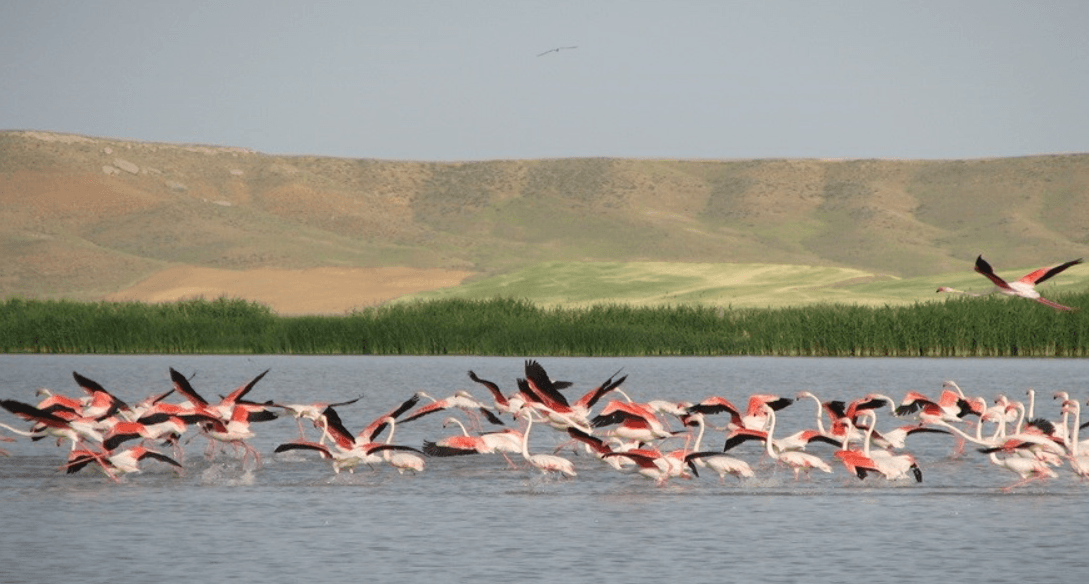
Seyfe Lake is a shallow, saline, closed-basin lake located within the boundaries of Mucur District, Kırşehir Province, in Türkiye’s Central Anatolia Region. Covering an area of approximately 10,700 hectares, the lake lies at an average elevation of 1100–1200 metres and forms the lowest part of the 1447 km² Seyfe Basin.
The lake is fed by groundwater, surface runoff, and three main springs: Seyfe, Horla, and Yenidoğanlı. However, the discharge rates of these sources have significantly declined over time, disrupting the lake’s hydrological balance. Lake levels rise primarily during spring due to snowmelt and rainfall, and recede during summer through evaporation.
The lake’s surface is highly seasonal. Analyses based on satellite data indicate that between 1985 and 2020, the surface area of Seyfe Lake shrank by 93.78 percent, decreasing from 66.86 km² to just 1.86 km². This dramatic reduction has led to severe losses in both the lake’s physical structure and its ecosystem services.

Seyfe Lake (Kırşehir Governorship)
The region is under the influence of a semi-arid climate. The annual average temperature is 11.3°C and annual precipitation is 377.5 mm, with the highest rainfall occurring in winter and spring. The lake is surrounded by Neogene sedimentary rocks and extends onto alluvial plains. The Kervansaray Mountains rise to the west and southwest. Gypsum formations in the lakebed are among the natural geological factors contributing to the salinity of the lake water.
Seyfe Lake is one of Türkiye’s most important bird sanctuaries. Designated under the International Council for the Protection of Birds (ICDP) and the Ramsar Convention, the area provides habitat for numerous threatened bird species. To date, 187 bird species have been recorded in the lake, 27 of which are protected under the Bern Convention.
The lake serves as a critical breeding and resting site for flamingos (Phoenicopterus ruber), with reports of up to 320,000 individuals observed at peak times. Other significant species include the black-winged stilt, avocet, gull, duck, pelican, crane, spoonbill, and ruff. During spring, thousands of birds nest in reed islands along the eastern shore of the lake. The surrounding steppes and grasslands also provide vital habitat for large bird populations.
The lake supports a rich flora and fauna. A total of 385 plant species belonging to 65 families have been identified, 52 of which are endemic to Türkiye. Halophytic, steppe, and meadow vegetation types are observed in the area. Phytoplankton, zooplankton, and benthic invertebrates form the foundation of the lake’s food chain, providing a rich nutrient source for aquatic birds.
Seyfe Lake was declared a First-Degree Natural Site in 1989, a Nature Conservation Area in 1990, and was officially listed under the Ramsar Convention in 1994 as an internationally significant wetland. It is also designated as an Important Natural Area (INA). The site includes birdwatching towers, a visitor information centre, day-use areas, and rain shelters.
Despite these high levels of protection, serious environmental threats persist. Water extraction and irrigation activities on the lake’s feeder sources, including deep wells and unregulated agricultural irrigation, are jeopardising the lake’s sustainability. Additionally, the conversion of surrounding steppes to agricultural land and drainage projects have caused habitat loss and disruptions to the water regime.
Over the past 40 years, discharge rates from the lake’s feeder sources have experienced severe declines. For example, the flow rate of the Seyfe spring, measured at 373.17 litres per second in 1969, had dropped to an average of just 0.78 litres per second by 2015. As a result, since the 2010s, large portions of the lake have periodically dried up completely. Experts warn that without external water transfers from adjacent basins, this condition may lead to irreversible consequences.
Global climate change further threatens the lake’s water availability by causing irregular precipitation patterns and increased evaporation. Between 1985 and 2020, the lake’s surface area decreased by 93.78 percent, resulting in the loss of a critical habitat for bird migration and breeding.
Seyfe Lake holds significant potential for sustainable tourism due to its proximity to Cappadocia and its rich biological diversity. Under the “Seyfe Lake Wetland Management Plan” covering 2011–2015, eco-tourism activities were planned, including investments in birdwatching towers, walking trails, and interpretive signage. However, infrastructure in the area remains inadequate and promotional efforts have not reached the desired level.
Ahiler Kalkınma Agency. *TR 71 REGION SEYFE LAKE SUSTAINABLE TOURISM DEVELOPMENT STUDY.* Belda LTD, 2016. Accessed May 10, 2025. https://www.kalkinmakutuphanesi.gov.tr/assets/upload/dosyalar/ahika-2016-kirsehir-seyfe-golu-surdurulebilir-turizm-gelisme-calismasi.pdf
Anadolu Ajansı. “Seyfe Gölü Kuş Cenneti, Kuraklığın Etkisiyle Sessizliğe Büründü.” Accessed May 10, 2025. https://www.aa.com.tr/tr/yasam/seyfe-golu-kus-cenneti-kurakligin-etkisiyle-sessizlige-burundu/2074476
Anadolu Ajansı. “Seyfe Gölü Kuş Cenneti, Yağışların Ardından Flamingo, Ördek ve Angutlarla Şenlendi.” Accessed May 10, 2025. https://www.aa.com.tr/tr/turkiye/seyfe-golu-kus-cenneti-yagislarin-ardindan-flamingo-ordek-ve-angutlarla-senlendi/2132084
Doğa Derneği. "Seyfe Gölü." Accessed May 10, 2025. https://dogadernegi.org/wp-content/uploads/2018/11/ort033-seyfe-golu-onemli-doga-alanlari-kitabi.pdf
Kiymaz, Sultan. “SEYFE GÖLÜ SULAK ALANI VE SU KAYNAKLARI YÖNETİMİNE İLİŞKİN SORUNLAR VE ÇÖZÜM ÖNERİLERİ”. *Ecological Life Sciences* 5, no. 2 (2010): 174–85. https://dergipark.org.tr/tr/download/article-file/185327
Ministry of Agriculture and Forestry of the Republic of Türkiye. "Kırşehir Seyfe Gölü Ramsar Sulak Alanımız." Ministry of Agriculture and Forestry of the Republic of Türkiye, 9th Regional Directorate. Accessed May 10, 2025. https://bolge9.tarimorman.gov.tr/Menu/85/Kirsehir-Seyfe-Golu-Ramsar-Sulak-Alanimiz
T.C.Kırşehir Valiliği. "Seyfe Gölü ve Kuş Cennetimiz." T.C. Kırşehir Governorship Website. Accessed May 10, 2025. https://www.kirsehir.gov.tr/seyfe-golu-ve-kus-cennetimiz
Yiğitbaşıoğlu, Hakan. “Seyfe Gölü Ekosistemi.” *Türkiye Coğrafyası Araştırma ve Uygulama Merkezi (TUCAUM) IV. Sempozyumu Bildiri Kitabı*, 2005. https://tucaum.ankara.edu.tr/wp-content/uploads/sites/280/2015/08/tucaum4_8.pdf
Yurteri, C., and T. Kurttaş. “Uzaktan Algılama ve CBS Teknikleri Kullanılarak Seyfe Gölü (Kırşehir) Yüzey Alanının Zamansal Değişiminin Analizi.” *Gümüşhane Üniversitesi Fen Bilimleri Dergisi* 11, no. 4 (2021): 1115–1128. https://doi.org/10.17714/gumusfenbil.848873

Climate and Geomorphology
Ecosystem and Biodiversity
Protection Status and Management
Threats and Sustainability Challenges
Tourism Potential and Management Plans
