



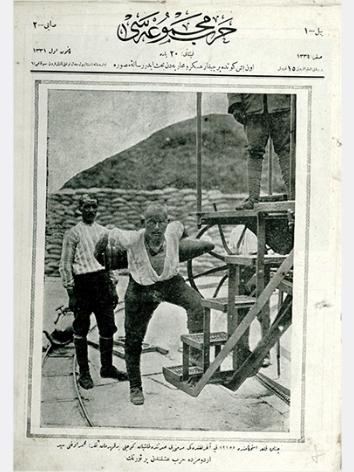
Koca Seyit (Seyit Ali Çabuk) was born in 1889 in Çamlık Village, district of Havran, Balıkesir. His father was Abdurrahman Efendi of the Cuburoğulları family, and his mother was Emine Hanım. Seyit Ali spent his childhood and youth in his birth village, assisting his family in farming and coal-related work. During the final years of the Ottoman State, he was conscripted into military service and served during the Gallipoli Campaign.

Seyit Onbaşı (Havran Municipality)
With the outbreak of the First World War in 1914, the Ottoman State declared general mobilization and began enlisting young men capable of bearing arms across the country. Seyit Ali was called up under this mobilization and was assigned as an artilleryman at the Rumeli Mecidiye Battery on the Gallipoli Front. Under the harsh conditions of the front, Ottoman soldiers fought fiercely to prevent the Allied navies from passing through the Dardanelles.

Ottoman Artillery System During the First World War (Havran Municipality)
On March 18, 1915, the Allied fleet launched a major assault to force its way through the Dardanelles and reach Istanbul. During the morning artillery bombardment, the Rumeli Mecidiye Battery came under intense fire and suffered heavy casualties. As a result of the attack, the battery’s gun crane was destroyed, the ammunition depot was largely damaged, and many soldiers were killed. The number of surviving soldiers within the battery was drastically reduced.

Mecidiye Battery (TRT News)
At this critical moment, artilleryman Seyit Ali Çabuk (Koca Seyit) took position at the battery’s last operational gun and carried a 276-kilogram shell on his back to load it into the barrel. Koca Seyit fired three shots; the first two missed their target, but the third struck the British battleship HMS Ocean. The ship’s steering system was disabled, and it subsequently hit one of the mines laid earlier by the Nusret minelayer, causing it to sink. This event is recorded as one of the critical turning points of the Naval Victory of Gallipoli.
This act was immediately reported to higher command, and Seyit Ali Çabuk was personally commended on the spot by Battery Commander Hilmi Bey and two German officers. For his extraordinary bravery, Seyit Ali Çabuk was promoted to the rank of Onbaşı (Corporal). When his commanders asked if he had any request, he asked for a pair of shoes, but soon withdrew this request, feeling it inappropriate to use this privilege while his comrades remained without basic necessities.
After the victory, a commemorative photograph was requested, and he was asked to lift again the same shell he had carried during the battle. He was unable to do so. Seyit Ali explained that he had been able to lift that weight during the battle only through faith and love for his homeland, and that under normal circumstances such a burden was impossible to carry.

Seyit Onbaşı with a Wooden Replica of the Artillery Shell (AA)
This commemorative photograph, taken with a wooden replica of the shell, has survived as a historical document.
After returning to his village, Koca Seyit resumed life with his family. He married Emine Çabuk and had two daughters. His eldest daughter, Ayşe Nine, was born on June 15, 1911. When Seyit Ali was called to serve, his daughter was only three years old. Although some sources claim she was nine when he returned, this is incorrect; when he came home in 1918, Ayşe was seven. His other daughter, Fatma, was born in 1922.
After the death of his first wife, Koca Seyit married Hatice Çabuk, with whom he had three sons: Ramazan, Osman, and Abdurrahman. Unfortunately, all three sons died at young ages due to various causes. Ayşe Nine, the last surviving member of the family, passed away in October 2007, leaving no living descendants.

Daughter of Seyit Onbaşı (Havran Municipality)
After the Gallipoli Campaign, Seyit Ali Çabuk earned his livelihood by producing and selling firewood charcoal at the Havran market, and also worked as a laborer at the Hacı Osmanoğulları Olive Oil Factory. Following the 1934 Surname Law, he adopted the surname “Çabuk.”
In the final years of his life, Seyit Ali Çabuk contracted pneumonia and died in December 1939 at the age of 50 in his birth village. His grave is located in what is now known as Koca Seyit Village, renamed in his honor. A monument and museum have also been built to preserve his memory.

Grave of Seyit Çabuk (Koca Seyit) (AA)

Seyit Onbaşı Monument (AA)
Koca Seyit is one of the most celebrated soldiers of the Gallipoli Campaign. His name appears in books, films, documentaries, and poetry.
In the Havran district of Balıkesir, the Koca Seyit Monument and Museum stand open to visitors and are visited by a significant number of people each year. Additionally, the Balıkesir Edremit Airport has been renamed “Balıkesir Koca Seyit Airport.”
Anadolu Ajansı. “Seyit Onbaşı’nın Köyündeki Müze Yeni Yüzüyle Ziyaretçilerini Ağırlıyor.” aa.com.tr. March 18, 2022. Accessed May 6, 2025. https://www.aa.com.tr/tr/yasam/seyit-onbasinin-koyundeki-muze-yeni-yuzuyle-ziyaretcilerini-agirliyor/2433382
Anadolu Ajansı. “Sırtladığı Top Mermisiyle Tarihin Seyrini Değiştiren Kahraman: Seyit Onbaşı.” aa.com.tr. March 18, 2021. Accessed May 6, 2025. https://www.aa.com.tr/tr/portre/sirtladigi-top-mermisiyle-tarihin-seyrini-degistiren-kahraman-seyit-onbasi/2060242.
Anadolu Ajansı. “İşgal Güçlerine Çanakkale’yi Dar Eden Kahraman: Seyit Onbaşı.” *aa.com.tr*. March 18, 2022. Accessed May 6, 2025. https://www.aa.com.tr/tr/kultur-sanat/isgal-guclerine-canakkaleyi-dar-eden-kahraman-seyit-onbasi/2434371.
Havran Belediyesi. "Seyit Onbaşı Hakkında." *havran.bel.tr*. Accessed May 6, 2025. https://www.havran.bel.tr/seyit-onbasi/seyit-onbasi-hakkinda/
T.C. Ministry of National Education Burhaniye District National Education Directorate. "Seyit Onbaşı’yı Rahmetle Anıyoruz." *burhaniye.meb.gov.tr*. Accessed May 6, 2025. https://burhaniye.meb.gov.tr/www/seyit-onbasiyi-rahmetle-aniyoruz/icerik/1284.
TRT Haber. “Seyit Onbaşı Kimdir, Kaç Kilo Mermi Kaldırdı? Çanakkale Zaferi.” trthaber.com. March 18, 2024. Accessed May 6, 2025. https://www.trthaber.com/haber/guncel/seyit-onbasi-kimdir-kac-kilo-mermi-kaldirdi-canakkale-zaferi-664906.html.

Military Service and Participation in the Gallipoli Front
March 18, 1915 and His Historic Heroism
Rank and Awards
Family Life
Post-War Life and Death
Legacy and Contemporary Relevance