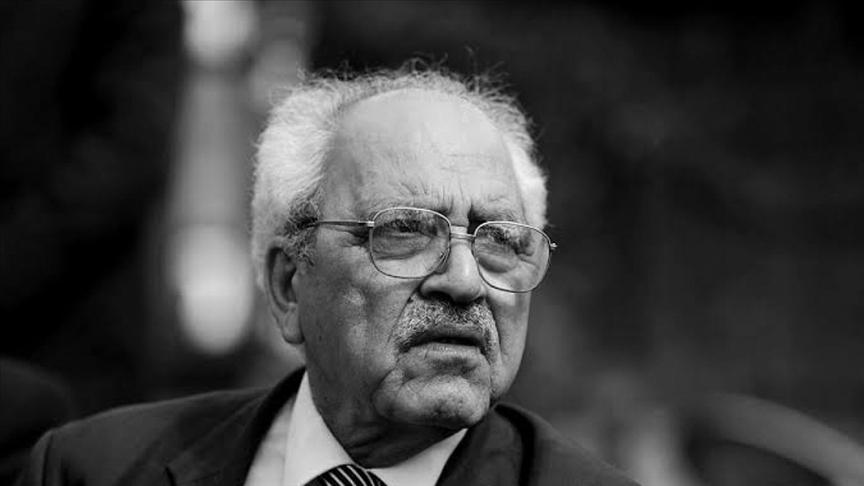



Full Name | Ahmet Sezai Karakoç | ||||||||
|---|---|---|---|---|---|---|---|---|---|
Birth | 22 January 1933, Ergani, Diyarbakır | ||||||||
Death | 16 November 2021, Istanbul | ||||||||
Profession(s) | Poet Politician Thinker Writer | ||||||||
Education | Ankara University Faculty of Political Sciences Department of Finance (1955) | ||||||||
Literary Period | Republican Era Turkish Literature – The Second New Generation | ||||||||
Magazine | Diriliş (1960–1992) | ||||||||
Political Activity | Diriliş Party (1990–1997), Yüce Diriliş Party (2007) | ||||||||
Place of Burial | Şehzadebaşı Camii Haziresi, Istanbul | ||||||||
Sezai Karakoç (Ahmet Sezai Karakoç; b. 22 January 1933, Ergani, Diyarbakır – d. 16 November 2021, Istanbul) was one of the leading figures of Turkish poetry in the Republican era, as well as a thinker, writer, and politician. Through his poetry, which emphasized metaphysical themes, Karakoç advocated for the reconstruction of Turkish-Islamic civilization and established a literary and intellectual movement under the name “Diriliş.” He authored numerous works on literature, philosophy, history, politics, and civilization, and is regarded as one of the pioneers of the Islamist and cultural conservative current in modern Turkish thought.
Documentary on Sezai Karakoç (TRT Archive)
Ahmet Sezai Karakoç was born on 22 January 1933 in the district of Ergani, Diyarbakır. His father, Yasin Bey, was a merchant who was captured by Russian forces on the Caucasian Front during the First World War; his mother was Emine Hanım. The family’s nickname was “Leventoğulları,” and after the Surname Law, they adopted the surname “Karakoç.”
His childhood was spent in the towns of Ergani, Maden, and Piran (present-day Dicle). He completed primary school in Ergani in 1944, Maraş Middle School in 1947, and Gaziantep High School in 1950. From an early age, he developed a strong habit of reading. In primary school, he read classic religious texts such as the stories of Battal Gazi and Muhammediye; in middle school, he became familiar with the works of Namık Kemal, Ziya Paşa, Tevfik Fikret, and Ziya Gökalp.
In 1950, he enrolled in the Finance Department of the Faculty of Political Sciences at Ankara University and graduated in 1955. In the same year, he began working at the Ministry of Finance; in 1956 he became an assistant inspector, and in 1959 he was appointed Controller of Revenues in Istanbul. In 1965, he resigned from his position to focus on literary pursuits; he briefly returned to public service in 1971 and left government service entirely in 1973.
During his university years, he became closely associated with Islamic thought under the influence of the journal Büyük Doğu, published by Necip Fazıl Kısakürek, and after meeting Kısakürek, he joined his circle. His earliest writings were published in Büyük Doğu in the 1950s. Later, his poems and essays appeared in journals such as Yeni İstanbul, Hisar, Hilâl, Soyut, Pazar Postası, Türk Dili, Türk Yurdu, and Şiir Sanatı.
In 1960, Karakoç began publishing the journal Diriliş, which continued intermittently until 1992. The journal served both as a literary and artistic publication and as a theoretical platform for Islamic thought. Karakoç’s decision not to publish his writings elsewhere demonstrated that all his literary and intellectual activities were centered around the Diriliş movement.
In 1990, Karakoç founded the Diriliş Party to translate his “Diriliş” idea into the political sphere and served as its general chairman until 1997. The party was dissolved because it did not participate in two consecutive elections. In 2007, he established the Yüce Diriliş Partisi along the same ideological lines.
Karakoç died in Istanbul on 16 November 2021 at the age of 88 and was buried in the cemetery of Şehzadebaşı Camii.
Sezai Karakoç is regarded as a poet within the İkinci Yeni movement, yet one who preserved tradition in his poetry. While most İkinci Yeni poets advocated a break from tradition, Karakoç sustained tradition both formally and thematically, reworking the imagery of classical Ottoman and Sufi poetry in a modern language.
His poetic thought is shaped around the concept of “poetic logic.” His “new logic” transcends classical logic and carries the idea of rebirth tied to the “Diriliş” philosophy. Each poem exists by its own internal logic; this is expressed in his line, “My logic is above logic.”
Karakoç’s poetry is grounded in a metaphysical dimension. The imagery in his poems carries a distinct consciousness within the abstract world of İkinci Yeni; these images are poetic projections of the concept of “civilization of truth.” Symbols such as death, rebirth, truth, light, city, mother, and civilization acquire both worldly and otherworldly meanings in his poetic language.
In his works Edebiyat Yazıları I-II, he systematically articulated his understanding of poetry. For him, poetry is an aesthetic instrument that enables the comprehension of existence and being; its meaning is grasped through intuition and metaphysical experience rather than through logical proof.
The concept of “Diriliş” lies at the center of Karakoç’s thought system. Diriliş signifies the rebirth of the soul, Islam, and humanity. The rebirth of the soul refers to the individual’s metaphysical awareness; the rebirth of Islam denotes the reconstruction of Muslim societies; and the rebirth of humanity means the attainment of all humankind by the civilization of truth.
Karakoç rejects a Western-centric understanding of civilization and instead views it as a pluralistic structure. He defines Islamic civilization as the “civilization of truth” and presents it as an alternative to Western civilization, which he sees as alienating humanity and severed from metaphysics.
Sezai Karakoç’s political thought aligns with Islamist ideology. He envisions an Islamic civilization progressing from the individual to society and from society to the state. He imagines the state as a “Muslim confederation” based on the concept of the ummah. He regards Islam as an ontological source of security for the individual and as the fundamental norm of order for society.
In Karakoç’s personality, religion is the fundamental force guiding all aspects of life. Religion shaped his art, politics, and understanding of humanity. Karakoç explains the crisis of the modern age as a departure from authentic Islam and presents Islam as the remedy for humanity’s salvation.
Karakoç’s complete works span a wide range of genres including poetry, thought, criticism, theater, and biography.
Karakoç’s works Yunus Emre (1965), Mehmed Âkif (1968), Mevlânâ (1988), and Yitik Cennet (1974) are biographical and monographic in nature. In these works, he explores the ideal model of humanity and the aesthetic foundations of Islamic civilization through historical figures.
Sezai Karakoç is regarded as a figure who bridged modern Turkish poetry and tradition. His “Diriliş” idea shaped the cultural and aesthetic dimensions of Islamist thought in Turkey during the late twentieth century. Close associates emphasized that there was no contradiction between his writings, poetry, and life, as he consistently upheld the same ethical principles in all his actions.
Acar, Saadettin. “Sezai Karakoç’un Yazısı, Şiiri ve Hayatı Arasında Asla Bir Tenakuz Yoktu.” *Cins Dergisi*, December 2021. Accessed November 8, 2025. https://www.cins.com.tr/2021/12/sezai-karakocun-yazisi-siiri-ve-hayati-arasinda-asla-bir-tenakuz-yoktu/
Akın, Mahmut Hakkı. “Sezai Karakoç.” *İslam Düşünce Atlası.* Accessed November 8, 2025. https://islamdusunceatlasi.org/sezai-karakoc/257
Altunya, Hülya. “Sezai Karakoç’ta Poetik Düşüncenin Mantığı.” *Üniversite Araştırmaları Dergisi* 1, no. 2 (2018): 52–57. Accessed November 8, 2025. https://doi.org/10.32329/uad.449005
Anadolu Ajansı. "İslam Dünyasının Yeniden Dirilişini Amaç Edinen Mütefekkir Şair Sezai Karakoç." Accessed November 8, 2025. https://www.aa.com.tr/tr/kultur/islam-dunyasinin-yeniden-dirilisini-amac-edinen-mutefekkir-sair-sezai-karakoc/3394645
Anadolu Ajansı. “Şair, Yazar ve Fikir Adamı Sezai Karakoç Vefat Etti.” Accessed November 8, 2025. https://www.aa.com.tr/tr/gundem/sair-yazar-ve-fikir-adami-sezai-karakoc-vefat-etti/2422479
Anadolu Mektebi. “Sezai Karakoç.” *anadolumektebi.org.* Accessed November 8, 2025. https://www.anadolumektebi.org/tr/icerik/sezai-karakoc/1545312926211
Dere, Lutfiye, and Habil Şentürk. “Sezai Karakoç’un Kişiliği ve Dini Hayatı Üzerine Psiko-Biyografik Analizler.” *Türk Din Psikolojisi Dergisi* 3 (June 2021): 39–57. Accessed November 8, 2025. https://dergipark.org.tr/en/download/article-file/1395956
Dönmez, Erdem. “Etkiler ve Katkılar Bağlamında Sezai Karakoç’un Sanatına Hatıraları Üzerinden Bakmak.” *Hikmet – Akademik Edebiyat Dergisi* 17 (Fall 2022): 236–259. Accessed November 8, 2025. https://doi.org/10.28981/hikmet.1141440
Furtana, Filiz. “Sezai Karakoç Şiirlerinde Tabiat ve Kültür Unsurları.” *Karamanoğlu Mehmetbey Üniversitesi Sosyal ve Ekonomik Araştırmalar Dergisi* 2014, no. 4 (2014): 41–48. Accessed November 8, 2025. https://dergipark.org.tr/tr/pub/kmusekad/issue/10209/125403
Fıstıkçıoğlu, Ferhat Mustafa. “Sezai Karakoç’un ‘Hâtıralar’ının Konularına Göre İncelenmesi.” *Selçuk Üniversitesi Türkiyat Araştırmaları Dergisi* 62 (2024): 299–318. Accessed November 8, 2025. https://doi.org/10.21563/sutad.1538414
Gündüz, Olgun. “İkinci Yeni Şiiri İçinde Geleneği Sürdüren Şair: Sezai Karakoç.” *Muhafazakâr Düşünce Dergisi* 10, no. 38 (2013): 53–81. Accessed November 8, 2025. https://dergipark.org.tr/tr/pub/muhafazakar/issue/52848/698504
Hüküm, Muhammed. “Sezai Karakoç’un Biyografik/Monografik Kitaplarında Estetik Özellikler.” *Yeni Türk Edebiyatı Araştırmaları* 14, no. 28 (2022): 1–28. Accessed November 8, 2025. https://dergipark.org.tr/tr/pub/ytea/issue/73680/1306710
Kotan, Cem. “Sezai Karakoç ve Siyasi Fikirleri: Birey, Toplum ve Devlet.” *Afyon Kocatepe Üniversitesi Sosyal Bilimler Dergisi* 25, no. 1 (2023): 121–137. Accessed November 8, 2025. https://doi.org/10.32709/akusosbil.1049944
Kula, Fikri. “Sezai Karakoç’un Hayatına Dair.” *Türk Dili* 70, no. 840 (December 2021): 68–76. Accessed November 8, 2025. https://www.tdk.gov.tr/wp-content/uploads/2021/12/Fikri-Kula-_-SEZA%C4%B0-KARAKO%C3%87%E2%80%99UN-_-9-1.pdf
Orhanoğlu, Hayrettin. “Sezai Karakoç’un Şiirinde İmgeler.” *Yeni Türk Edebiyatı Araştırmaları* 1 (2009): 73–104. Accessed November 8, 2025. https://dergipark.org.tr/tr/pub/ytea/issue/28268/300167
TRT Archive. *Sezai Karakoç Belgeseli.* YouTube Video. Accessed November 8, 2025. https://www.youtube.com/watch?v=2PRyZak_Cl0
Tahan, Ahmet. “Hatıralarının Işığında Sezai Karakoç’un Hayatı.” *Yedi İklim Dergisi*, (November–December 1993): 119–126. Accessed November 8, 2025. https://ismailkara.izu.edu.tr/xmlui/bitstream/handle/ismailkara/1278/%20KA6205.pdf?sequence=1
Yaşar, Hüseyin. “Sezai Karakoç’un Medeniyet Tasavvurunda Anne.” *Turkish Studies – International Periodical for the Languages, Literature and History of Turkish or Turkic* 7, no. 4 (Fall 2012): 3215–3234. Accessed November 8, 2025. http://www.ajindex.com/dosyalar/makale/acarindex-1423933532.pd
Şamlıoğlu, Kemal. “Sezai Karakoç’un Medeniyet Tasavvuru: Batı’nın Ötesinde Bir Arayış.” *Gazi Türkiyat* 36 (2025): 1–8. Accessed November 8, 2025. https://dergipark.org.tr/en/pub/gaziturkiyat/issue/92957/1648925

Full Name | Ahmet Sezai Karakoç | ||||||||
|---|---|---|---|---|---|---|---|---|---|
Birth | 22 January 1933, Ergani, Diyarbakır | ||||||||
Death | 16 November 2021, Istanbul | ||||||||
Profession(s) | Poet Politician Thinker Writer | ||||||||
Education | Ankara University Faculty of Political Sciences Department of Finance (1955) | ||||||||
Literary Period | Republican Era Turkish Literature – The Second New Generation | ||||||||
Magazine | Diriliş (1960–1992) | ||||||||
Political Activity | Diriliş Party (1990–1997), Yüce Diriliş Party (2007) | ||||||||
Place of Burial | Şehzadebaşı Camii Haziresi, Istanbul | ||||||||
Life
Family and Childhood Years
Educational and Civil Service Career
Beginning of Literary and Intellectual Life
Diriliş Journal and Publishing Activities
Political Activities
Death
Literary Identity
Poetic Vision and Poetics
Imagery and Metaphysical Elements in His Poetry
Literary Essays and Poetic Texts
Thought World and Conception of Civilization
The Idea of Diriliş
Conception of Civilization
Political and Social Views
Psychological and Religious Personality
Works
Poetry Books
Thought and Essay Works
Biographical and Monographic Works
Intellectual Legacy and Influence