


This article was automatically translated from the original Turkish version.
Shear locking is a phenomenon encountered in finite element analysis that arises from the nature of linear quadrilateral elements. Linear elements are unable to adequately represent the curvature of strains within the material, resulting in spurious shear stresses within the element. These additional shear stresses, which do not exist in reality, cause the element to reach equilibrium with exaggerated displacements. This phenomenon leads to an overestimation of stiffness and results in deflections due to bending being lower than expected.
Shear locking stems from the element’s inability to accurately capture its deformation kinematics. When considering a beam under bending, the left side shows the linear elastic solution for an Euler-Bernoulli beam, while the right side shows the linear element’s equation.
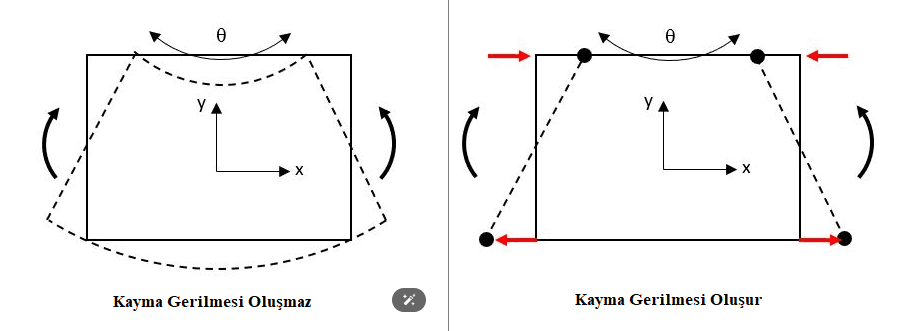
Euler-Bernoulli Beam Solution and Linear Element Solution
In a linear element, the horizontal displacement of the corner nodes induces a shear strain in the horizontal plane. This shear stress contributes to force equilibrium but distorts the deformation of the bent beam and negatively affects the accuracy of the analysis.
The following methods can be used to prevent shear locking
To minimize the effects of shear locking, these methods should be used in combination. In particular, insufficient tetrahedral meshes can produce stress values lower than those actually occurring in reality.
