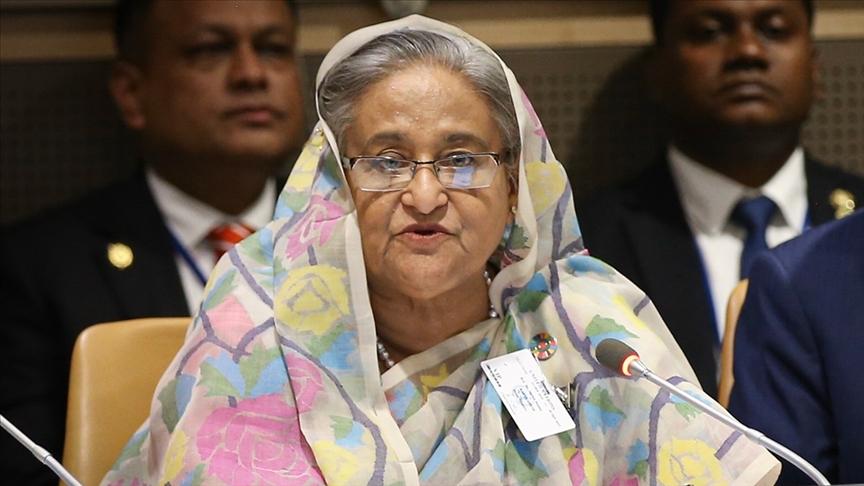



Birth | 28 September 1947, Tungipara | ||||||||
|---|---|---|---|---|---|---|---|---|---|
Babası | Sheikh Mujibur Rahman, (founder president of Bangladesh) | ||||||||
Office | Longest-serving prime minister of Bangladesh, (5 terms) | ||||||||
Spouse(s) | Physicist Wazed Miah | ||||||||
Child | 2 | ||||||||
Sheikh Hasina Wazed (b. 28 September 1947, Tungipara) is the longest-serving prime minister of Bangladesh and has served five terms in office. She is the daughter of Bangladesh’s founding president Sheikh Mujibur Rahman and has been one of the most influential and controversial figures in Bangladeshi politics.
Content on the Life of Sheikh Hasina Wazed (GZT)
Hasina was born in the village of Tungipara. Her father, Bangabandhu Mujibur Rahman, was a leader of the movement that secured the country’s independence in 1971 and became the first president of independent Bangladesh. Growing up in a deeply political atmosphere alongside her mother and siblings, Hasina became involved in politics from an early age.
Her family was killed during a military coup on 15 August 1975; Hasina survived because she was in West Germany at the time with her sister Sheikh Rehana. After this event, she moved to the United Kingdom and then to India, where she lived in exile for many years. Hasina married physicist Wazed Miah in 1968 and has two children.
Hasina completed her early education in her hometown and then enrolled at the University of Dhaka, where she studied Bengali literature and graduated in 1973. She played an active role in student movements, serving as president of the student wing of the Awami League and being elected vice president of the student union in 1966. During this period she acted as a political coordinator for her father.
After her father’s assassination, Hasina lived in exile for approximately six years. When she returned to Bangladesh in 1981, she was elected leader of the Awami League, the party founded by her father and now the country’s largest political force. She was frequently arrested and placed under house arrest for her struggle for democracy against the military regime.
Hasina played a key role in the popular uprising of 1990 alongside her rival Begum Khaleda Zia in pressuring the then military leader Ershad to step down. Although her party suffered a heavy defeat in the 1991 elections, she retained her position as leader of the opposition. Allegations of electoral fraud in those elections generated prolonged political tension.
Hasina became prime minister for the first time on 23 June 1996 after the Awami League won a majority in the general elections. In the 2001 elections her party suffered a severe defeat. During these years she survived numerous assassination attempts; in a 2004 attack she suffered permanent damage to her hearing.
Hasina became prime minister for the second time following the Awami League’s victory in the 2008 elections and was sworn in on 6 January 2009. From that date onward she remained in power for four consecutive terms, setting a record in her country’s history.
In the January 2024 elections she was elected prime minister for a fifth time, solidifying her status as Bangladesh’s longest-serving leader.
The protests that began in Bangladesh in July 2024 were among the most intense social upheavals in the country’s recent history. What started as a reaction against a quota system reserving government jobs for children of independence war veterans quickly spread nationwide. Student movements opposing the government were decisive in the early phase of the protests, but as the unrest grew, casualties and the intensity of security force interventions increased sharply.
During the protests, hundreds of people lost their lives and thousands were arrested. There was widespread criticism that Hasina’s government resorted to “harsh and repressive methods” to suppress the demonstrations. In this atmosphere, the government blamed the Jamaat-e-Islami Party and student organizations for the unrest, while opposition groups argued that the government itself was the primary source of violence.
During the peak of the violent incidents, Prime Minister Sheikh Hasina left her official residence and flew to India by military helicopter. On the same day, protesters stormed the prime minister’s residence and the national administration effectively collapsed. Shortly afterward, Nobel laureate Muhammad Yunus was sworn in as “interim head of government.”
Following these events, the International Crimes Tribunal of Bangladesh (ICT) opened a case against former Prime Minister Hasina, holding her responsible for the mass casualties during the July 2024 protests. In the prosecution’s indictment by ICT Chief Prosecutor Muhammad Tajul Islam, the government’s crackdown on the protests was classified as a “crime against humanity”, and Hasina was directly held accountable for her decisions during this period.
The tribunal convened a panel of three judges and tried Hasina in absentia. The court concluded that she was responsible for:
The ICT sentenced Hasina to death for the crime of “crimes against humanity.” In the same ruling, former Interior Minister Asaduzzaman Khan Kamal and Inspector General of Bangladesh Police Chowdhury Abdullah Al-Mamun were also sentenced to death on identical charges.
This verdict is viewed as a consequence of the political vacuum created after Hasina’s departure from the country following nearly two decades of uninterrupted rule.
Anadolu Ajansı. "Bangladeş'te en uzun süre başbakanlık yapan Şeyh Hasina." Accessed November 17, 2025. https://www.aa.com.tr/tr/dunya/bangladeste-en-uzun-sure-basbakanlik-yapan-seyh-hasina-/3296264
Anadolu Ajansı. "Bangladeş'te mahkeme, eski Başbakan Hasina'yı 'insanlığa karşı işlediği suçlardan' idam cezasına çarptırdı." Accessed November 17, 2025. https://www.aa.com.tr/tr/dunya/bangladeste-mahkeme-eski-basbakan-hasinayi-insanliga-karsi-isledigi-suclardan-idam-cezasina-carptirdi/3745776
Anadolu Ajansı. "Hindistan'ın eski Bangladeş Başbakanı Hasina'nın iktidarda kalması için ABD'ye baskı yaptığı iddiası." Accessed November 17, 2025. https://www.aa.com.tr/tr/dunya/hindistanin-eski-banglades-basbakani-hasinanin-iktidarda-kalmasi-icin-abdye-baski-yaptigi-iddiasi/3305029
Fokus. "Who Is Bangladesh Prime Minister Sheikh Hasina Wazed?" Accessed November 17, 2025. https://www.fokusplus.com/portre/banglades-basbakani-seyh-hasina-vecid-kimdir?utm_campaign=dsa&utm_adgroup=dsa_all&gad_source=1&gad_campaignid=21265745424&gbraid=0AAAAAqhRebe_1
GZT Youtube Kanalı. "Asya'nın en güçlü kadını Şeyh Hasina Vecid kimdir?" Accessed November 17, 2025. https://www.youtube.com/watch?v=Oy048HcApjE

Birth | 28 September 1947, Tungipara | ||||||||
|---|---|---|---|---|---|---|---|---|---|
Babası | Sheikh Mujibur Rahman, (founder president of Bangladesh) | ||||||||
Office | Longest-serving prime minister of Bangladesh, (5 terms) | ||||||||
Spouse(s) | Physicist Wazed Miah | ||||||||
Child | 2 | ||||||||
No Discussion Added Yet
Start discussion for "Sheikh Hasina Vecid" article
Early Life and Family
Education and Student Years
Exile and Return to Politics
Political Struggle After 1990
First Term as Prime Minister (1996–2001)
Resurgence and Long-Term Rule (2009–2024)
Key Highlights During Her Prime Ministership
2024 Protests and Departure from the Country
Death Sentence