


This article was automatically translated from the original Turkish version.
+2 More
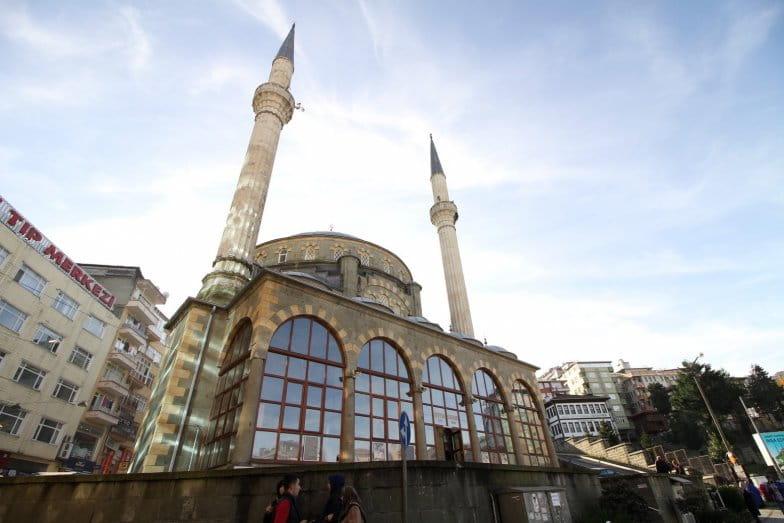
Sheikh Mosque
Type(s) | Mosque | ||||||||
|---|---|---|---|---|---|---|---|---|---|
Province / District | Rize / Center | ||||||||
Coordinate(s) | 41.0249 40.5167 | ||||||||
Construction Date(s) | 1711 (original construction) 2014 (restoration) 1953–1965 (reconstruction) | ||||||||
Commissioned by | El Hac Muhammed Efendi (original), Hacı Şeyh Osman Niyazi Efendi | ||||||||
Şeyh Camii is a historical place of worship located in the central district of Rize, in Türkiye’s Black Sea Region. The current structure exhibits characteristics of both traditional Ottoman mosque architecture and regional building styles. This building, which continues to serve religious, cultural, and architectural functions, is registered in the inventory under the name Şeyh Camii and is identified by the inventory code TR.ANT.53.060.067.

Şeyh Camii (Photo: Ahsen Güneş)
The mosque follows a central plan composed of a square prayer hall and a rectangular congregational space located on its northern side. The entire structure is built of cut stone. The main prayer area is covered by a large double-tiered central dome, with four half-domes positioned around it. All domes are covered with lead.
The congregational space is covered by five small domes supported by stone columns and arranged in a staggered arch pattern. On the eastern and western facades, two minarets stand on cut stone bases, each featuring a prismatic base and a cylindrical shaft. Both minarets are single-balconied and crowned with conical caps.
Numerous windows, featuring arched openings and stone surrounds arranged in a staggered pattern, are located on the dome drum and side walls. This window arrangement allows natural light to illuminate the interior space. The entrance consists of a round-arched opening flanked by pilasters adorned with fluted capitals that project outward. Inside the entrance arch, an Arabic inscription is present, while above it, a marble plaque bears an inscription.

Şeyh Camii (Black Sea Culture Inventory)
The interior is equipped with numerous windows that enhance the mosque’s overall luminous character. The women’s gallery on the northern side was later constructed using reinforced concrete and is supported by two columns in a movable arrangement. The mihrab, minbar, and pulpit are made of marble; the interior of the mihrab is decorated with muqarnas, and its niche is designed in stepped form. The surface of the minbar is adorned with vegetal motifs. Additionally, the interior contains calligraphic inscriptions and decorations, as well as stained-glass windows on the dome skirts.

Interior (Black Sea Culture Inventory)

Interior (Black Sea Culture Inventory)
The mosque’s history extends back to the 18th century. According to its inscription, the original structure was built in 1123 AH (1711 CE) by El Hac Muhammed Efendi. However, this early building deteriorated beyond repair and was demolished; a new mosque was constructed between 1953 and 1965. Following restoration work completed in 2014, the mosque acquired its present architectural appearance.
Karadeniz Vakfı. “Şeyh Camii.” Karadeniz.gov.tr. Accessed May 20, 2025. https://karadeniz.gov.tr/seyh-camii/#prettyPhoto.
T.C.Rize İl Directorate of Culture and Tourism. "Camiler." Rize Kültür veTurizm İl Müdürlüğü. Accessed May 20, 2025. https://rize.ktb.gov.tr/TR-127866/camiler.html.

Sheikh Mosque
Type(s) | Mosque | ||||||||
|---|---|---|---|---|---|---|---|---|---|
Province / District | Rize / Center | ||||||||
Coordinate(s) | 41.0249 40.5167 | ||||||||
Construction Date(s) | 1711 (original construction) 2014 (restoration) 1953–1965 (reconstruction) | ||||||||
Commissioned by | El Hac Muhammed Efendi (original), Hacı Şeyh Osman Niyazi Efendi | ||||||||
Architectural Features
Interior Features
History and Conservation