


This article was automatically translated from the original Turkish version.
+1 More
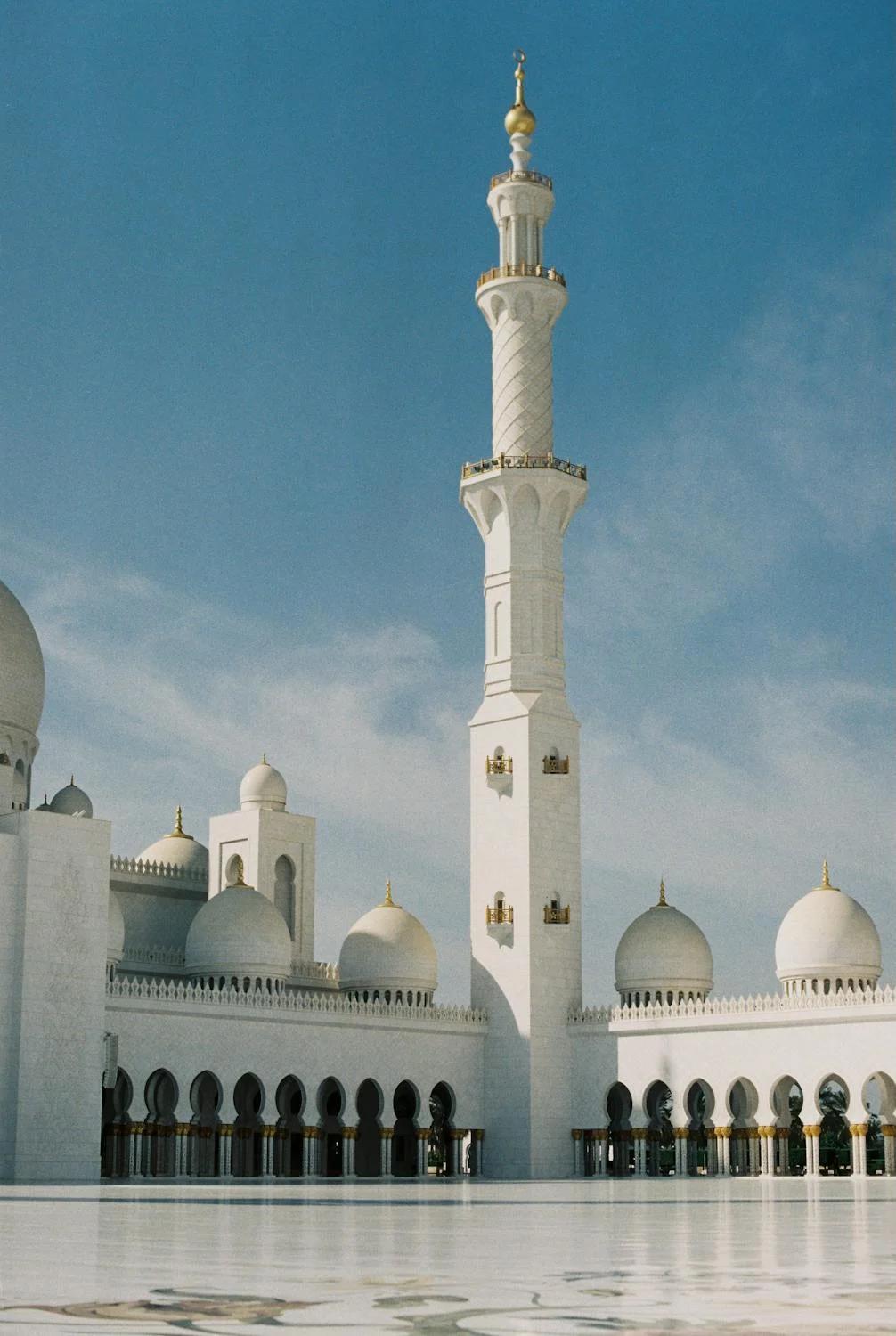
Sheikh Zayed Mosque
Location | Abu Dhabi / United Arab Emirates | ||||||||
|---|---|---|---|---|---|---|---|---|---|
Construction Period | 1996–2007 | ||||||||
Opening Date(s) | December 2007 | ||||||||
Capacity | Approximately 41,000 people | ||||||||
Total Area | 22,412 m² | ||||||||
Construction Materials | Greek and Macedonian marble, gold, semi-precious stones, crystal, ceramic | ||||||||
Architect(s) | Yousef Abdelky | ||||||||
Minarets | 4 units of 107 m | ||||||||
Number of Domes | 82 | ||||||||
Calligraphers | M. Allam (Jordan) F. Haddad (Syria) M. Mandi El Tamimi (UAE) Hasan Çelebi (Türkiye) | ||||||||
Award(s) | 2010 IALD Lighting Design Award | ||||||||
The Sheikh Zayed Grand Mosque is a monumental religious structure located in Abu Dhabi, the capital of the United Arab Emirates, constructed between 1996 and 2007. The mosque was founded in 1996 as a vision of the UAE’s founding president, Sheikh Zayed bin Sultan Al Nahyan; it was named in his honor following his death in 2004 and he is buried in a tomb located within the mosque courtyard. Construction of the mosque was completed in 2007, with landscape improvements finalized in 2010.

Sheikh Zayed Grand Mosque (Pexels)
The mosque’s architectural design was developed by Syrian architect Yousef Abdelky as the winning entry in an international competition held in 1988. Turkish architects Doğan Kuban and Cafer Bozkurt also participated in the competition and received third prize. The mosque is described as a synthesis of architectural styles from various Islamic regions. Elements from Ottoman, Maghrebi, Mamluk, Cordoban, Iranian and Indian Islamic architecture are combined within its structure. In this regard, the mosque is regarded as an example reflecting the architectural diversity of the Islamic world in a unified whole.
The mosque is situated 9.5 meters above sea level and has a floor area of 22,412 square meters. It can accommodate up to 40,960 worshippers simultaneously in its interior and exterior spaces. The central prayer hall has a capacity of 6,000 men, while the two side halls each accommodate 1,500 women. At each of the four corners of the building stand four minarets, each 107 meters high and featuring three balconies. The structural system is a reinforced concrete shell and frame construction; 250,000 cubic meters of concrete and 33,000 tons of steel were used in its construction.
The interior of the mosque contains three large domes and a total of 82 domes. The central dome has a diameter of 32.8 meters, an internal height of 70 meters and an external height of 87 meters. The three large interior domes are supported by six load-bearing columns. The enclosed prayer area has a total capacity of 9,000 worshippers: one central hall for 6,000 men and two side halls each for 1,500 women. The interior contains 96 columns and the exterior contains 1,048 columns, all clad in marble and adorned with inlaid decorative patterns.
The mihrab is decorated with 24-carat gold inlay on marble and features a simple yet elegant design. The adjacent minbar is a wooden structure intricately carved with floral motifs. The qibla wall measures 23 meters in height and 53 meters in width and bears the 99 names of Allah rendered in 24-carat gold. The wall is also embellished with glass mosaics and precious stones. The calligraphy within the mosque employs Naskh, Thuluth and Kufic scripts. The calligraphic works were executed by Turkish calligrapher Hasan Çelebi, Mohammed Mandi El Tamimi (UAE), Farouk Haddad (Syria) and Mohammed Allam (Jordan).
The floor covering consists of a hand-woven carpet measuring 7,119 square meters, weighing 45 tons and composed of 2,268,000 knots, designed by Dr. Ali Khaliqi and manufactured in Iran. This carpet holds the record as the largest single-piece carpet in the world by area.
The three large chandeliers used for interior lighting were manufactured in Germany and designed with 24-carat gold plating and Swarovski crystals. The central chandelier, with a diameter of 10 meters, a height of 15 meters and a weight of 9 tons, is among the largest in the world.

Interior of Sheikh Zayed Grand Mosque (Pexels)
The main entrance to the mosque is from the north via a courtyard covering 18,000 square meters, paved with white Sivec marble imported from Macedonia. The three surrounding arcades cover an area of 7,874 square meters and are decorated with mosaic patterns on white marble. The capitals of the columns feature gilded palm motifs, while the floral patterns on the ground were designed by Kevin Dean. These mosaics were produced by the Italian firm Fantini Mosaici using 37 different shades of marble and jet-water techniques.
The interior and exterior facades of the entrance are adorned with marble inlays featuring floral designs and handcrafted Iznik tiles produced by the Iznik Foundation. These tiles were made using the underglaze technique and inspired by 15th and 16th century Ottoman tile traditions. The joints between the panels are illuminated with fiber-optic lighting.
The interior sections of the mosque are illuminated by natural light. Colored stained-glass panels are installed on the south, west and north walls, allowing light to filter into the interior space. A total of 3,500 interior and exterior lighting units are employed; the lighting design was carried out by Spiers and Major Associates and was awarded by the International Association of Lighting Designers (IALD) in 2010.

Courtyard of Sheikh Zayed Grand Mosque ()
The mosque features concealed lighting and climate control systems. Airflow mechanisms integrated into the large columns and ceiling systems maintain thermal balance throughout the space. Additionally, large plasma screens placed at various locations enable sermons to be viewed from every corner of the mosque.
The project was initiated under the leadership of the Abu Dhabi Department of Government Affairs, with construction phases transferred among different contractors over time. From 2001 onward, it was executed by six companies under the umbrella of the Arab Construction Company. Project supervision was carried out by Halcrow Group (United Kingdom), and formwork systems were implemented by PERI (Germany). The total construction cost amounted to 545 million US dollars; the cost of the three large chandeliers in the interior alone was reported at 8 million US dollars.
The Sheikh Zayed Grand Mosque Centre (SZGMC) was established in 2008 by decree of Sheikh Mansour bin Zayed Al Nahyan. The centre operates to promote Sheikh Zayed’s religious, cultural and humanitarian legacy, and to preserve and present the mosque as a center of religious, scientific and cultural significance. Within this scope, it organizes conferences, exhibitions, seminars, Quran recitation competitions and various cultural activities. The centre also aims to establish a library housing resources on Islamic art, calligraphy and architecture, and to support related publications.
Anadolu Ajansı. "Abu Dabi’nin Görkemli Şeyh Zayed Camii." Accessed May 10, 2025. https://www.aa.com.tr/tr/pg/foto-galeri/abu-dabinin-gorkemli-seyh-zayed-camii/0/32802.
Pexels. “Altın Ve Beyaza Boyanmış Sütunlar Ve Kemerler JPG.” Accessed May 19, 2025. https://www.pexels.com/tr-tr/fotograf/altin-ve-beyaza-boyanmis-sutunlar-ve-kemerler-3680910/
Pexels. “Altın Ve Beyaza Boyanmış Sütunlar Ve Kemerler JPG.” Accessed May 19, 2025. https://www.pexels.com/tr-tr/fotograf/altin-ve-beyaza-boyanmis-sutunlar-ve-kemerler-3680910/
Pexels. “Avludan Görünen Şeyh Zayed Büyük Camii JPG.” Pexels. Accessed May 10, 2025. https://www.pexels.com/tr-tr/fotograf/avludan-gorunen-seyh-zayed-buyuk-camii-11118382/
Pexels. “Şehirde Katedral Manzarası JPG.” Pexels. Accessed May 19, 2025. https://www.pexels.com/tr-tr/fotograf/sehirde-katedral-manzarasi-337904/
Pexels. “Şeyh Zayed Camii Abu Dabi JPG.” Pexels. Accessed May 19, 2025. https://www.pexels.com/tr-tr/fotograf/seyh-zayed-camii-abu-dabi-20584923/
Sheikh Zayed Grand Mosque. "Sheikh Zayed Grand Mosque Centre." Sheikh Zayed Grand Mosque Web Sitesi. Accessed May 10, 2025. https://szgmc.gov.ae/en/about/sheikh-zayed-grand-mosque-centre.
Temples World Wide. "Şeyh Zayed Büyük Camii." Temples.org. Accessed May 10, 2025. https://temples.org/tr/seyh-zayed-buyuk-camii/.
Yesügey, S. Cengiz. "Şeyh Zayed Büyük Camii: Mimari Özellikler ve Yapım Süreci." YEDİ: SANAT, TASARIM VE BİLİM DERGİSİ, no. 11 (2014): 69–78. Accessed May 10, 2025. https://dergipark.org.tr/tr/download/article-file/203747

Sheikh Zayed Mosque
Location | Abu Dhabi / United Arab Emirates | ||||||||
|---|---|---|---|---|---|---|---|---|---|
Construction Period | 1996–2007 | ||||||||
Opening Date(s) | December 2007 | ||||||||
Capacity | Approximately 41,000 people | ||||||||
Total Area | 22,412 m² | ||||||||
Construction Materials | Greek and Macedonian marble, gold, semi-precious stones, crystal, ceramic | ||||||||
Architect(s) | Yousef Abdelky | ||||||||
Minarets | 4 units of 107 m | ||||||||
Number of Domes | 82 | ||||||||
Calligraphers | M. Allam (Jordan) F. Haddad (Syria) M. Mandi El Tamimi (UAE) Hasan Çelebi (Türkiye) | ||||||||
Award(s) | 2010 IALD Lighting Design Award | ||||||||
No Discussion Added Yet
Start discussion for "Sheikh Zayed Mosque" article
Design and Architectural Features
Interior Space and Decoration
Exterior Space and Courtyard
Climate Control and Technological Infrastructure
Construction and Contributing Organizations
Sheikh Zayed Grand Mosque Centre