
+2 More


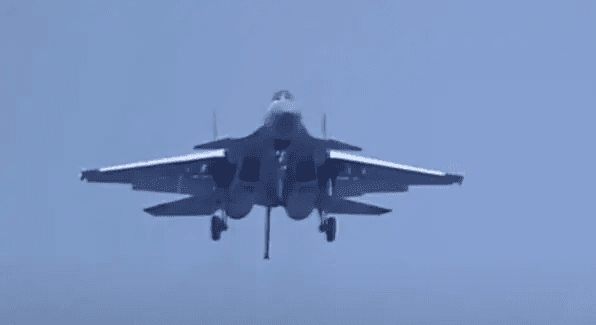
The Shenyang J-15 is an all-weather, twin-engine, multirole, carrier-based fighter aircraft developed by the Shenyang Aircraft Corporation (SAC) for the Chinese People's Liberation Army Navy. Referred to as "Flanker-X2" in Western sources, the J-15 is known by the nickname "Flying Shark." It is a modernized version of the Russian-made Su-33 fighter and constitutes the main air power of China's aircraft carrier fleets.

Shenyang J-15 (New China TV)
The development process for the J-15 began with China reverse-engineering an unfinished Soviet Su-33 prototype (T-10K-3) acquired from Ukraine. Chinese engineers used the aerodynamic characteristics of this prototype as a base and integrated domestically acquired technologies, avionics systems, and radar technology from the J-11B program to create the J-15. The aircraft's design features a stronger fuselage than the J-11, increased wing area, and strengthened landing gear and a tail hook, which are mandatory for carrier operations.
The J-15 prototype conducted its maiden flight in 2009. In 2012, it successfully completed landing and take-off tests on the aircraft carrier Liaoning, proving its suitability for carrier operations. The canard (small forewing) and fly-by-wire (electronic flight control) system in the aircraft's design increase its maneuverability.
Early versions of the J-15 used Russian-made Saturn AL-31F turbofan engines. However, to reduce reliance on foreign motor supply, China aimed to use the domestically developed WS-10H Taihang turbofan engines in this aircraft. Each of these engines produces approximately 132 kN (29,700 lbf) of thrust. Imagery released towards the end of 2022 confirmed that the operational versions of the J-15 were fitted with domestically produced WS-10 engines. This development is considered an indicator of the progress China has made in aviation engine technology.
Shenyang J-15 (New China TV)
The J-15 is a fighter aircraft that can carry a wide range of weapons and demonstrates high performance for multirole missions.
The Shenyang J-15 is the primary fighter aircraft aboard the Chinese People's Liberation Army Navy's Liaoning and Shandong aircraft carriers. The aircraft provides air defense for the carriers and undertakes strike missions against ground and naval targets. Due to the ski-jump (catapult-less) take-off system on the Liaoning and Shandong carriers, the J-15 cannot take off with a full fuel and ordnance load. This limits the aircraft's range and weapon carrying capacity. Despite this, the J-15 plays a vital role in China's projection of air power over the ocean and serves as a transition platform for carriers equipped with the more modern CATOBAR (Catapult-Assisted Take-Off But Arrested Recovery) system.
Liaoning, J-15 jetleriyle tatbikat gerçekleştirdi (CGTN)
The J-15 is launched using the STOBAR (Short Take-Off But Arrested Recovery) system present on China's in-service aircraft carriers. In this system, the aircraft takes off from a "ski-jump" ramp. However, this method prevents the aircraft from taking off with a full fuel and weapon load, which limits the J-15's operational range and combat effectiveness.
The J-15 possesses a powerful weapon system to execute a wide range of missions. In addition to a fuselage-integrated 30 mm cannon, it can carry various ordnance on 12 underwing hardpoints. This ordnance includes:
Aero Corner. "Shenyang J-15." Accessed: October 19, 2025. https://aerocorner.com/aircraft/shenyang-j-15
CGTN. "Chinese aircraft carrier Liaoning carries out drill with J-15 jets on board." YouTube. Accessed: October 19, 2025. https://www.youtube.com/watch?v=oi_Apiq3BMI
China.org.cn. "J-15 fighter jet test on Liaoning." China.org.cn. Accessed: October 19, 2025. http://www.china.org.cn/china/2013-03/02/content_28109971.htm
Defense News. "Footage shows domestic engine on China’s J-15 fighter jet." Defense News. Accessed: October 19, 2025. https://www-defensenews-com.translate.goog/air/2022/11/28/footage-shows-domestic-engine-on-chinas-j-15-fighter-jet/?_x_tr_sl=en&_x_tr_tl=tr&_x_tr_hl=tr&_x_tr_pto=tc
Descalsota, Marielle. "J-15 China Fighter Jet Shenyang Photos Warned Off US Destroyer." Business Insider. Accessed: October 19, 2025. https://www.businessinsider.com/j15-china-fighter-jet-shenyang-photos-warned-off-us-destroyer-2022-10
Kurunç, Kamer. "Çin’in Yerli Olarak Geliştirdiği WS-10 Motorunu J-15 Savaş Uçağına Taktı." GDH Digital. Accessed: October 19, 2025. https://archive.gdh.digital/cin-yerli-olarak-gelistirdigi-ws-10-motorunu-j-15-savas-ucagina-takti-47559
Military Factory. "Shenyang J-15." Military Factory. Accessed: October 19, 2025. https://www.militaryfactory.com/aircraft/detail.php?aircraft_id=1026
New China TV. "Exclusive footage of China's J-15 fighter jets." YouTube. Accessed: October 19, 2025. https://www.youtube.com/watch?v=cIudO13ijDw
The War Zone. "China's J-15 Naval Fighter Is Now Powered By Locally Made Engines." The War Zone. Accessed: October 19, 2025. https://www.twz.com/chinas-j-15-naval-fighter-is-now-powered-by-locally-made-engines

Design and Development
Engine and Improvements
Technical Specifications
Operational Role and Usage
Launch System and Limitations
Weapon Systems