


This article was automatically translated from the original Turkish version.
Shibuya Crossing
Location | Japan/Tokyo-Shibuya (in front of Hachiko Exit of Shibuya Station) | ||||||||
|---|---|---|---|---|---|---|---|---|---|
Type | Pedestrian Priority Intersection ("Scramble Crossing") | ||||||||
Establishment | 1973 (when the scramble system was first implemented) | ||||||||
Daily Pedestrian Count | Approximately 2.4 million people (2,500–3,000 people per crossing during peak hours) | ||||||||
Signal Cycle Duration | Approximately 120 seconds | ||||||||
Daily Passenger Count of Connected Station | Approximately 3 million (Shibuya Station) | ||||||||
Cultural Visibility | Films: Lost in Translation (2003) Events: 2016 Rio Olympics Closing Ceremony (Tokyo 2020 promotion) Jujutsu Kaisen Anime/TV Series: Alice in Borderland Resident Evil: Afterlife (2010) Tokyo Drift (2006) | ||||||||
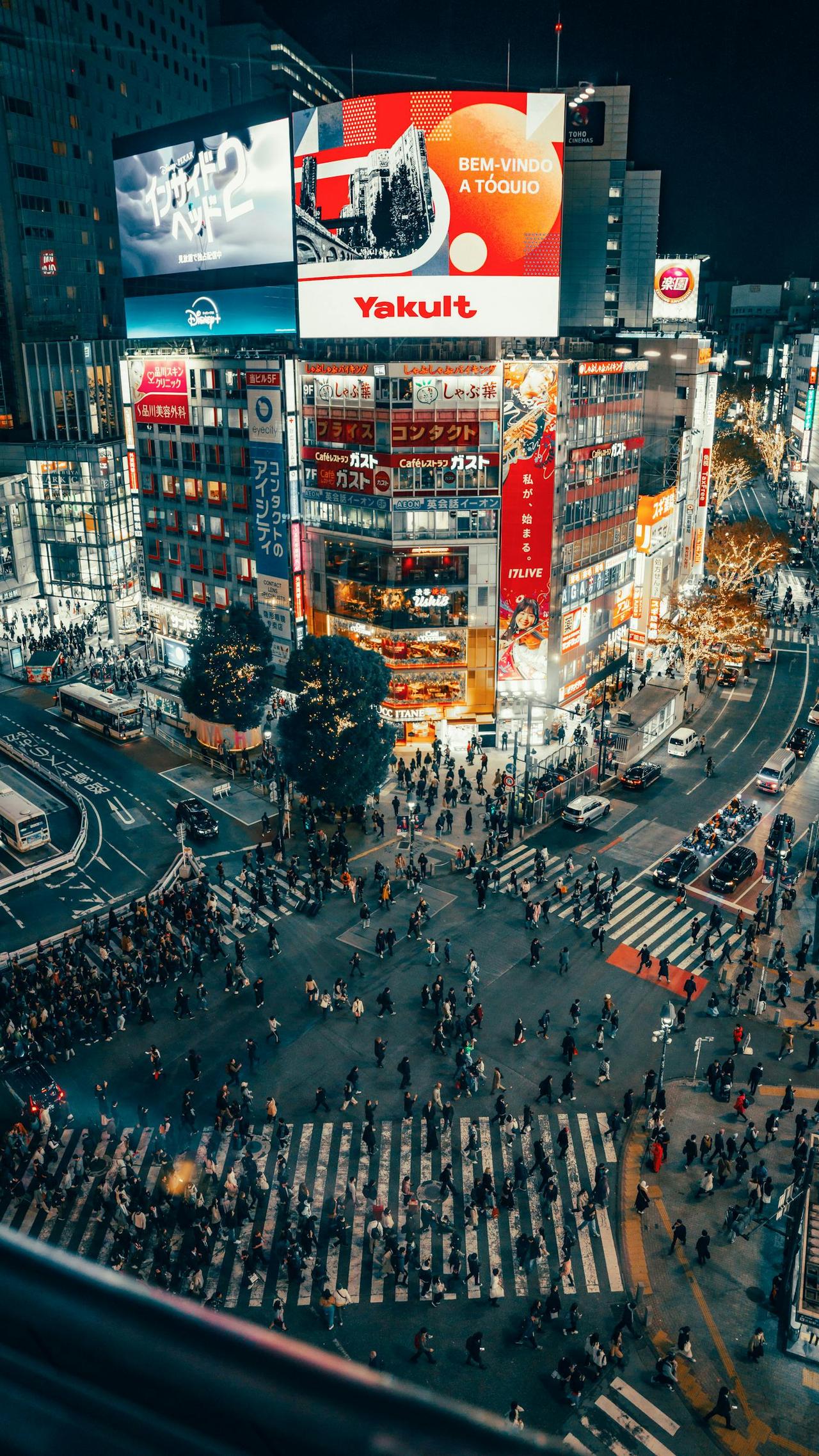
Shibuya Crossing (Shibuya Scramble Crossing), Japan’s capital Tokyo’s Shibuya district, directly in front of the Hachikō Exit of Shibuya Station, is a pedestrian crossing renowned worldwide. This intersection features a “scramble crossing” system that allows pedestrian traffic to flow in all directions simultaneously, making it a notable urban public space from both urban planning and social life perspectives. Daily average pedestrian crossings exceed 2.4 million, with estimates suggesting that during peak hours, 2,500 to 3,000 people cross during each light cycle.
The crossing arrangement implemented in 1973 was introduced in response to rising pedestrian density in the Shibuya area. The surrounding area is enclosed by digital advertising screens, high-rise buildings, shops, and cafes; this environment has endowed the crossing with both technological and cultural significance. Over time, Shibuya Crossing has become an iconic symbol of Tokyo’s modern urban identity and has transformed into a frequently used visual element in cinema, television, music videos, and international events.

Shibuya, Pexels
Shibuya’s emergence as one of Tokyo’s key centers began in 1885 with the opening of Shibuya Station on a railway line that would later become part of the present-day JR Yamanote Line. Initially of limited importance, the area gained its commercial and transportation identity alongside Tokyo’s rapid modernization and urbanization during the Taishō (1912–1926) and Shōwa (1926–1989) periods.
The addition of new railway lines to the station (such as the 1932 opening of the Tokyu Toyoko Line connecting the area to the neighboring port city of Yokohama) and the concentration of large department stores (like the Tokyu Department Store) and commercial enterprises around the station significantly increased both pedestrian and vehicle traffic. The need to manage this growing traffic, particularly during the post-World War II reconstruction and rapid economic growth period, paved the way for the development of the intersection that would become today’s Shibuya Crossing.【1】 【2】
Although the current intersection existed previously, the “scramble crossing” system, which allows pedestrians to cross simultaneously from all directions, was implemented in 1973. This date coincided with other major commercial developments, such as the opening of Shibuya PARCO, which triggered a surge of visitors to the area.
Shibuya Station and its surrounding area have undergone numerous large-scale redevelopment projects over the decades to respond to Tokyo’s growing population and changing urban needs. Starting in the 2000s, these projects accelerated; structures such as Shibuya Hikarie, Shibuya Stream, and Shibuya Scramble Square—completed in 2020 and featuring a panoramic observation deck overlooking the crossing—have been added to the district’s skyline.
Shibuya Crossing is located in the Shibuya district of Tokyo, Japan’s capital. The crossing sits directly in front of the Hachikō Exit of Shibuya Station, known for its statue of Hachiko, the loyal dog.
Physically, the crossing is a wide intersection where multiple pedestrian pathways converge from different directions. It operates as a “scramble crossing,” enabling pedestrians to move simultaneously in all directions under controlled signals. The crossing is surrounded by tall buildings adorned with digital video screens (such as the one on the QFRONT building facing the intersection) and numerous colorful neon advertising billboards that illuminate the area at night. This visual dynamism and constant movement are among its most distinctive features.
Shibuya Crossing is widely recognized globally as “the world’s busiest pedestrian crossing” and is considered one of Tokyo’s most iconic landmarks. This designation stems from the extraordinary volume of pedestrians using it. Estimates suggest that during peak hours, between 2,500 and 3,000 people cross simultaneously during a single green light phase (approximately 120 seconds). Another estimate suggests that during the busiest periods, between 1,000 and 2,500 people cross every two-minute cycle.
The fact that Shibuya Station handles approximately 3 million daily passengers provides important context for understanding the overall human movement in the area and the crossing’s intensity. This high level of activity continues even during late-night or early-morning hours.

Tokyo Shibuya Night Street View, Fatih Turan
Shibuya Crossing has transcended its role as a mere traffic intersection to become one of the most globally recognized symbols of modern Tokyo and Japan. The crossing represents the city’s dynamism, relentless energy, technological advancement, and the balance between opposing forces such as order and chaos or tradition and modernity. This symbolic value has established it as a popular tourist destination for international visitors and a well-known landmark.
Within the local culture context, Shibuya Crossing has been regarded since the 1970s as the public manifestation of Shibuya’s youth culture, fashion, and contemporary trends. The nearby Hachikō Statue, a symbolic representation of loyalty in Japanese culture, serves as a well-known meeting point for both locals and visitors.
The crossing’s layered meaning and striking visual identity have made it a frequently chosen location in popular culture and media. It has been featured as a characteristic scene in numerous films, television series, music videos, anime, and news programs, both in Japan and internationally, to represent urban life and Tokyo’s dynamic character. This visibility has led to comparisons with international icons such as Times Square in New York. Notable productions featuring the crossing include:

Tokyo, Japan Pexels
The operation of Shibuya Crossing is based on a specialized traffic management system designed to ensure pedestrian safety and flow efficiency. At regular intervals, all vehicle approaches to the intersection are halted with red lights, while all pedestrian crossings simultaneously display green lights. This system allows pedestrians not only to cross from side to side but also diagonally across the corners of the intersection. The system’s foundation is a synchronized, pre-programmed traffic light cycle. The duration of each light cycle is approximately 120 seconds, accounting for both vehicle and pedestrian traffic.
This setup is sometimes cited as an example of Japan’s approach to efficiency and engineering planning. Although not directly part of the crossing’s operational system, the massive digital screens mounted on the facades of surrounding high-rise buildings contribute significantly to the area’s modern technological appearance. These screens display advertisements, public announcements, and various visual content, typically changing in sync with the traffic light cycle.
Due to its high usage levels and unique design, Shibuya Crossing is frequently studied in fields such as urban planning, transportation engineering, and urban sociology. It has been the subject of numerous academic studies concerning pedestrian flow management, crowd control, and the use of public space, and is also referenced as a model in sustainable urban mobility frameworks.
100 Year Company Strategy Online. "TOKYO街COLORS-渋谷編- VORTのある街" (TOKYO Machi COLORS - Shibuya-hen - VORT no aru Machi) [Tokyo Şehir Renkleri - Shibuya Edisyonu - VORT'un Olduğu Şehir]. Accessed April 5, 2025.https://100years-company.jp/column/article-020090/
BesPes. "About Shibuya Station Area|Detailed history and overview." BesPes JT Article. Accessed April 5, 2025.https://article.bespes-jt.com/en/article/shibuya
Geinokai. "Shibuya Crossing: 8 Facts About The Legendary Landmark of Tokyo." Geinokai Blog. Accessed April 5, 2025.https://geinokai.jp/blog/2024/12/16/the-history-shibuya-crossing/
JRailPass. "Shibuya Crossing, the World's Busiest Crossing." JRailPass Blog. Accessed April 5, 2025.https://www.jrailpass.com/blog/shibuya-crossing
Japan National Tourism Organization (JNTO). "Shibuya Crossing." Travel Japan. Accessed April 5, 2025.https://www.japan.travel/en/spot/2177/
Japan Travel. "Shibuya Crossing." Accessed April 5, 2025.https://www.japan.travel/en/spot/2177/
Shibuya Shimbun. "スクランブル交差点の豆知識" (Scramble Kōsaten no Mame Chishiki) [Scramble Geçidi Hakkında Bilgiler]. Shibuya Newspaper. Accessed April 5, 2025.https://shibuya-shimbun.com/archives/190
Yousef, Ibrahim. "Vibrant Shibuya Crossing at Night in Tokyo." Pexels. Accessed April 5, 2025.https://www.pexels.com/photo/vibrant-shibuya-crossing-at-night-in-tokyo-30429425/
[1]
Japan National Tourism Organization (JNTO), "Shibuya Crossing," Travel Japan, son erişim: 5 Nisan 2025, https://www.japan.travel/en/spot/2177/
[2]
Shibuya Shimbun, "スクランブル交差点の豆知識 (Scramble Kōsaten no Mame Chishiki)," Shibuya Newspaper, son erişim: 5 Nisan 2025, https://shibuya-shimbun.com/archives/190

Shibuya Crossing
Location | Japan/Tokyo-Shibuya (in front of Hachiko Exit of Shibuya Station) | ||||||||
|---|---|---|---|---|---|---|---|---|---|
Type | Pedestrian Priority Intersection ("Scramble Crossing") | ||||||||
Establishment | 1973 (when the scramble system was first implemented) | ||||||||
Daily Pedestrian Count | Approximately 2.4 million people (2,500–3,000 people per crossing during peak hours) | ||||||||
Signal Cycle Duration | Approximately 120 seconds | ||||||||
Daily Passenger Count of Connected Station | Approximately 3 million (Shibuya Station) | ||||||||
Cultural Visibility | Films: Lost in Translation (2003) Events: 2016 Rio Olympics Closing Ceremony (Tokyo 2020 promotion) Jujutsu Kaisen Anime/TV Series: Alice in Borderland Resident Evil: Afterlife (2010) Tokyo Drift (2006) | ||||||||
History and Development
Location
Cultural Significance and Media Representations
Films
TV Series and Anime
Music Videos
Special Events
Operation and Technology