


This article was automatically translated from the original Turkish version.
+2 More
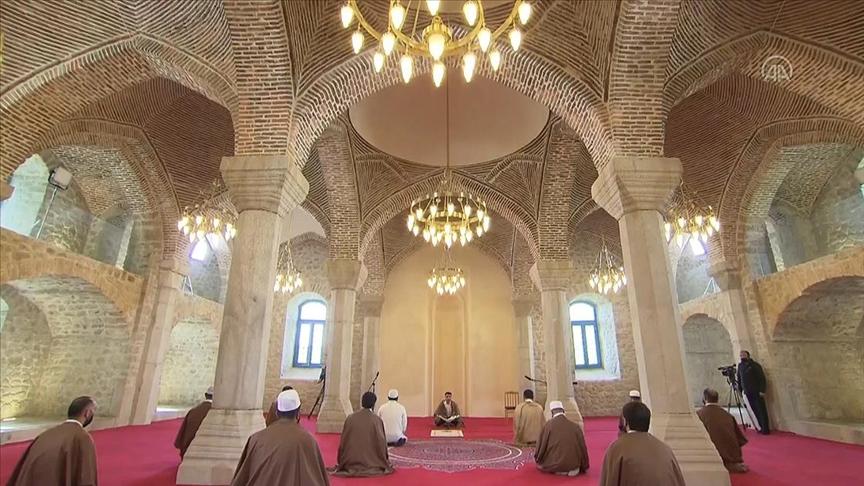
Yukarı Gövher Ağa Camii is located in the city of Shusha, within the Nagorno-Karabakh region of Azerbaijan, and was constructed in the 19th century. It is regarded as one of the finest examples of Turkic-Islamic architecture in Azerbaijan. The mosque was built between 1883 and 1885 at the initiative of Gövher Ağa, daughter of Karabakh Khan Ibrahim Khalil Khan, with the architect being the renowned Azerbaijani master Kerbelayi Sefi Han. The structure is the first of Shusha’s two-minaret mosques, combining the local architectural style of the period with traditional Islamic architectural elements.
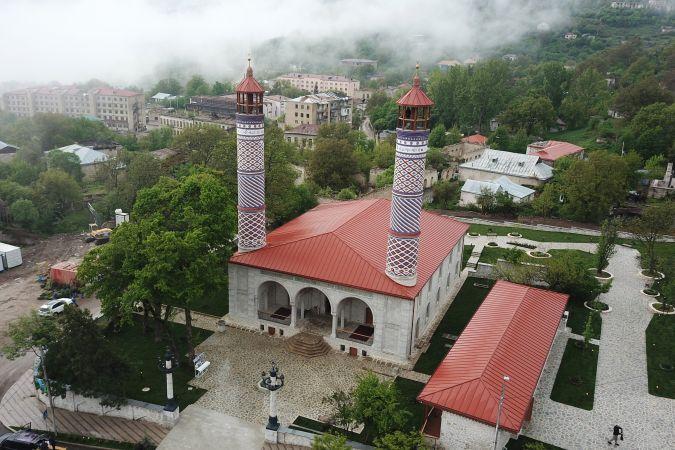
General View of Yukarı Gövher Ağa Camii (Heydar Aliyev Foundation)
The Yukarı Gövher Ağa Camii was constructed in the last quarter of the 19th century in the city of Shusha, Azerbaijan, under the orders of Gövher Ağa, daughter of Karabakh Khan Ibrahim Khalil Khan. Construction began in 1883 and was completed in 1885. It was carried out by Kerbelayi Sefi Han, one of the most distinguished Azerbaijani architects of the era. Gövher Ağa was also the patron of the earlier Aşağı Gövher Ağa Camii, built by her father; however, the Yukarı Gövher Ağa Camii stands out for its more sophisticated and symmetrical planning and decoration. Built as the central structure of the Yukarı Mahalle neighborhood—one of Shusha’s seventeen quarters—the mosque is not merely a place of worship but also forms part of a külliye that includes a madrasa and a cemetery.
Depictions of the mosque appear in the drawings of the Russian painter VV Vereshchagin. These drawings remain the only historical sources that reflect the architectural and artistic features of the building. According to Vereshchagin’s illustrations, the mosque originally consisted of a two-story structure with a dome at its center.
During the Armenian forces’ occupation of Shusha in 1992, some of the city’s seventeen mosques were completely destroyed, others damaged, and some repurposed. During this approximately 30-year occupation, the Yukarı Gövher Ağa Camii suffered severe damage. However, following the Azerbaijani armed forces’ recapture of Shusha after the 44-day Patriotic War between 27 September and 10 November 2020, restoration efforts for the mosque and other historic structures were initiated.
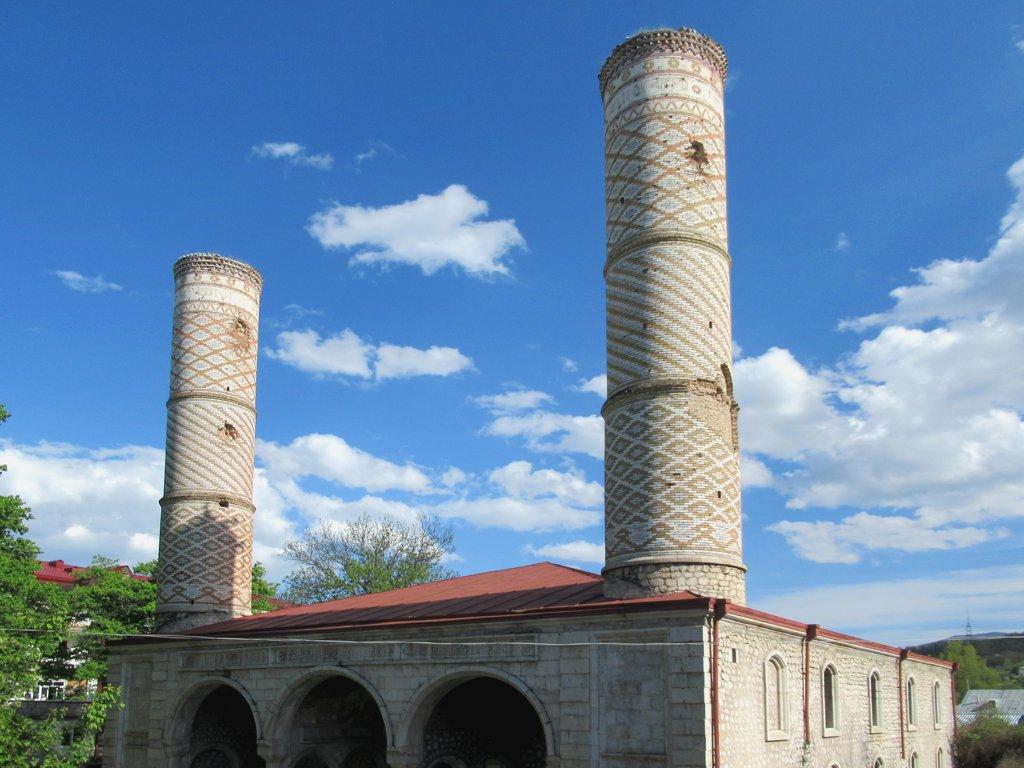
Yukarı Gövher Ağa Camii Before Restoration ()
The restoration process was conducted with the primary aim of preserving the building’s original architectural fabric. During restoration, the main prayer hall, dome covering, mihrab, minbar, and wooden elements were renewed in accordance with their original forms. Interior wall plasters were carefully treated with consideration for the original decorative elements. The mosque’s minarets were repaired using the same techniques, reviving their geometric brick ornamentation. The madrasa building was also reconstructed during the restoration to form a functional whole with the mosque. Furthermore, the külliye has been equipped with modern museum facilities and transformed into a cultural space that serves both as a place of religious worship and as a repository of cultural memory.
Expert teams from Austria, Italy, Latvia, and Türkiye participated in the restoration. The work was documented using scientific methods and carried out in accordance with international architectural standards. Today, the Yukarı Gövher Ağa Camii has been reestablished in Shusha’s skyline as both an important heritage of Azerbaijani architecture and a symbol of Karabakh’s cultural revival.
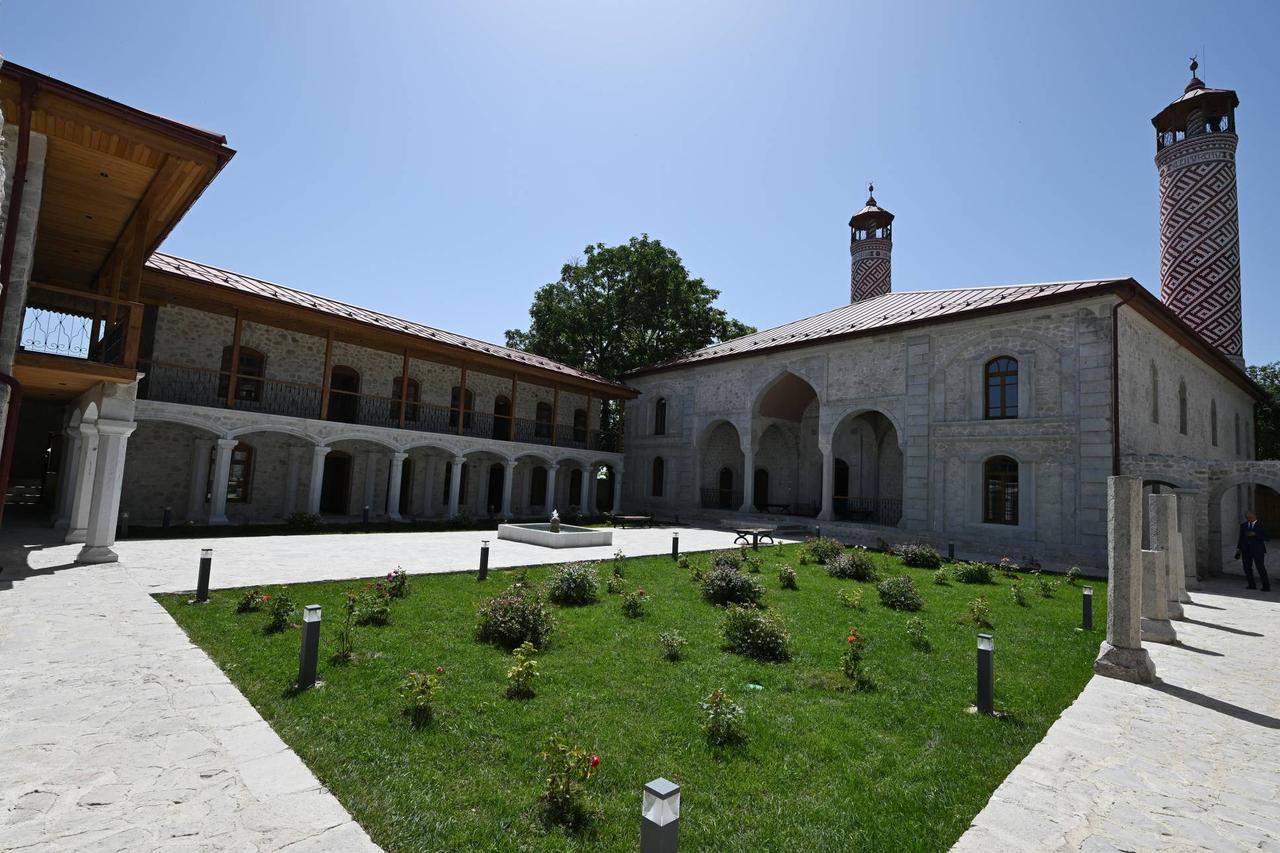
After Restoration: Mosque and Prayer Hall (President.az)
The Yukarı Gövher Ağa Camii is a monumental structure that unites the traditional architecture of Karabakh with the formal elements of Islamic art. The mosque consists of a rectangular prayer hall oriented north-south, a three-bay congregational space at its southern end, and two symmetrical twin minarets positioned at the corners of this section. The main structure rests on a basement level—a structural solution found in some other mosques in Shusha. The prayer hall is divided into twelve equal bays: two central spaces covered by a dome, surrounded by ten cross-vaulted sections.
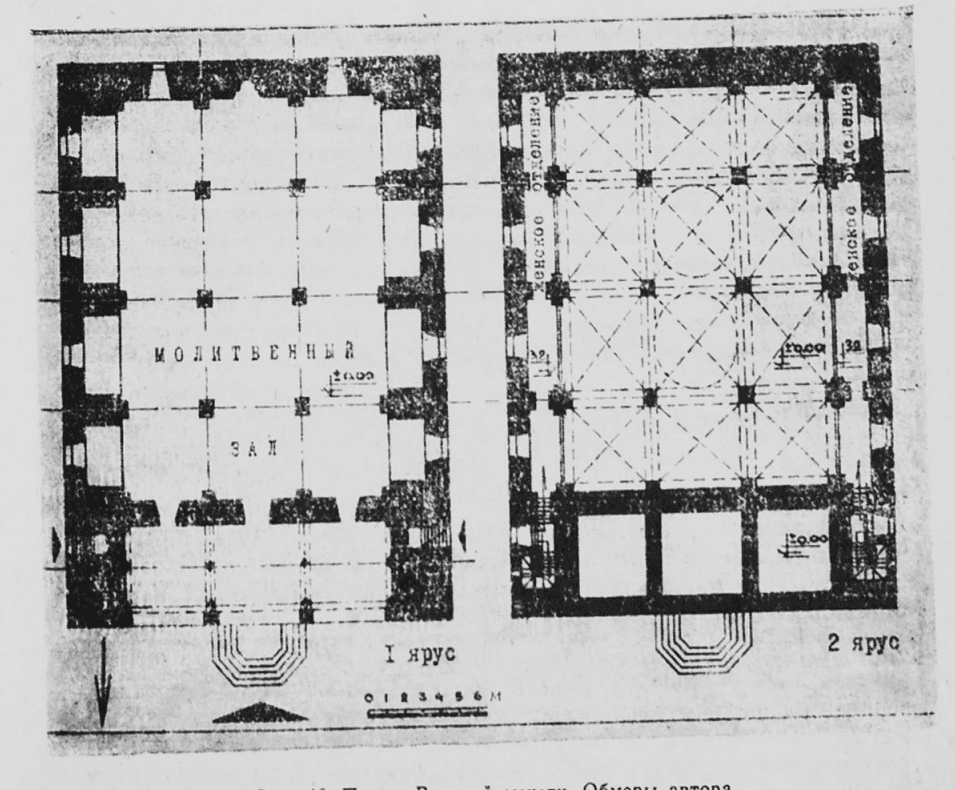
Plan (Qarabag)
The eastern and western facades of the mosque exhibit a distinctive architectural arrangement. Both facades are two-story and divided into five vertical axes, creating a rhythmic composition that imparts aesthetic balance to the structure. Each of the four outer axes contains a window on both the ground floor and the first floor.
The northern axis, however, follows a different arrangement: a doorway on the ground floor and a window above. This ground-floor entrance functions as a passage to the women’s gallery and the minarets. All openings on the facades are designed with depressed arches, framed by corbelled stone moldings that project outward. These details enrich the building’s architectural aesthetics and reflect the stonemasonry techniques and architectural sensibilities of the period.
The overall dimensions of the mosque measure approximately 26.5 by 21.5 meters. The compositional and planning solution of the new mosque, as well as its architectural and artistic appearance, differ markedly from those of the earlier structure. Notably, the original entrance niche has been replaced by a large iwan that nearly covers the entire northern facade. The iwan measures approximately 5.0 by 14.5 meters and consists of three equal arches rising almost the full height of the two-story facade. Above the iwan’s arches runs a long horizontal band of Quranic calligraphy.
Inside the prayer hall, the mihrab is centrally positioned on the southern wall and is notable for its simplicity. The minbar is made of wood and adorned with traditional carving. The columns supporting the prayer hall are constructed of stone with plain capitals. The eastern and western facades are designed as two-story structures; the arched windows on these facades allow natural light to enter the interior in a regulated manner. The arch forms of the windows vary between pointed and horseshoe shapes. The original floor of the mosque was paved with stone slabs; during restoration, this paving was renewed using traditional materials.
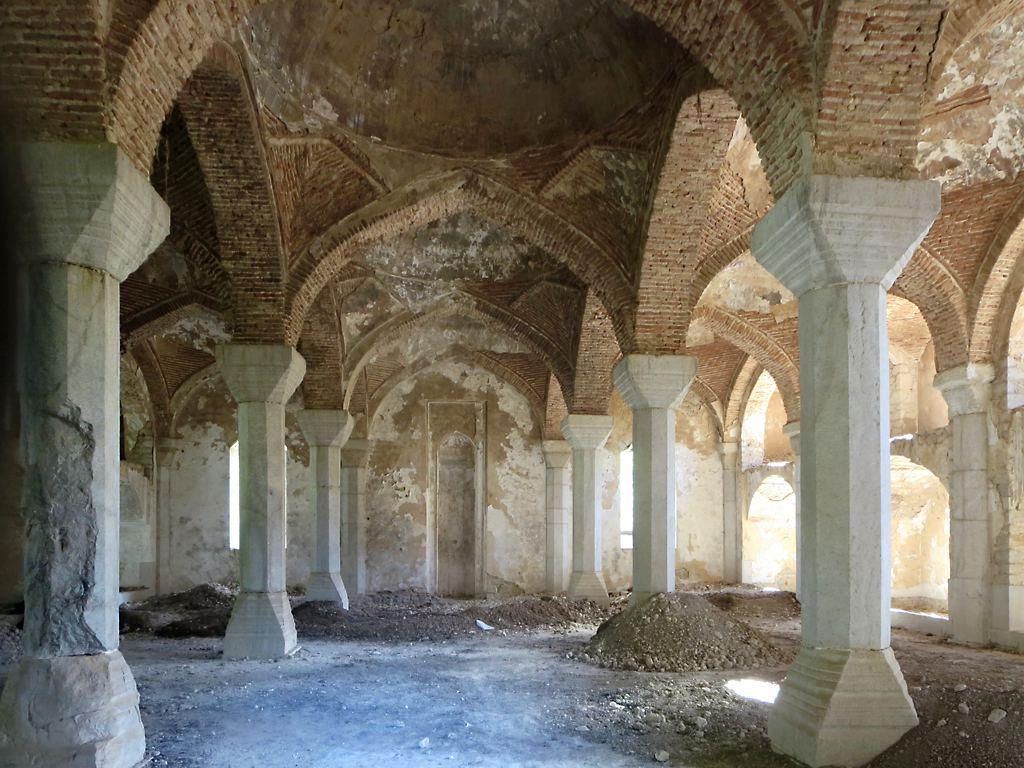
Interior Before Restoration (David Stanley, flickr)
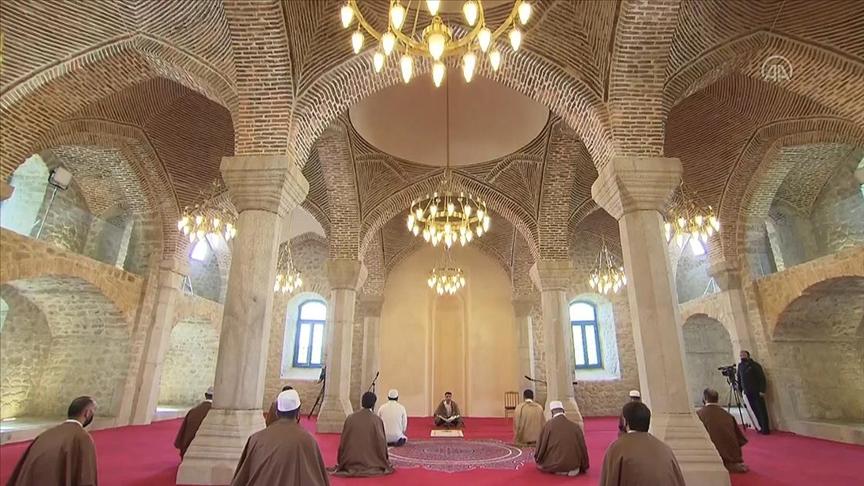
Interior After Restoration (AA)
One of the most striking features of the building is the pair of cylindrical minarets rising on either side of the main entrance facade. Geometric patterns created with glazed bricks in red, blue, and white transform these minarets into both structural and ornamental elements. These decorations are a typical example of the brick ornamentation tradition that developed in Shusha during the 19th century and contain visual references to the Great Seljuk architectural heritage.
The minarets are symmetrically designed in their ornamentation. Their cylindrical bodies are divided into three distinct bands. The lowest band is constructed of profiled cut stone, while the two upper bands are formed with projecting bricks that emphasize their contours. Between these bands, seven horizontal rows of geometric motifs are arranged. The two-color (red and blue) arrangement of the bricks creates a regular rhythm along the minarets’ outer surfaces. Additionally, inscriptions from the Quran, executed in brickwork, adorn the upper sections of the minarets. It is known that the design of these decorations was carried out by the Shusha artisan Mir Möhsün Nevvab.
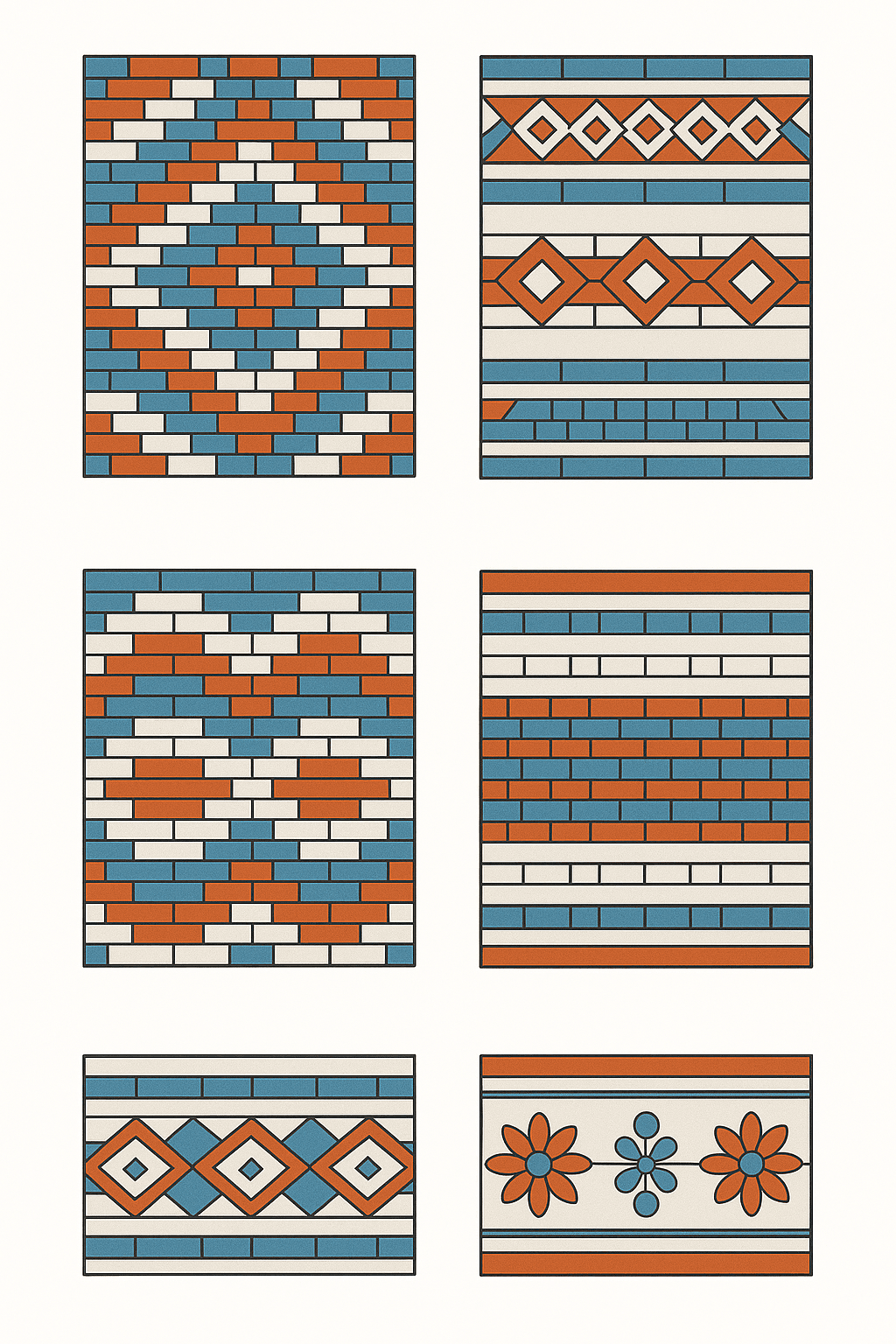
Representative Illustration of Minaret Decorations (Generated with AI assistance.)
Inside the minarets, a narrow and steep spiral staircase ascends, supported by slender columns within a compact core, leading to the muezzin’s gallery. The top of the staircase is covered by a pointed arched canopy unique to the structure.
On the body walls directly beneath the minarets, at the eastern and western ends of the northern facade, three stone decorations each have been carved and relief-worked using low-relief and incision techniques. These feature prominent eight-pointed stars and circular motifs. These geometric decorations serve not only an aesthetic function but also reflect the application of stonemasonry techniques of the period.
Anadolu Ajansı. “Karabağ'ın sembol şehri Şuşa'da 29 yıl sonra ilk bayram namazı.” Accessed May 7, 2025. Accessed adresi
Avalov, S. M. Архитектура города Шуши и вопросы сохранения его исторического облика. Bakı: Elm, 1977.
David Stanley. “Mosque Interior JPG.” Flickr. Accessed May 7, 2025. https://flic.kr/p/Cjoox3
David Stanley. “Yukhari Govhar Agha Mosque JPG.” Flickr. Accessed May 7, 2025. https://flic.kr/p/Z2gsS5
Guseynov, A. N. Градостроительство города Шуша. Bakı: Azərbaycan Respublikası Dövlət Şəhərsalma və Arxitektura Komitəsi, 2022.
Heydar Aliyev Foundation. "Yuxarı Gövhər Ağa məscidi." Accessed May 7, 2025.
Presidency of the Republic of Turkey Communication Directorate Publications. *The Victory in 44 Days in Nagorno-Karabakh.* Presidency of the Republic of Turkey Communication Directorate Publications. Ankara, 2021. Accessed adresi
President of the Republic of Azerbaijan Ilham Aliyev. "Ilham Aliyev Attends the Opening of the Aşağı Gövhər Ağa Mosque in Shusha After Restoration." President AZ. Accessed May 7, 2025. https://president.az/az/articles/view/66405/images
Qarabağ. "ŞUŞANIN ƏN QƏDIM MƏSCIDI – YUXARI GÖVHƏR AĞA MƏSCIDI." Accessed May 7, 2025. https://qarabag.com/govheraghamescidi/
Uçar, Aygül, and Vefa Kurban. “Şuşa Yukarı Gövher Ağa Camii.” *Sanat Tarihi Dergisi* 32, no. 2 (2023): 1001–1023. https://doi.org/10.29135/std.1309474

No Discussion Added Yet
Start discussion for "Shusha Upper Gövher Ağa Camii" article
History
Restoration Process
Architectural Features
Decorative Elements