This article was automatically translated from the original Turkish version.
+1 More
Place of Discovery | Jerusalem, Siloam Tunnel | ||||||||
|---|---|---|---|---|---|---|---|---|---|
Dating | 8th century BCE | ||||||||
Language(s) | Paleo-Hebrew | ||||||||
Date of Discovery | 1880 | ||||||||
Current Location | Istanbul Archaeology Museums | ||||||||
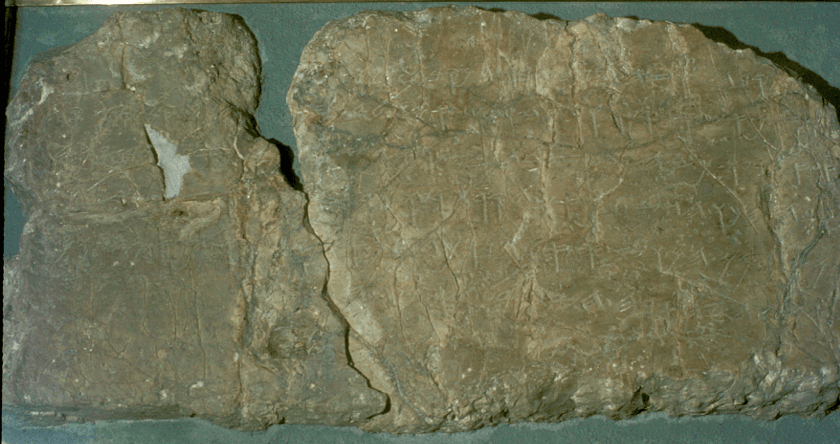
Siloam Inscription is an Hebrew inscription carved into the wall of the Siloam Tunnel (Hezekiah’s Tunnel) in Jerusalem and is one of the archaeological records from the Kingdom of Judah during the Old Testament period. Dated to the 8th century BCE, the text represents an early example of the Paleo-Hebrew alphabet of Phoenician origin and reflects the writing style and linguistic features of its time.

Siloam Inscription
【1】
The inscription was discovered in the Siloam Tunnel, located in the southeast of Jerusalem and believed to have been constructed during the reign of King Hezekiah. The tunnel was built to secure the city’s water supply and protect its water sources from enemy forces during sieges. The tunnel was first identified in 1837 by Edward Robinson and later named the “Siloam Tunnel” through subsequent research.
The Siloam Inscription was accidentally discovered in 1880 when a student of Conrad Schick, a German architect in Jerusalem, slipped and fell into the water while playing inside the Siloam (Silvan) Tunnel. Upon noticing letter-like markings on the rock surface, Schick visited the site and made a copy of the inscription. Shortly afterward, Archibald Sayce, Claude Conder, and other researchers produced additional copies of the inscription.
The inscription is located approximately six meters from the tunnel’s exit, on the eastern wall, and consists of six lines. In 1890 it was removed from the rock and transported to Istanbul, where it is now preserved in the Museum of Ancient Oriental Treasures, part of the Istanbul Archaeology Museums.

Entrance of the Tunnel Where the Inscription Was Found
【2】
Based on paleographic analysis, the inscription is dated to the 8th century BCE. This period corresponds to the preparations undertaken by King Hezekiah of Judah (reigned 715–687 BCE) to secure Jerusalem’s water sources against the Assyrian threat. However, some scholars have suggested that the inscription may have been created later, during the Hasmonean period.
Paleographic studies support the view that the inscription dates to the reign of King Hezekiah. Radiocarbon and uranium-thorium analyses conducted in the 2000s indicate that the inscription was created around 700 BCE.
The inscription describes the moment when two teams of workers, digging from opposite ends of the tunnel, met each other. The text recounts the methods used by the stonecutters, the sounds heard during excavation, and the eventual connection of the two tunnels. The text reads as follows:
“And the pickaxes met each other, and while the stonecutters were still three cubits away, the voice of the men calling out to each other was heard. And on the day the pickaxes struck, each man met his companion. Then the waters flowed from the spring to the pool, a distance of 1,200 cubits.”【3】

Copy of the Hebrew Text on the Inscription
【4】
The Siloam Inscription is one of the most concrete epigraphic records of infrastructure projects in the Kingdom of Judah. It provides direct evidence of ancient water engineering and urban defense systems. It parallels the biblical accounts in the Old Testament describing Hezekiah’s construction of water systems.
The linguistic features of the inscription also reflect the evolution of the Hebrew alphabet and early methods of word separation. Moreover, the inscription is among the oldest known sources documenting a vernacular variant of Biblical Hebrew closely resembling spoken language of the time.
The Siloam Inscription has become a subject of contemporary diplomatic and political debate not only for its archaeological value but also due to its role in modern territorial disputes. Former Israeli Prime Minister Benjamin Netanyahu has stated that during a meeting with then Turkish Prime Minister Mesut Yılmaz, he requested the inscription and even offered to exchange it for any other Ottoman-era artifact. However, this proposal was not accepted.
Israel’s attempts to claim the inscription from Türkiye are not new. The Tel Aviv government has repeatedly raised the same demand in the past, but each time it has been rejected by Türkiye. Türkiye maintains that at the time of its discovery in 1880, Jerusalem was part of Ottoman territory and that today it should be considered part of Palestine, not Israel, and therefore refuses all requests for its return. In this context, the inscription has become one of the focal points in ongoing international debates over the ownership and cultural heritage of archaeological artifacts.【5】
Anadolu Ajansı. "Türkiye’den Siloam Yazıtı’nı alamayan Netanyahu, Cumhurbaşkanı Erdoğan’ı hedef gösterdi". Accessed September 18, 2025. https://www.aa.com.tr/tr/dunya/turkiye-den-siloam-yaziti-ni-alamayan-netanyahu-cumhurbaskani-erdogan-i-hedef-gosterdi/3689868
Ay Arçın, Şeyma. “Demir Çağı Yazılı ve Arkeolojik Kaynaklarında İsrail ve Yahuda Krallıkları.” *Filistin Araştırmaları Dergisi*, no. 2 (Winter 2017): 1–31. http://www.filistin.org/tr/pub/issue/34901/367480
Gerçekcioğlu, Fatma. “Samiri Tevratı’nın Kökenine Dair Araştırmalar Üzerine Bir Değerlendirme”. Oksident 6, no. 2 (2024): 239–255. https://dergipark.org.tr/en/download/article-file/4366672
Mitchell, T. C. “New Light on the Siloam Tunnel Inscription.” *Buried History* 41 (2005): 43–50. https://www.researchgate.net/publication/379948998_New_Light_on_the_Siloam_Tunnel_Inscription
Sayce, A. H. “The Siloam Inscription”. *Palestine Exploration Quarterly* 15, no. 4 (1883): 210–223. https://ia600805.us.archive.org/view_archive.php?archive=/13/items/crossref-pre-1909-scholarly-works/10.1179%252Fpeq.1890.22.2.130.zip&file=10.1179%252Fpeq.1898.30.1.56.pdf
Waterman, H. B. “The Siloam Inscription: With a Suggested Translation.” *The Hebrew Student* (1881): 52–62. https://www.journals.uchicago.edu/doi/pdf/10.1086/469119
[1]
T. C. Mitchell, “New Light on the Siloam Tunnel Inscription,” Buried History 41 (2005): 43. https://www.researchgate.net/publication/379948998_New_Light_on_the_Siloam_Tunnel_Inscription
[2]
Mitchell, “New Light on the Siloam Tunnel Inscription,” 45. https://www.researchgate.net/publication/379948998_New_Light_on_the_Siloam_Tunnel_Inscription
[3]
Şeyma Ay Arçın, “Demir Çağı Yazılı ve Arkeolojik Kaynaklarında İsrail ve Yahuda Krallıkları,” Filistin Araştırmaları Dergisi, 2 (Kış 2017): 25. https://www.academia.edu/37973669/F%C4%B0L%C4%B0ST%C4%B0N_ARA%C5%9ETIRMALARI_DERG%C4%B0S%C4%B0_KUD%C3%9CS_SAYISI
[4]
Mitchell, “New Light on the Siloam Tunnel Inscription,” 46. https://www.researchgate.net/publication/379948998_New_Light_on_the_Siloam_Tunnel_Inscription
[5]
Anadolu Ajansı. "Türkiye’den Siloam Yazıtı’nı alamayan Netanyahu, Cumhurbaşkanı Erdoğan’ı hedef gösterdi". Anadolu Ajansı. Son Erişim: 18.09.2025. https://www.aa.com.tr/tr/dunya/turkiye-den-siloam-yaziti-ni-alamayan-netanyahu-cumhurbaskani-erdogan-i-hedef-gosterdi/3689868

Place of Discovery | Jerusalem, Siloam Tunnel | ||||||||
|---|---|---|---|---|---|---|---|---|---|
Dating | 8th century BCE | ||||||||
Language(s) | Paleo-Hebrew | ||||||||
Date of Discovery | 1880 | ||||||||
Current Location | Istanbul Archaeology Museums | ||||||||
Location and Discovery
Dating
Content of the Inscription
Historical and Cultural Significance
Current Debates