This article was automatically translated from the original Turkish version.
Type of Geographical İndication | Origin Name | ||||||||
|---|---|---|---|---|---|---|---|---|---|
Application Date | 14.01.2020 | ||||||||
Registration Number | 1152 | ||||||||
Registration Date | 21.06.2022 | ||||||||
Product / Product Group(s) | Processed and unprocessed fruits vegetables and mushrooms | ||||||||
Province(s) | Kütahya | ||||||||
Applicant/Registrant(s) | Simav Chamber of Agriculture | ||||||||
Simav Chestnut is a chestnut variety unique to the Simav district of Kütahya and officially registered with geographical indication. Under Law No. 6769 on Industrial Property, an application was submitted on 14 January 2020 and it was registered as a geographical indication on 21 June 2022. The registration was carried out by the Simav Chamber of Agriculture.
Simav Chestnut is produced in a forest strip approximately 30 km long and 10 km wide, located on the northern slopes of Simav Mountain, encompassing the central area and villages of the Simav district in Kütahya. This region lies at an altitude of 900 metres and features slopes ranging from 20% to 50%. The climate and soil conditions of the area play a crucial role in developing the distinctive characteristics of the chestnut. The annual average air temperature is 14.4 °C, the soil temperature is 16.6 °C, the annual precipitation per square metre is 711 mm, and the soil structure is loose. Humidity levels are around 90%.
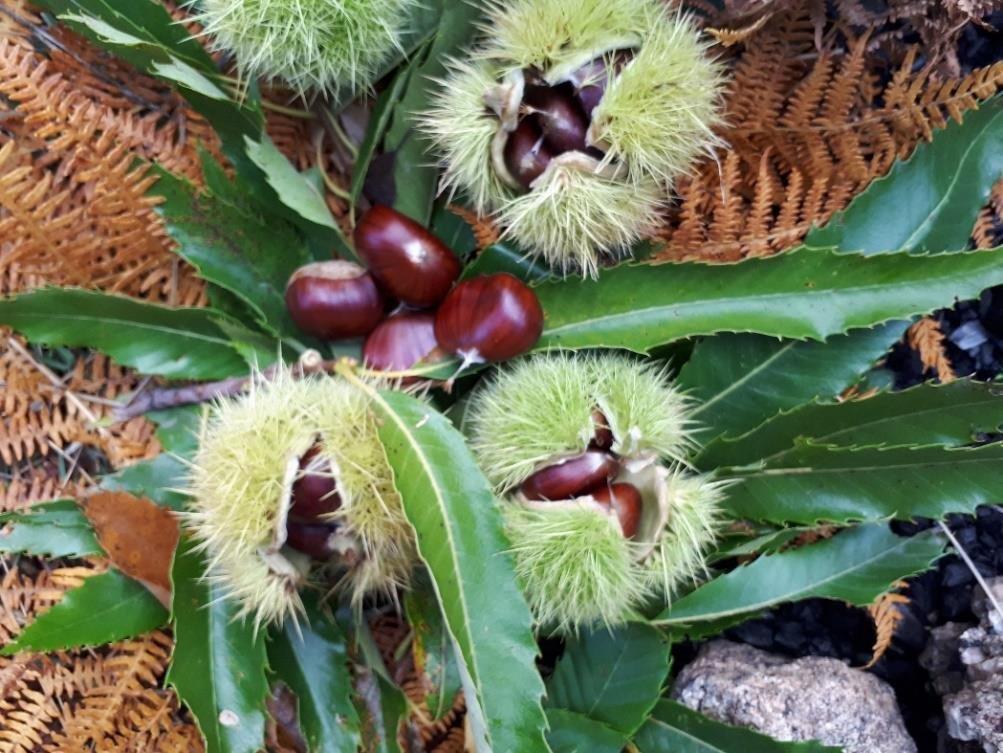
Simav Chestnut is derived from the Sarı graft variety of the European chestnut (Castanea sativa Mill.). The fruits are spherical to hemispherical in shape, with flattened sides and a glossy dark brown shell. Shell thickness ranges from 1.81 to 5.50 mm. The fruits are large to very large, with a width of 23.95–26.73 mm, length of 40.86–46.06 mm, and height of 32.30–35.66 mm. Fruit weight ranges from 16.19 to 18.83 grams, and the edible portion constitutes 11.99% to 15.81% of the total weight. The flesh is soft, glossy white, and crisp. The shell colour (L* value) ranges from 23.80 to 27.18, while the flesh colour (L* value) ranges from 74.71 to 80.39. Total sugar content is 0.711–0.819 mg/100 g, and reducing sugar content is 0.116–0.144 mg/100 g. The low reducing sugar content makes the chestnut suitable for fresh and roasted consumption, offering a sweet flavour.
Simav Chestnut grows naturally in forested areas without the use of pesticides, fertilizers, or soil cultivation. Trees are grafted using the Sarı grafting method, resulting in strong and spreading growth. Regular pruning is performed during the dormant season each year to ensure high-quality yields and facilitate harvesting. Harvesting takes place in the second half of October, when the shell colour turns light brown, typically using poles to shake the nuts loose. The harvested chestnuts are stored in natural underground cellars in the villages, at temperatures of 4–6 °C, inside sacks known locally as “kirpi,” along with their shells, for approximately one month. During this period, sugar content increases by 30–40%, and the shell colour becomes glossy dark brown. Before being placed on the market, each package is labelled with a tag issued by the Simav Chamber of Agriculture, indicating the harvest date and inspection approval.
The packaging of Simav Chestnut includes a logo and emblem identifying its geographical indication. When packaging is not feasible, the logo and emblem must be clearly displayed at the production facility. The product is marketed exclusively with labels provided by the Simav Chamber of Agriculture.
The production, sale, and quality control of Simav Chestnut are supervised by an inspection body composed of experts from the Simav District Directorate of Agriculture and Forestry, the Kütahya Regional Directorate of Forestry, and the Simav Forest Management Directorate, under the coordination of the Simav Chamber of Agriculture. Inspections are conducted twice annually, in July or August and in October. Additional inspections are carried out upon complaint or as needed. Inspections verify compliance with the use of the Sarı graft variety, adherence to production methods, conformity of product characteristics to established standards, storage and packaging conditions, and proper use of labels and logos. The Ministry of Agriculture and Forestry’s Non-Wood Forest Products Utilization Plan serves as a guiding document for inspection procedures. The inspection body maintains records of the number of producers, the number of trees, and the quantity of chestnuts placed on the market.
The history of Simav Chestnut is deeply rooted, with chestnut trees in the region dating back over 400 years. Since 1985, the Simav Chestnut Festival has been regularly held in Simav, highlighting the cultural and economic importance of the product.
Turk Patent and Trademark Office. "Simav Kestanesi." Accessed August 18, 2025. https://ci.turkpatent.gov.tr/cografi-isaretler/detay/1526.
Türk Patent ve Marka Kurumu. "Simav Kestanesi Coğrafi İşaret Tescil Belgesi." Accessed August 18, 2025. https://ci.turkpatent.gov.tr/Files/GeographicalSigns/6f7a20f3-8df0-44d5-8cda-5f4ab7b1b058.pdf.

Type of Geographical İndication | Origin Name | ||||||||
|---|---|---|---|---|---|---|---|---|---|
Application Date | 14.01.2020 | ||||||||
Registration Number | 1152 | ||||||||
Registration Date | 21.06.2022 | ||||||||
Product / Product Group(s) | Processed and unprocessed fruits vegetables and mushrooms | ||||||||
Province(s) | Kütahya | ||||||||
Applicant/Registrant(s) | Simav Chamber of Agriculture | ||||||||
Geographical Boundary
Product Characteristics
Production Method
Packaging and Use
Inspection
History and Cultural Significance